Steger Krista, Brady James, Wang Weili, Duskin Meg, Donato Karen, Peshwa Madhusudan
Forge 4ward Consulting, Brentwood, NH, USA
MaxCyte, Inc., Gaithersburg, MD, USA.
J Biomol Screen. 2015 Apr;20(4):545-51. doi: 10.1177/1087057114563494. Epub 2014 Dec 17.
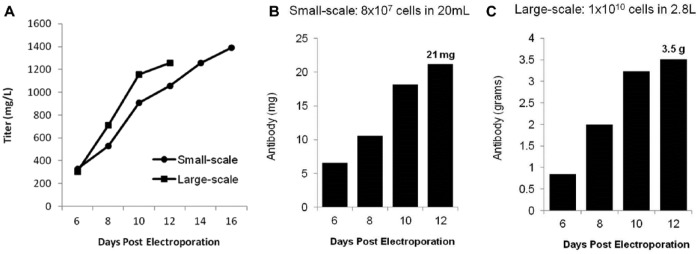
In recent years, researchers have turned to transient gene expression (TGE) as an alternative to CHO stable cell line generation for early-stage antibody development. Despite advances in transfection methods and culture optimization, the majority of CHO-based TGE systems produce insufficient antibody titers for extensive use within biotherapeutic development pipelines. Flow electroporation using the MaxCyte STX Scalable Transfection System is a highly efficient, scalable means of CHO-based TGE for gram-level production of antibodies without the need for specialized expression vectors or genetically engineered CHO cell lines. CHO cell flow electroporation is easily scaled from milligram to multigram quantities without protocol reoptimization while maintaining transfection performance and antibody productivity. In this article, data are presented that demonstrate the reproducibility, scalability, and antibody production capabilities of CHO-based TGE using the MaxCyte STX. Data show optimization of posttransfection parameters such as cell density, media composition, and feed strategy that result in secreted antibody titers >1 g/L and production of multiple grams of antibody within 2 weeks of a single CHO-S cell transfection. In addition, data are presented to demonstrate the application of scalable electroporation for the rapid generation of high-yield stable CHO cell lines to bridge the gap between early- and late-stage antibody development activities.
近年来,研究人员已将瞬时基因表达(TGE)作为在早期抗体开发中替代CHO稳定细胞系生成的方法。尽管转染方法和培养优化取得了进展,但大多数基于CHO的TGE系统产生的抗体滴度不足以在生物治疗开发流程中广泛使用。使用MaxCyte STX可扩展转染系统进行流式电穿孔是一种高效、可扩展的基于CHO的TGE方法,可用于克级抗体生产,无需专门的表达载体或基因工程CHO细胞系。CHO细胞流式电穿孔可以轻松地从毫克级扩展到克级,无需重新优化方案,同时保持转染性能和抗体生产力。本文展示的数据证明了使用MaxCyte STX进行基于CHO的TGE的可重复性、可扩展性和抗体生产能力。数据显示了转染后参数(如细胞密度、培养基组成和补料策略)的优化,这些优化可导致分泌抗体滴度>1 g/L,并在单次CHO-S细胞转染后2周内产生数克抗体。此外,本文还展示了数据,以证明可扩展电穿孔在快速生成高产稳定CHO细胞系中的应用,以弥合早期和晚期抗体开发活动之间的差距。