Parker David, Belaud-Rotureau Marc-Antoine
Precision for Medicine, Bethesda, Maryland, USA.
Université de Rennes 1, Faculté de Médecine, Rennes, France. ; Service de Cytogénétique et Biologie Cellulaire, CHU de Rennes, Rennes, France. ; UMR 6290 IGDR, Cancer du Rein-BIOSIT, Rennes, France.
Clin Med Insights Oncol. 2014 Dec 8;8:145-52. doi: 10.4137/CMO.S19236. eCollection 2014.
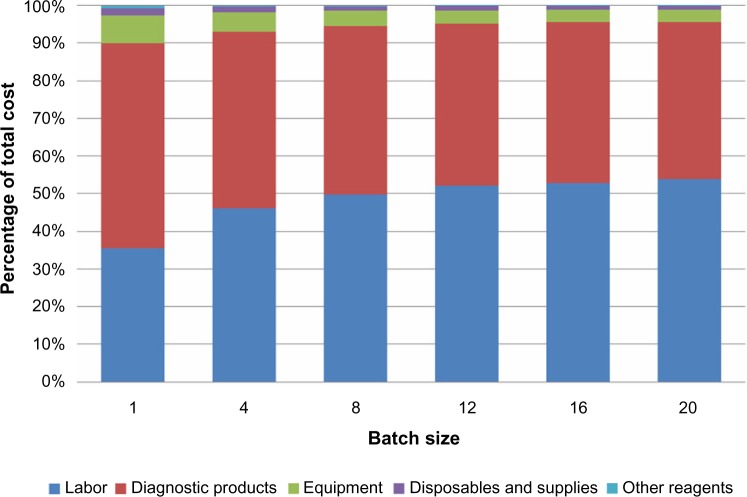
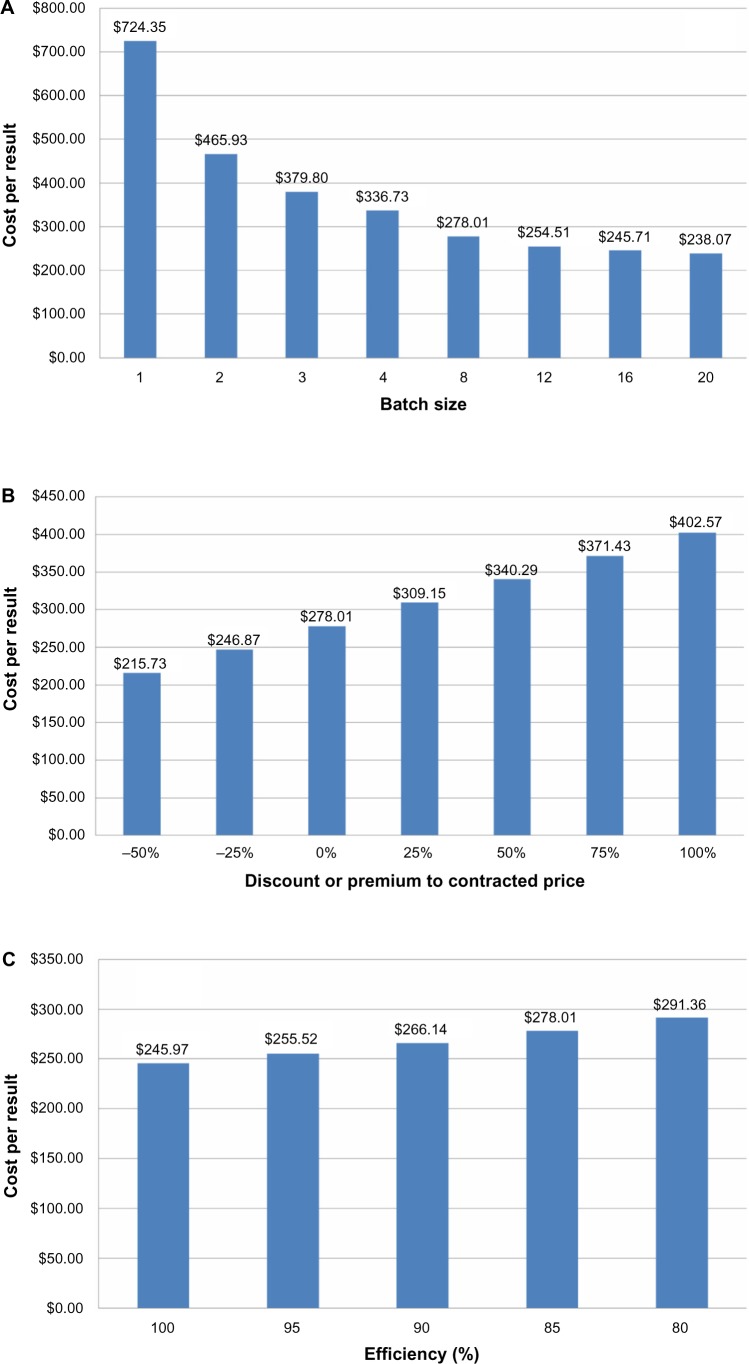
Break-apart fluorescence in situ hybridization (FISH) is the gold standard test for anaplastic lymphoma kinase (ALK) gene rearrangement. However, this methodology often is assumed to be expensive and potentially cost-prohibitive given the low prevalence of ALK-positive non-small cell lung cancer (NSCLC) cases. To more accurately estimate the cost of ALK testing by FISH, we developed a micro-cost model that accounts for all cost elements of the assay, including laboratory reagents, supplies, capital equipment, technical and pathologist labor, and the acquisition cost of the commercial test and associated reagent kits and controls. By applying a set of real-world base-case parameter values, we determined that the cost of a single ALK break-apart FISH test result is $278.01. Sensitivity analysis on the parameters of batch size, testing efficiency, and the cost of the commercial diagnostic testing products revealed that the cost per result is highly sensitive to batch size, but much less so to efficiency or product cost. This implies that ALK testing by FISH will be most cost effective when performed in high-volume centers. Our results indicate that testing cost may not be the primary determinant of crizotinib (Xalkori(®)) treatment cost effectiveness, and suggest that testing cost is an insufficient reason to limit the use of FISH testing for ALK rearrangement.
断裂荧光原位杂交(FISH)是间变性淋巴瘤激酶(ALK)基因重排的金标准检测方法。然而,鉴于ALK阳性非小细胞肺癌(NSCLC)病例的低患病率,这种方法通常被认为成本高昂且可能令人望而却步。为了更准确地估算FISH检测ALK的成本,我们开发了一个微观成本模型,该模型考虑了检测的所有成本要素,包括实验室试剂、耗材、资本设备、技术人员和病理学家的劳动力,以及商业检测和相关试剂盒及对照的购置成本。通过应用一组实际的基础案例参数值,我们确定单个ALK断裂FISH检测结果的成本为278.01美元。对批量大小、检测效率和商业诊断检测产品成本等参数的敏感性分析表明,每个结果的成本对批量大小高度敏感,但对效率或产品成本的敏感性要低得多。这意味着在高容量中心进行FISH检测ALK时最具成本效益。我们的结果表明,检测成本可能不是克唑替尼(Xalkori(®))治疗成本效益的主要决定因素,并表明检测成本不足以成为限制使用FISH检测ALK重排的理由。