Pettorruso Mauro, De Risio Luisa, Di Nicola Marco, Martinotti Giovanni, Conte Gianluigi, Janiri Luigi
Department of Neuroscience, Institute of Psychiatry and Clinical Psychology, Catholic University of Sacred Heart , Rome , Italy.
Department of Neuroscience and Imaging, Institute of Psychiatry, "G. d'Annunzio" University of Chieti-Pescara , Chieti , Italy.
Front Psychiatry. 2014 Dec 3;5:173. doi: 10.3389/fpsyt.2014.00173. eCollection 2014.
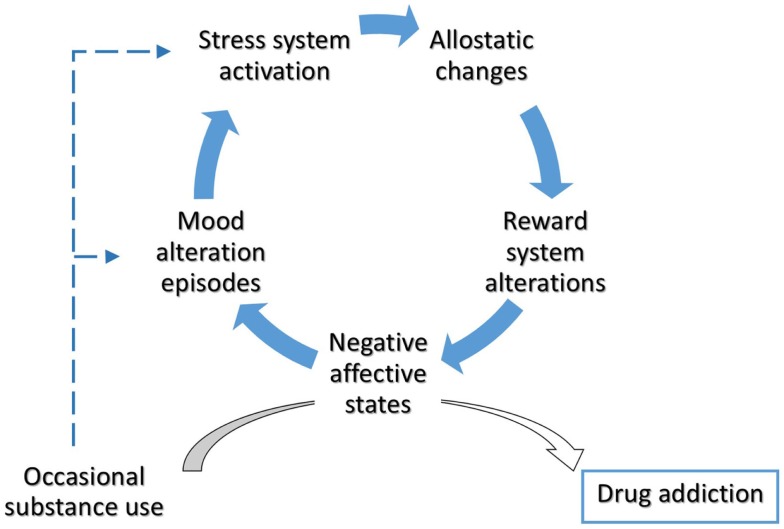
Bipolar disorders (BDs) and addictions constitute reciprocal risk factors and are best considered under a unitary perspective. The concepts of allostasis and allostatic load (AL) may contribute to the understanding of the complex relationships between BD and addictive behaviors. Allostasis entails the safeguarding of reward function stability by recruitment of changes in the reward and stress system neurocircuitry and it may help to elucidate neurobiological underpinnings of vulnerability to addiction in BD patients. Conceptualizing BD as an illness involving the cumulative build-up of allostatic states, we hypothesize a progressive dysregulation of reward circuits clinically expressed as negative affective states (i.e., anhedonia). Such negative affective states may render BD patients more vulnerable to drug addiction, fostering a very rapid transition from occasional drug use to addiction, through mechanisms of negative reinforcement. The resulting addictive behavior-related ALs, in turn, may contribute to illness progression. This framework could have a heuristic value to enhance research on pathophysiology and treatment of BD and addiction comorbidity.
双相情感障碍(BDs)和成瘾构成了相互的风险因素,最好从统一的角度来考虑。稳态和稳态负荷(AL)的概念可能有助于理解BD与成瘾行为之间的复杂关系。稳态需要通过募集奖赏和应激系统神经回路的变化来保障奖赏功能的稳定性,这可能有助于阐明BD患者成瘾易感性的神经生物学基础。将BD概念化为一种涉及稳态状态累积的疾病,我们假设奖赏回路会逐渐失调,临床上表现为负性情绪状态(即快感缺失)。这种负性情绪状态可能使BD患者更容易染上药物成瘾,通过负性强化机制,促使其从偶尔使用药物迅速转变为成瘾。反过来,由此产生的与成瘾行为相关的稳态负荷可能会导致疾病进展。这一框架可能具有启发价值,有助于加强对BD与成瘾共病的病理生理学和治疗的研究。