Madsen Karine, Torstensen Eva, Holst Klaus K, Haahr Mette E, Knorr Ulla, Frokjaer Vibe G, Brandt-Larsen Malene, Iversen Pernille, Fisher Patrick M, Knudsen Gitte M
Neurobiology Research Unit, Copenhagen University Hospital Rigshospitalet, Copenhagen, Denmark (Drs Madsen, Torstensen, Holst, Haahr, Frokjaer, Fisher, and Knudsen); Center for Integrated Molecular Brain Imaging, Copenhagen University Hospital Rigshospitalet, Copenhagen, Denmark (Drs Madsen, Holst, Haahr, Frokjaer, Iversen, Fisher, and Knudsen); Department of Biostatistics, University of Copenhagen, Denmark (Dr Holst); Psychiatric Centre Copenhagen, Copenhagen University Hospital Rigshospitalet, Copenhagen, Denmark (Dr Knorr); PET and Cyclotron Unit, Copenhagen University Hospital Rigshospitalet, Copenhagen, Denmark (Dr Brandt-Larsen); Center for Functional and Diagnostic Imaging and Research, Copenhagen University Hospital Hvidovre, Hvidovre, Denmark (Dr Iversen).
Int J Neuropsychopharmacol. 2014 Oct 31;18(1):pyu034. doi: 10.1093/ijnp/pyu034.
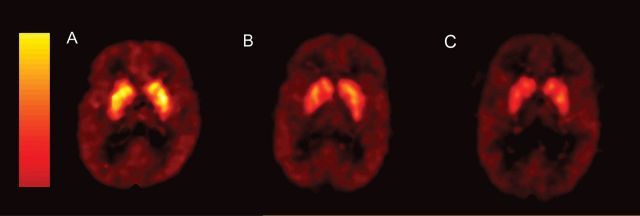
The 5-HT4 receptor provides a novel potential target for antidepressant treatment. No studies exist to elucidate the 5-HT4 receptor's in vivo distribution in the depressed state or in populations that may display trait markers for major depression disorder (MDD). The aim of this study was to determine whether familial risk for MDD is associated with cerebral 5-HT4 receptor binding as measured with [(11)C]SB207145 brain PET imaging. Familial risk is the most potent risk factor of MDD.
We studied 57 healthy individuals (mean age 36 yrs, range 20-86; 21 women), 26 of which had first-degree relatives treated for MDD.
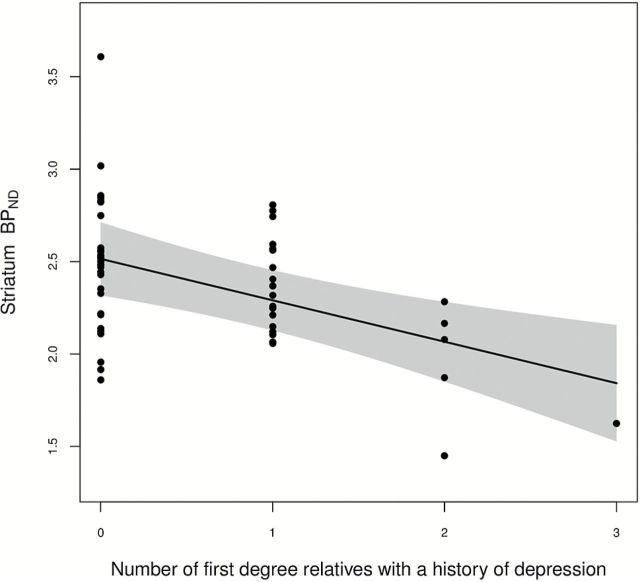
We found that having a family history of MDD was associated with lower striatal 5-HT4 receptor binding (p = 0.038; in individuals below 40 years, p = 0.013). Further, we found evidence for a "risk-dose effect" on 5-HT4 receptor binding, since the number of first-degree relatives with a history of MDD binding correlated negatively with 5-HT4 receptor binding in both the striatum (p = 0.001) and limbic regions (p = 0.012).
Our data suggest that the 5-HT4 receptor is involved in the neurobiological mechanism underlying familial risk for depression, and that lower striatal 5-HT4 receptor binding is associated with increased risk for developing MDD. The finding is intriguing considering that the 5-HT4 receptor has been suggested to be an effective target for antidepressant treatment.
5-羟色胺4(5-HT4)受体为抗抑郁治疗提供了一个新的潜在靶点。目前尚无研究阐明5-HT4受体在抑郁状态下或可能显示重度抑郁症(MDD)特质标记的人群中的体内分布情况。本研究的目的是确定MDD的家族风险是否与用[(11)C]SB207145脑PET成像测量的脑5-HT4受体结合有关。家族风险是MDD最有力的风险因素。
我们研究了57名健康个体(平均年龄36岁,范围20 - 86岁;21名女性),其中26人有患MDD并接受治疗的一级亲属。
我们发现有MDD家族史与较低的纹状体5-HT4受体结合有关(p = 0.038;40岁以下个体中,p = 0.013)。此外,我们发现了5-HT4受体结合存在“风险剂量效应”的证据,因为有MDD病史的一级亲属数量与纹状体(p = 0.001)和边缘区域(p = 0.012)的5-HT4受体结合均呈负相关。
我们的数据表明,5-HT4受体参与了抑郁症家族风险的神经生物学机制,纹状体中较低的5-HT4受体结合与患MDD风险增加有关。鉴于5-HT4受体已被认为是抗抑郁治疗的有效靶点,这一发现很有趣。