Fries Gabriel Rodrigo, Vasconcelos-Moreno Mirela Paiva, Gubert Carolina, dos Santos Bárbara Tietböhl Martins Quadros, Sartori Juliana, Eisele Bárbara, Ferrari Pamela, Fijtman Adam, Rüegg Joëlle, Gassen Nils Christian, Kapczinski Flávio, Rein Theo, Kauer-Sant'Anna Márcia
INCT for Translational Medicine, Hospital de Clínicas de Porto Alegre, Universidade Federal do Rio Grande do Sul, Porto Alegre, Brazil (Drs Fries, Vasconcelos-Moreno, Gubert, dos Santos, Sartori, Eisele, Ferrari, Fijtman, Kapczinski, and Kauer-Sant'Anna); Programa de Pós-Graduação em Ciências Biológicas: Bioquímica, UFRGS, Porto Alegre, Brazil (Drs Fries, Gubert, Kapczinski, and Kauer-Sant'Anna); Programa de Pós-Graduação em Ciências Médicas: Psiquiatria, UFRGS, Porto Alegre, Brazil (Drs Vasconcelos-Moreno, Ferrari, Kapczinski, and Kauer-Sant'Anna); Max Planck Institute of Psychiatry, Munich, Germany (Drs Gassen and Rein); Karolinska Institute, Stockholm, Sweden (Dr Rüegg).
Int J Neuropsychopharmacol. 2014 Oct 31;18(1):pyu043. doi: 10.1093/ijnp/pyu043.
Impaired stress resilience and a dysfunctional hypothalamic-pituitary-adrenal (HPA) axis are suggested to play key roles in the pathophysiology of illness progression in bipolar disorder (BD), but the mechanisms leading to this dysfunction have never been elucidated. This study aimed to examine HPA axis activity and underlying molecular mechanisms in patients with BD and unaffected siblings of BD patients.
Twenty-four euthymic patients with BD, 18 siblings of BD patients, and 26 healthy controls were recruited for this study. All subjects underwent a dexamethasone suppression test followed by analyses associated with the HPA axis and the glucocorticoid receptor (GR).
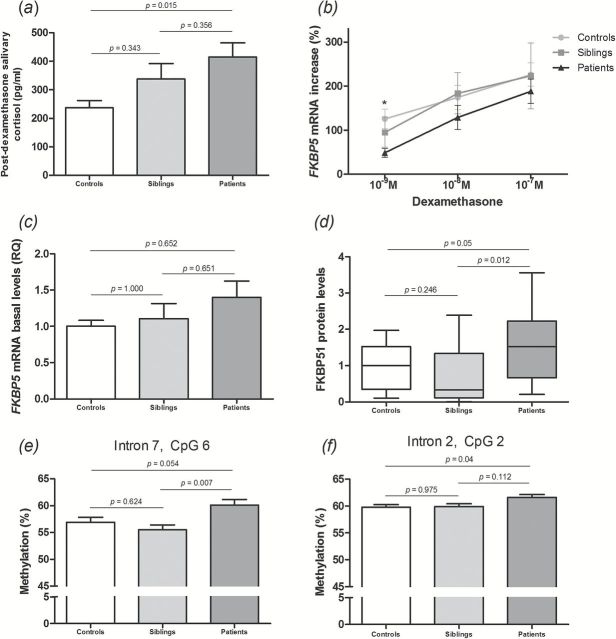
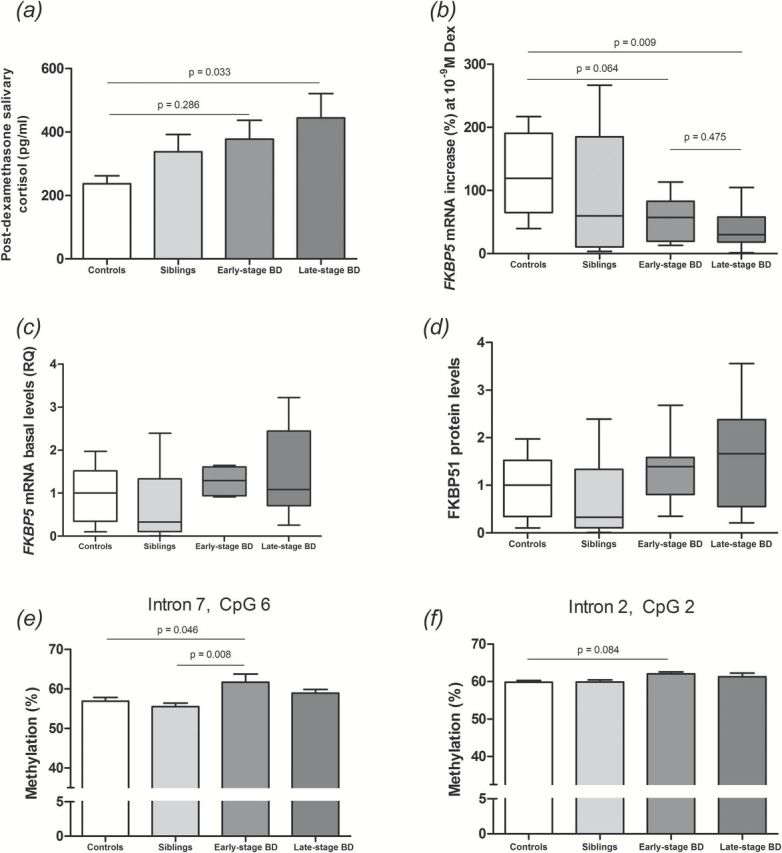
Patients with BD, particularly those at a late stage of illness, presented increased salivary post-dexamethasone cortisol levels when compared to controls (p = 0.015). Accordingly, these patients presented reduced ex vivo GR responsiveness (p = 0.008) and increased basal protein levels of FK506-binding protein 51 (FKBP51, p = 0.012), a co-chaperone known to desensitize GR, in peripheral blood mononuclear cells. Moreover, BD patients presented increased methylation at the FK506-binding protein 5 (FKBP5) gene. BD siblings presented significantly lower FKBP51 protein levels than BD patients, even though no differences were found in FKBP5 basal mRNA levels.
Our data suggest that the epigenetic modulation of the FKBP5 gene, along with increased FKBP51 levels, is associated with the GR hyporesponsiveness seen in BD patients. Our findings are consistent with the notion that unaffected first-degree relatives of BD patients share biological factors that influence the disorder, and that such changes are more pronounced in the late stages of the illness.
应激恢复力受损和下丘脑 - 垂体 - 肾上腺(HPA)轴功能失调被认为在双相情感障碍(BD)疾病进展的病理生理学中起关键作用,但导致这种功能失调的机制尚未阐明。本研究旨在检查BD患者及其未患病的BD患者兄弟姐妹的HPA轴活性及潜在分子机制。
本研究招募了24名处于心境正常期的BD患者、18名BD患者的兄弟姐妹以及26名健康对照者。所有受试者均接受地塞米松抑制试验,随后进行与HPA轴和糖皮质激素受体(GR)相关的分析。
与对照组相比,BD患者,尤其是疾病晚期患者,唾液中地塞米松后皮质醇水平升高(p = 0.015)。相应地,这些患者外周血单核细胞中离体GR反应性降低(p = 0.008),而已知会使GR脱敏的共伴侣FK506结合蛋白51(FKBP51)的基础蛋白水平升高(p = 0.012)。此外,BD患者FK506结合蛋白5(FKBP5)基因的甲基化增加。BD患者的兄弟姐妹的FKBP51蛋白水平明显低于BD患者,尽管FKBP5基础mRNA水平未发现差异。
我们的数据表明,FKBP5基因的表观遗传调控以及FKBP51水平升高与BD患者中观察到的GR低反应性有关。我们的研究结果与以下观点一致,即BD患者未患病的一级亲属共享影响该疾病的生物学因素,并且这种变化在疾病晚期更为明显。