Davies Kalina T J, Tsagkogeorga Georgia, Rossiter Stephen J
School of Biological & Chemical Sciences, Queen Mary University of London, Mile End Road, London, E1 4NS, UK.
BMC Evol Biol. 2014 Dec 19;14:261. doi: 10.1186/s12862-014-0261-5.
The majority of DNA contained within vertebrate genomes is non-coding, with a certain proportion of this thought to play regulatory roles during development. Conserved Non-coding Elements (CNEs) are an abundant group of putative regulatory sequences that are highly conserved across divergent groups and thus assumed to be under strong selective constraint. Many CNEs may contain regulatory factor binding sites, and their frequent spatial association with key developmental genes - such as those regulating sensory system development - suggests crucial roles in regulating gene expression and cellular patterning. Yet surprisingly little is known about the molecular evolution of CNEs across diverse mammalian taxa or their role in specific phenotypic adaptations. We examined 3,110 vertebrate-specific and ~82,000 mammalian-specific CNEs across 19 and 9 mammalian orders respectively, and tested for changes in the rate of evolution of CNEs located in the proximity of genes underlying the development or functioning of auditory systems. As we focused on CNEs putatively associated with genes underlying the development/functioning of auditory systems, we incorporated echolocating taxa in our dataset because of their highly specialised and derived auditory systems.
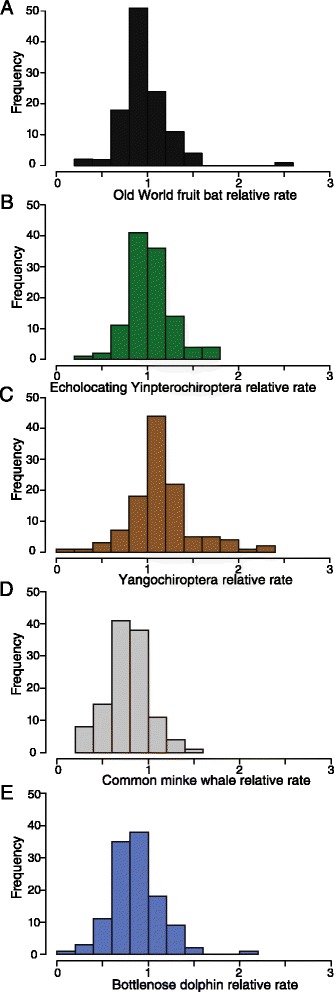
Phylogenetic reconstructions of concatenated CNEs broadly recovered accepted mammal relationships despite high levels of sequence conservation. We found that CNE substitution rates were highest in rodents and lowest in primates, consistent with previous findings. Comparisons of CNE substitution rates from several genomic regions containing genes linked to auditory system development and hearing revealed differences between echolocating and non-echolocating taxa. Wider taxonomic sampling of four CNEs associated with the homeobox genes Hmx2 and Hmx3 - which are required for inner ear development - revealed family-wise variation across diverse bat species. Specifically within one family of echolocating bats that utilise frequency-modulated echolocation calls varying widely in frequency and intensity high levels of sequence divergence were found.
Levels of selective constraint acting on CNEs differed both across genomic locations and taxa, with observed variation in substitution rates of CNEs among bat species. More work is needed to determine whether this variation can be linked to echolocation, and wider taxonomic sampling is necessary to fully document levels of conservation in CNEs across diverse taxa.
脊椎动物基因组中包含的大部分DNA是非编码的,其中一定比例的DNA被认为在发育过程中发挥调节作用。保守非编码元件(CNE)是一类丰富的假定调节序列,在不同类群中高度保守,因此被认为受到强烈的选择约束。许多CNE可能包含调节因子结合位点,并且它们与关键发育基因(如调节感觉系统发育的基因)的频繁空间关联表明其在调节基因表达和细胞模式中起关键作用。然而,令人惊讶的是,对于不同哺乳动物类群中CNE的分子进化及其在特定表型适应中的作用知之甚少。我们分别检查了19个和9个哺乳动物目中的3110个脊椎动物特异性和约82000个哺乳动物特异性CNE,并测试了位于听觉系统发育或功能相关基因附近的CNE进化速率的变化。由于我们关注的是与听觉系统发育/功能相关基因假定相关的CNE,因此我们在数据集中纳入了回声定位类群,因为它们具有高度特化和衍生的听觉系统。
尽管序列保守程度很高,但串联CNE的系统发育重建大致恢复了公认的哺乳动物关系。我们发现,CNE替换率在啮齿动物中最高,在灵长类动物中最低,这与之前的研究结果一致。对几个包含与听觉系统发育和听力相关基因的基因组区域的CNE替换率进行比较,发现回声定位类群和非回声定位类群之间存在差异。对与同源框基因Hmx2和Hmx3相关的四个CNE进行更广泛的分类采样(内耳发育需要这些基因),发现不同蝙蝠物种之间存在家族差异。具体而言,在一个利用频率和强度变化很大的调频回声定位叫声的回声定位蝙蝠家族中,发现了高水平的序列分歧。
作用于CNE的选择约束水平在基因组位置和类群之间都有所不同,在蝙蝠物种中观察到CNE替换率的变化。需要更多的工作来确定这种变化是否与回声定位有关,并且需要更广泛的分类采样来全面记录不同类群中CNE的保守水平。