Ueda Yutaro, Takeda Hiroyuki, Yui Tatsuto, Koike Kazuhide, Goto Yasutomo, Inagaki Shinji, Ishitani Osamu
Department of Chemistry, Graduate School of Science and Engineering, Tokyo Institute of Technology, 2-12-1-NE-1 O-okayama, Meguro-ku, Tokyo 152-8550 (Japan).
ChemSusChem. 2015 Feb;8(3):439-42. doi: 10.1002/cssc.201403194. Epub 2014 Dec 18.
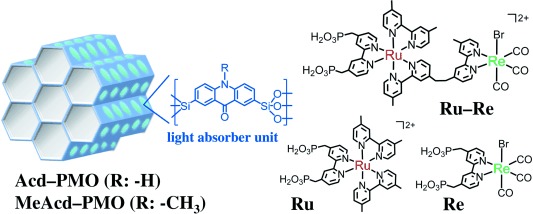
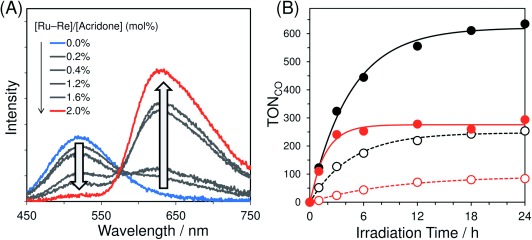
A photocatalytic system for CO2 reduction exhibiting visible-light harvesting was developed by preparing a hybrid consisting of a supramolecular metal complex as photocatalyst and periodic mesoporous organosilica (PMO) as light harvester. A Ru(II) Re(I) binuclear complex (RuRe) with methylphosphonic acid anchor groups was adsorbed on acridone or methylacridone embedded in the walls of PMO mesochannels to yield the hybrid structure. The embedded organic groups absorbed visible light, and the excitation energy was funneled to the Ru units. The energy accumulation was followed by electron transfer and catalytic reduction of CO2 to CO on the Re unit. The light harvesting of these hybrids enhanced the photocatalytic CO evolution rate by a factor of up to ten compared with that of RuRe adsorbed on mesoporous silica without a light harvester.
通过制备一种由超分子金属配合物作为光催化剂和周期性介孔有机硅(PMO)作为光捕获剂组成的杂化物,开发了一种用于二氧化碳还原的具有可见光捕获能力的光催化体系。一种带有甲基膦酸锚定基团的Ru(II)-Re(I)双核配合物(Ru-Re)吸附在嵌入PMO介孔通道壁中的吖啶酮或甲基吖啶酮上,以产生杂化结构。嵌入的有机基团吸收可见光,激发能被导向Ru单元。能量积累之后是电子转移,并在Re单元上催化将二氧化碳还原为一氧化碳。与吸附在没有光捕获剂的介孔二氧化硅上的Ru-Re相比,这些杂化物的光捕获能力使光催化一氧化碳析出速率提高了多达10倍。