Ordu Cetin, Selcuk Nalan A, Erdogan Ezgi, Angin Gulden, Gural Zeynep, Memis Hatice, Yencilek Esin, Dalsuna Sinem, Pilanci Kezban
From the Department of Medical Oncology, Bilim University, Istanbul, Turkey (CO, KP); Department of Nuclear Medicine, Yeditepe University, Istanbul, Turkey (NAS); Department of Nuclear Medicine, Bezmi Alem Foundation University, Istanbul, Turkey (EE); Department of Radiation Oncology, Balikesir State Hospital, Balikesir, Turkey (GA); Department of Radiation Oncology, Bezmi Alem Foundation University, Istanbul, Turkey (ZG); Department of Nuclear Medicine, Balikesir State Hospital, Balikesir, Turkey (HM, SD); and Department of Radiology, Haydarpasa Educational and Research Hospital, Istanbul, Turkey (EY).
Medicine (Baltimore). 2014 Dec;93(28):e299. doi: 10.1097/MD.0000000000000299.
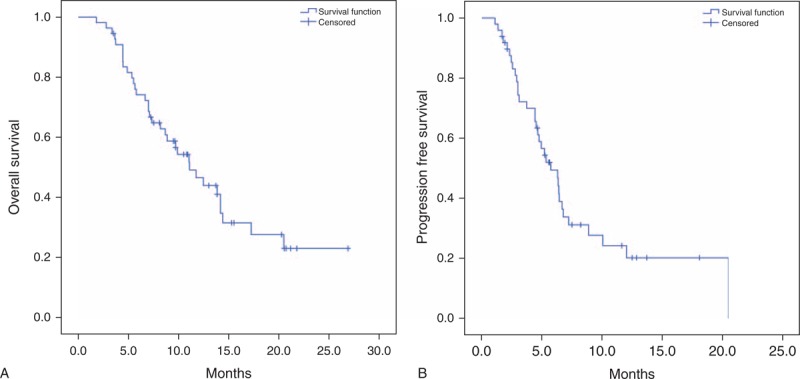
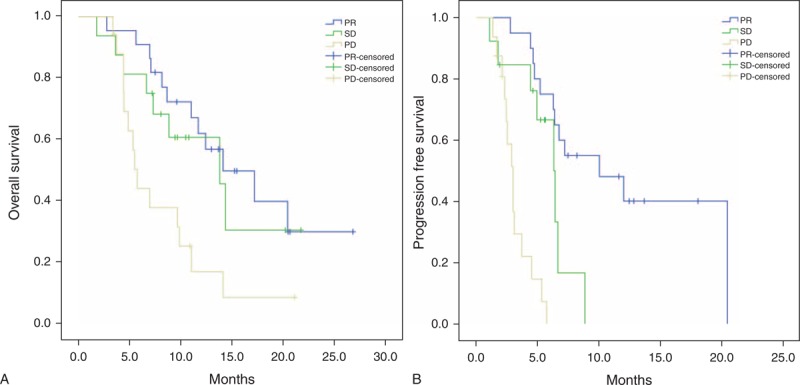
The aim of this study is to determine the prognostic role and the timing of metabolic response to chemotherapy, based on F-fluorodeoxyglucose positron emission tomography (F-FDG-PET), in patients with metastatic non-small-cell lung cancer (NSCLC). The study included 55 patients with metastatic NSCLC that were analyzed in terms of prognostic factors and survival. F-FDG-PET/CT findings were evaluated in patients separated into 3 groups, before and after 1st, 2nd, 3rd cycle of the first line chemotherapy. Metabolic response was assessed according to PET Response Criteria in Solid Tumors (PERCIST 1.0). Among the 55 patients, 34 (62%) died, and 21 (38%) remained alive during a mean follow-up of 13.5 months. Median overall survival (OS) was 11.69 months (range 2-26.80 months) and median progression-free survival (PFS) was 6.27 months (range 1.37-20.43 months). Univariate analysis showed that the only favorable prognostic factor for OS in all the patients was the achievement of metabolic response. Metabolic response according to PERCIST, and weight lose ≤ 5% were also independent favorable prognostic factors predictive of survival in all patients based on multivariet analysis (metabolic response: P=0.002, OR; 1.90, 95% CI 1.26-2.89, and weight lose ≤5%: P=0.022, OR; 2.24, 95% CI 1.12-4.47). Median OS in all patients with partial response (PR)-according to the PERCIST 1.0- was significantly longer than in those with progressive disease (PD) (16.36 months vs 8.14 months, P=0.008). Median OS in the patients with PR was significantly longer than in those with PD based on PET/CT performed after 2nd and 3rd cycles of chemotherapy (18.35 months vs 7.54 months, P=0.012 and 18.04 months vs 7.43 months, P<0.001, respectively), whereas, median OS did not differ significantly between patients with PR and those with PD based on PET/CT performed after the 1st cycle of chemotherapy (8.01 months vs 5.08 months, P=0.290). Metabolic response according to PERCIST and weight loss are independent factors predictive of OS. PET/CT performed after second cycle of chemotherapy may be the earliest predictor of treatment response in patients with advanced stage NSCLC.
本研究的目的是基于氟脱氧葡萄糖正电子发射断层扫描(F-FDG-PET)确定代谢反应对转移性非小细胞肺癌(NSCLC)患者化疗的预后作用及时间。该研究纳入了55例转移性NSCLC患者,对其预后因素和生存情况进行分析。将患者分为3组,在一线化疗的第1、2、3周期前后评估F-FDG-PET/CT检查结果。根据实体瘤PET反应标准(PERCIST 1.0)评估代谢反应。55例患者中,34例(62%)死亡,21例(38%)在平均13.5个月的随访期内存活。总生存(OS)中位数为11.69个月(范围2 - 26.80个月),无进展生存(PFS)中位数为6.27个月(范围1.37 - 20.43个月)。单因素分析显示,所有患者中OS唯一的有利预后因素是达到代谢反应。根据PERCIST评估的代谢反应以及体重减轻≤5%也是基于多因素分析的所有患者生存的独立有利预后因素(代谢反应:P = 0.002,OR;1.90,95%CI 1.26 - 2.89,体重减轻≤5%:P = 0.022,OR;2.24,95%CI 1.12 - 4.47)。根据PERCIST 1.0达到部分缓解(PR)的所有患者的OS中位数显著长于疾病进展(PD)患者(16.36个月对8.14个月,P = 0.008)。基于化疗第2和第3周期后进行的PET/CT检查,PR患者的OS中位数显著长于PD患者(分别为18.35个月对7.54个月,P = 0.012和18.04个月对7.43个月,P < 0.001),而基于化疗第1周期后进行的PET/CT检查,PR患者和PD患者的OS中位数无显著差异(8.01个月对5.08个月,P = 0.290)。根据PERCIST评估的代谢反应和体重减轻是OS的独立预测因素。化疗第2周期后进行的PET/CT检查可能是晚期NSCLC患者治疗反应的最早预测指标。