Moore Alana L, McCarthy Michael A, Parris Kirsten M, Moore Joslin L
Laboratoire de modélisation, CNRS-UMR Écologie des Forêts de Guyane, Kourou, French Guiana; School of Botany, The University of Melbourne, Parkville, Victoria, Australia.
School of Botany, The University of Melbourne, Parkville, Victoria, Australia.
PLoS One. 2014 Dec 19;9(12):e115345. doi: 10.1371/journal.pone.0115345. eCollection 2014.
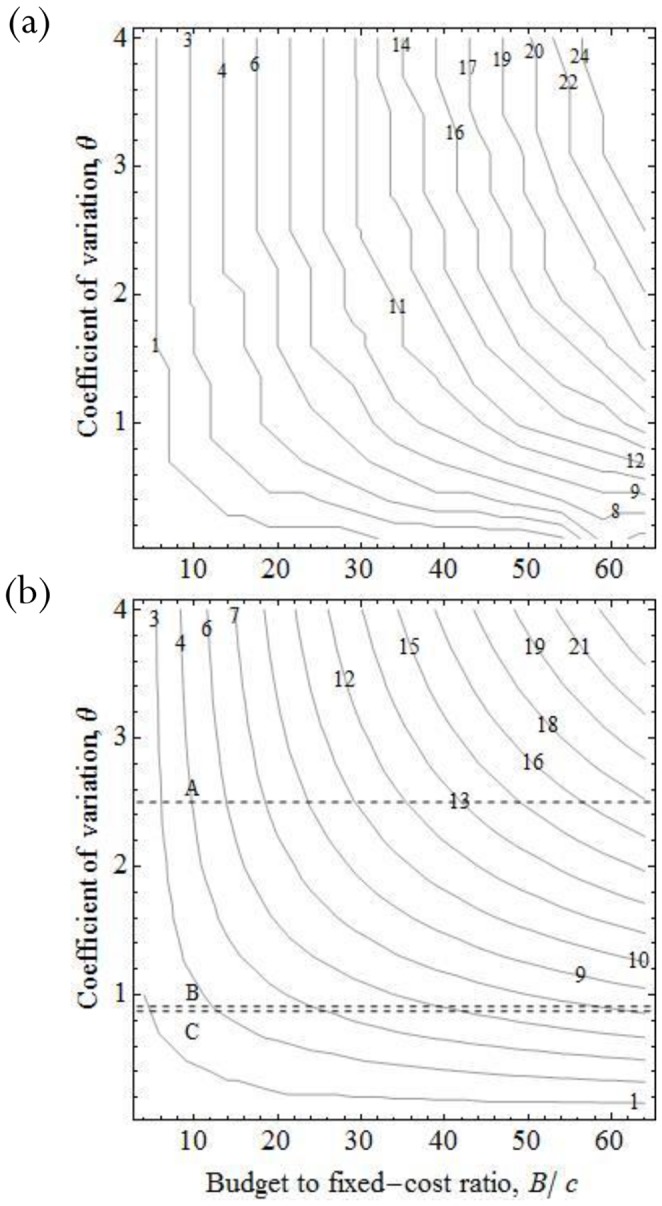
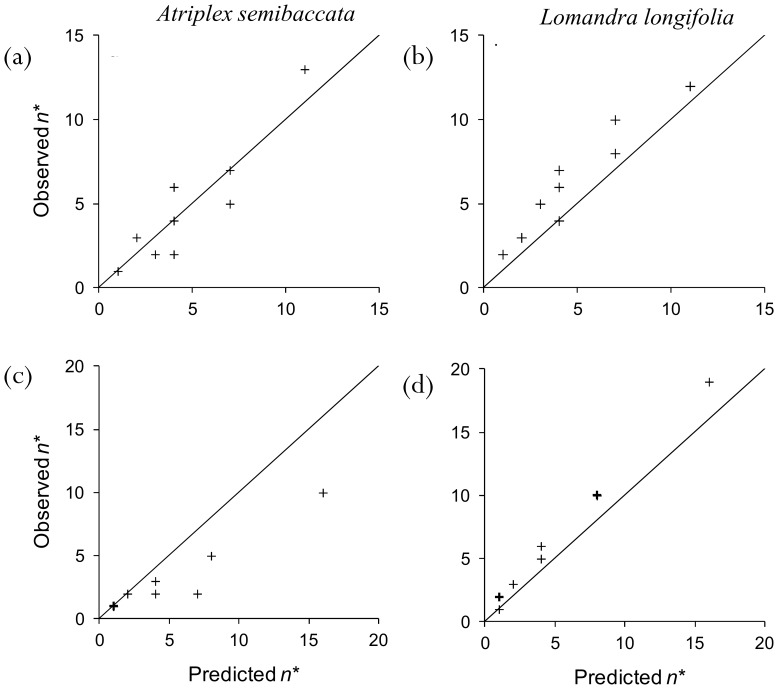
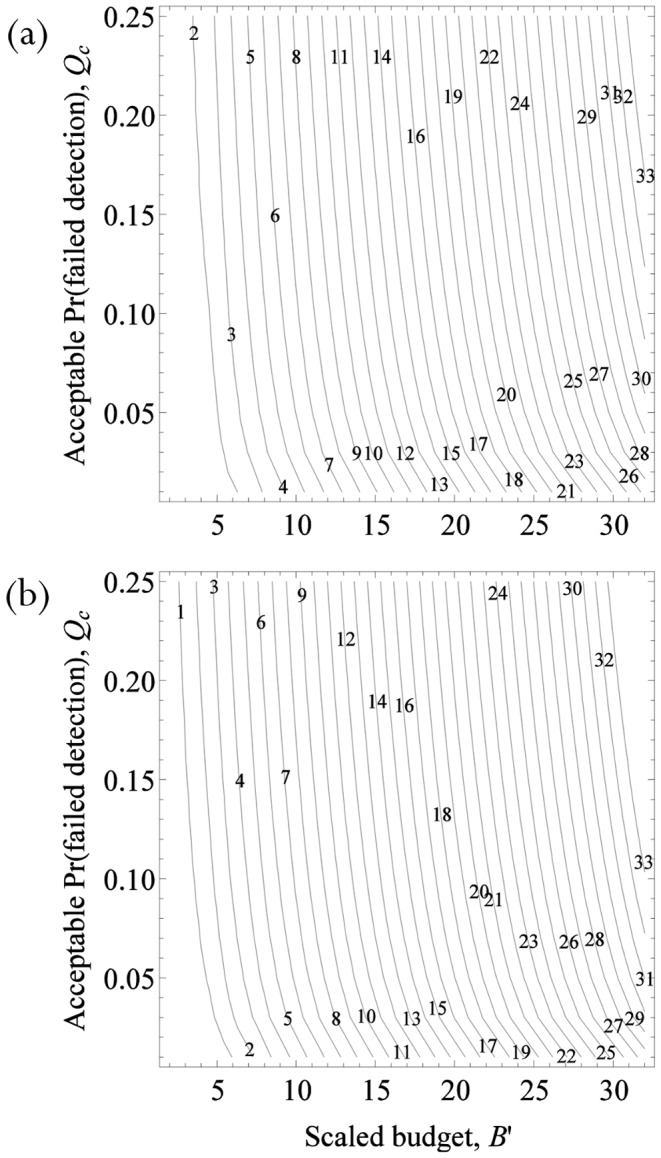
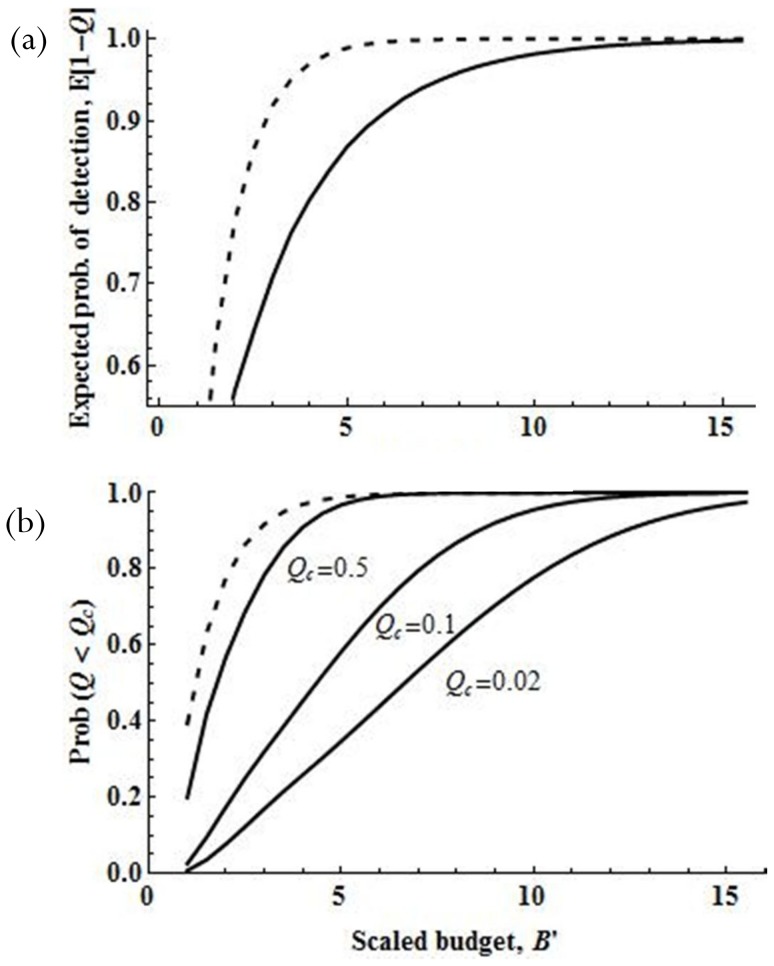
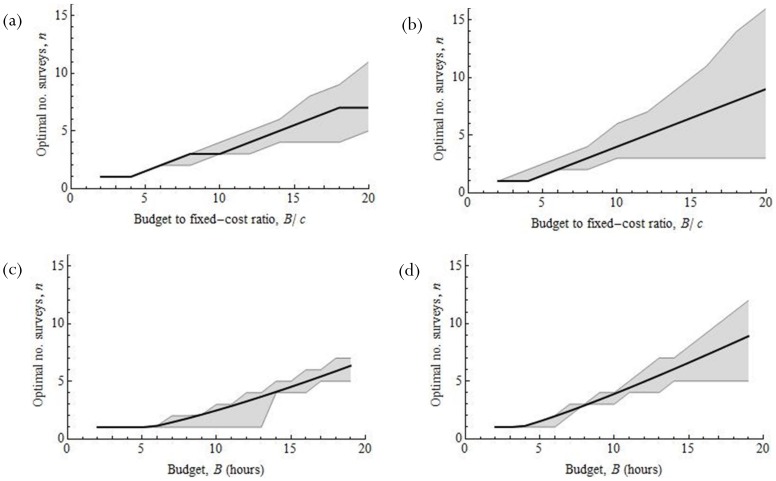
The survey of plant and animal populations is central to undertaking field ecology. However, detection is imperfect, so the absence of a species cannot be determined with certainty. Methods developed to account for imperfect detectability during surveys do not yet account for stochastic variation in detectability over time or space. When each survey entails a fixed cost that is not spent searching (e.g., time required to travel to the site), stochastic detection rates result in a trade-off between the number of surveys and the length of each survey when surveying a single site. We present a model that addresses this trade-off and use it to determine the number of surveys that: 1) maximizes the expected probability of detection over the entire survey period; and 2) is most likely to achieve a minimally-acceptable probability of detection. We illustrate the applicability of our approach using three practical examples (minimum survey effort protocols, number of frog surveys per season, and number of quadrats per site to detect a plant species) and test our model's predictions using data from experimental plant surveys. We find that when maximizing the expected probability of detection, the optimal survey design is most sensitive to the coefficient of variation in the rate of detection and the ratio of the search budget to the travel cost. When maximizing the likelihood of achieving a particular probability of detection, the optimal survey design is most sensitive to the required probability of detection, the expected number of detections if the budget were spent only on searching, and the expected number of detections that are missed due to travel costs. We find that accounting for stochasticity in detection rates is likely to be particularly important for designing surveys when detection rates are low. Our model provides a framework to do this.
对植物和动物种群的调查是开展野外生态学研究的核心内容。然而,检测并非完美无缺,因此无法确定某个物种是否确实不存在。为应对调查中检测不完美情况而开发的方法,尚未考虑到检测率随时间或空间的随机变化。当每次调查都有一笔固定成本并非用于搜索(例如,前往调查地点所需的时间)时,随机检测率会导致在对单个地点进行调查时,调查次数与每次调查时长之间存在权衡。我们提出了一个解决这种权衡的模型,并利用该模型确定调查次数,以实现以下两点:1)在整个调查期内使预期检测概率最大化;2)最有可能达到最低可接受检测概率。我们通过三个实际例子(最小调查工作量方案、每个季节青蛙调查的次数以及每个地点用于检测一种植物物种的样方数量)来说明我们方法的适用性,并使用来自实验性植物调查的数据来检验我们模型的预测。我们发现,在最大化预期检测概率时,最优调查设计对检测率的变异系数以及搜索预算与出行成本的比率最为敏感。在最大化实现特定检测概率的可能性时,最优调查设计对所需检测概率、若预算仅用于搜索时的预期检测次数以及因出行成本而错过的预期检测次数最为敏感。我们发现,当检测率较低时,考虑检测率的随机性对于设计调查可能尤为重要。我们的模型为此提供了一个框架。