Harrison Neil A, Cooper Ella, Dowell Nicholas G, Keramida Georgia, Voon Valerie, Critchley Hugo D, Cercignani Mara
Brighton and Sussex Medical School, University of Sussex, Brighton.; Sackler Centre for Consciousness Science, University of Sussex, Falmer.; Sussex Partnership National Health Service Trust, Brighton..
Brighton and Sussex Medical School, University of Sussex, Brighton.
Biol Psychiatry. 2015 Jul 1;78(1):49-57. doi: 10.1016/j.biopsych.2014.09.023. Epub 2014 Oct 14.
Systemic inflammation impairs brain function and is increasingly implicated in the etiology of common mental illnesses, particularly depression and Alzheimer's disease. Immunotherapies selectively targeting proinflammatory cytokines demonstrate efficacy in a subset of patients with depression. However, efforts to identify patients most vulnerable to the central effects of inflammation are hindered by insensitivity of conventional structural magnetic resonance imaging.
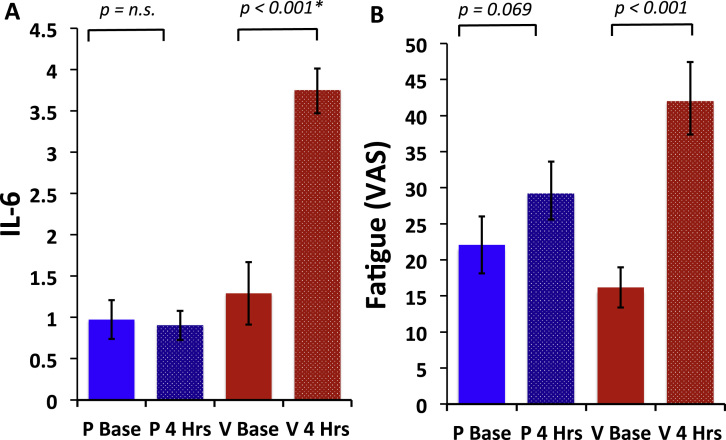
We used quantitative magnetization transfer (qMT) imaging, a magnetic resonance imaging technique that enables quantification of changes in brain macromolecular density, together with experimentally induced inflammation to investigate effects of systemic inflammatory challenge on human brain microstructure. Imaging with qMT was performed in 20 healthy participants after typhoid vaccination and saline control injection. An additional 20 participants underwent fluorodeoxyglucose positron emission tomography following the same inflammatory challenge.
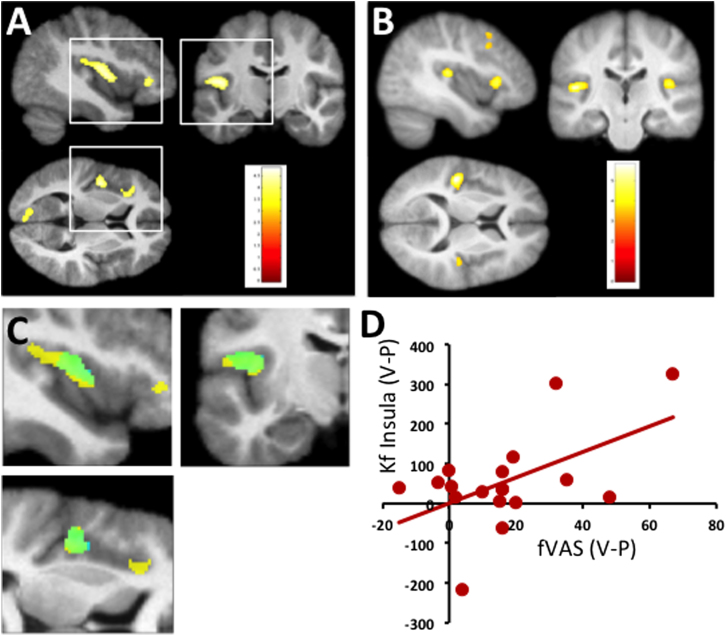
The qMT data demonstrated that inflammation induced a rapid change in brain microstructure, reflected in increased magnetization exchange from free (water) to macromolecular-bound protons, within a discrete region of insular cortex implicated in representing internal physiologic states including inflammation. The functional significance of this change in insular microstructure was demonstrated by correlation with inflammation-induced fatigue and fluorodeoxyglucose positron emission tomography imaging, which revealed increased resting glucose metabolism within this region following the same inflammatory challenge.
Together these observations highlight a novel structural biomarker of the central physiologic and behavioral effects of mild systemic inflammation. The widespread clinical availability of magnetic resonance imaging supports the viability of qMT imaging as a clinical biomarker in trials of immunotherapeutics, both to identify patients vulnerable to the effects of systemic inflammation and to monitor neurobiological responses.
全身炎症会损害脑功能,并且越来越多地与常见精神疾病的病因相关,尤其是抑郁症和阿尔茨海默病。选择性靶向促炎细胞因子的免疫疗法在一部分抑郁症患者中显示出疗效。然而,由于传统结构磁共振成像的不敏感性,识别最易受炎症中枢效应影响的患者的努力受到阻碍。
我们使用定量磁化传递(qMT)成像,这是一种能够量化脑大分子密度变化的磁共振成像技术,结合实验性诱导的炎症来研究全身炎症刺激对人脑微观结构的影响。在20名健康参与者接种伤寒疫苗和注射生理盐水对照后,用qMT进行成像。另外20名参与者在相同的炎症刺激后接受氟脱氧葡萄糖正电子发射断层扫描。
qMT数据表明,炎症在岛叶皮质的一个离散区域内引起脑微观结构的快速变化,表现为从游离(水)质子到大分子结合质子的磁化交换增加,该区域与代表包括炎症在内的内部生理状态有关。通过与炎症诱导的疲劳和氟脱氧葡萄糖正电子发射断层扫描成像的相关性,证明了岛叶微观结构这种变化的功能意义,后者显示在相同的炎症刺激后该区域静息葡萄糖代谢增加。
这些观察结果共同突出了轻度全身炎症的中枢生理和行为效应的一种新型结构生物标志物。磁共振成像的广泛临床可用性支持qMT成像作为免疫治疗试验中临床生物标志物的可行性,既可以识别易受全身炎症影响的患者,也可以监测神经生物学反应。