Christ Torsten, Grubitzsch Herko, Claus Benjamin, Heinze Georg, Dushe Simon, Konertz Wolfgang
Department of Cardiovascular Surgery, Charité-Universitätsmedizin Berlin, Charitéplatz 1, 10117, Berlin, Germany.
J Cardiothorac Surg. 2014 Dec 20;9:197. doi: 10.1186/s13019-014-0197-2.
Stentless aortic valve replacements show improved hemodynamics due to larger orifice area and lower transvalvular gradients in short and mid-term follow-up. Hemodynamic long-term behavior and the adaptation of the left ventricle as well as valve-durability in patients aged ≤60 years remains unclear.
7 to 16 years after aortic valve replacement, 54 patients (mean age at operation 53.1 ± years) received echocardiography and clinical examination. Mean follow-up time was 10.8 ± 2.2 years. Evaluated were NYHA class, transvalvular gradients, estimated aortic valve orifice area, degree of aortic valve insufficiency, left ventricular mass and function.
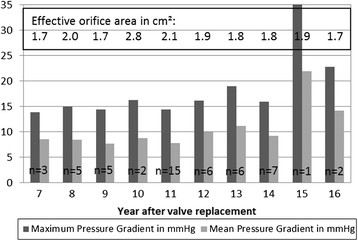
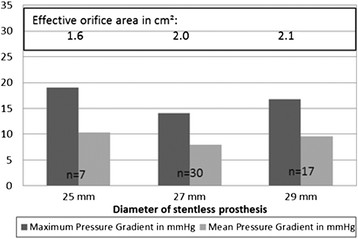
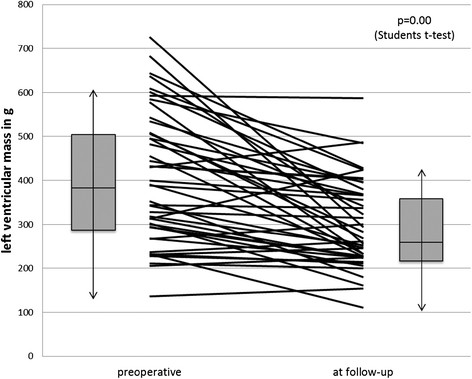
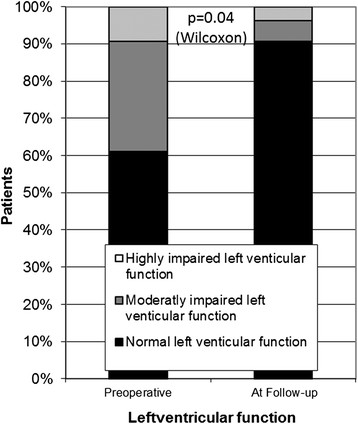
At follow-up only one patient presented with NYHA class III. All other patients were in NYHA class I or II. Maximum and mean pressure gradients of the prostheses were 16.3 ± 7.4 mmHg and 9.1 ± 4.2 mmHg, respectively. Compared to echocardiography at discharge the mean pressure gradients dropped 18.0% (2.0 ± 0.9 mmHg) and stayed stable until 14 years after the operation. Only 5 patients showed relevant regurgitation (at 13-16 years after valve replacement), 49 showed no or trivial regurgitation. Left ventricular mass had decreased 26.5% (107.9 ± 18.5 g). Left ventricular ejection fraction (LVEF) had increased in most patients and decreased in only one. For patients with preoperatively impaired left ventricular function an increase of LVEF of 13.1 ± 3.1% was seen.
Porcine stentless aortic valves provide excellent hemodynamic long-term results without significant rise of transvalvular pressure gradients or relevant insufficiencies until 14 years after implantation, leading to sustained decrease of left ventricular mass and improvement of left ventricular function.
无支架主动脉瓣置换术在短期和中期随访中显示,由于瓣口面积较大和跨瓣压差较低,血流动力学得到改善。年龄≤60岁患者的血流动力学长期表现、左心室适应性以及瓣膜耐久性仍不清楚。
在主动脉瓣置换术后7至16年,54例患者(手术时平均年龄53.1±岁)接受了超声心动图检查和临床检查。平均随访时间为10.8±2.2年。评估指标包括纽约心脏协会(NYHA)心功能分级、跨瓣压差、估计的主动脉瓣口面积、主动脉瓣关闭不全程度、左心室质量和功能。
随访时仅有1例患者为NYHAⅢ级。所有其他患者为NYHAⅠ级或Ⅱ级。人工瓣膜的最大和平均压力梯度分别为16.3±7.4 mmHg和9.1±4. .2 mmHg。与出院时的超声心动图相比,平均压力梯度下降了18.0%(2.0±0.9 mmHg),并在术后14年保持稳定。仅5例患者出现明显反流(瓣膜置换术后13至16年),49例患者无反流或微量反流。左心室质量下降了26.5%(107.9±18.5 g)。大多数患者的左心室射血分数(LVEF)增加,仅1例患者下降。术前左心室功能受损的患者LVEF增加了13.1±3.1%。
猪无支架主动脉瓣在植入后14年内可提供优异的长期血流动力学结果,跨瓣压力梯度无显著升高或无明显关闭不全,导致左心室质量持续下降和左心室功能改善。