van Turenhout Sietze T, Oort Frank A, van der Hulst René W M, Visscher Arjen P, Terhaar sive Droste Jochim S, Scholten Pieter, Bouman Anneke A, Meijer Gerrit A, Mulder Chris J J, van Rossum Leo G M, Coupé Veerle M H
Department of Gastroenterology and Hepatology, VU University Medical Centre, Amsterdam, the Netherlands.
Gastroenterology and Hepatology, Kennemer Gasthuis, Haarlem, the Netherlands.
BMC Gastroenterol. 2014 Dec 21;14:217. doi: 10.1186/s12876-014-0217-7.
Faecal immunochemical tests (FITs) are commonly used in colorectal cancer (CRC) screening. Diagnostic accuracy of FIT differs between males and females. This so far unexplained difference could result in a dissimilarity in screening outcome between both sexes. The aim of this study is to compare sensitivity and specificity of a FIT between males and females, and study potential explanatory variables.
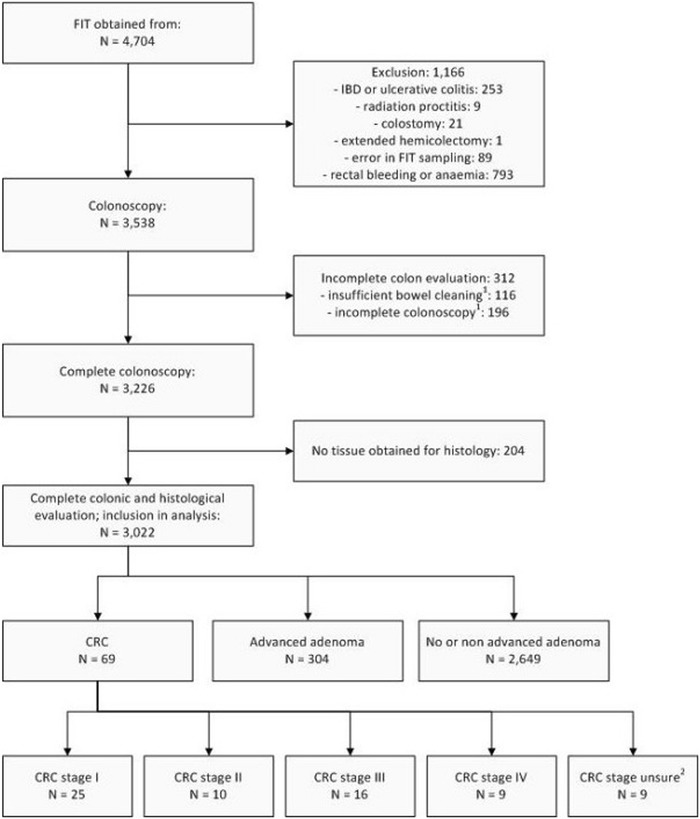
In this cross-sectional study, data were prospectively collected. 3,022 subjects performed a FIT prior to complete colonoscopy. Sensitivity, specificity, and ROC curves were compared for both sexes. Potential explanatory variables of the relation between sensitivity and sex were explored.
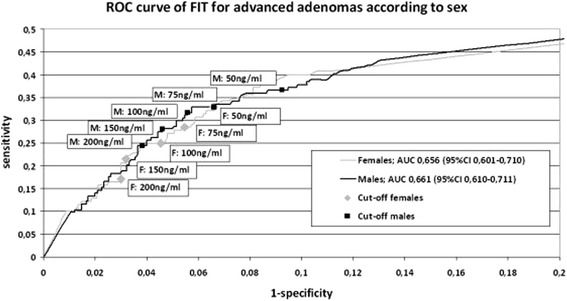
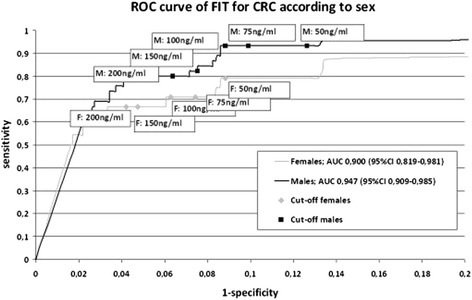
At all cut-off values, FIT sensitivity for CRC was higher (range 13-23%) and specificity was lower (range 2-4%) in males compared to females. At 75 ng/ml, sensitivity for CRC was 93% in males compared to 71% in females (p = 0.03), and specificity was 90% in males compared to 93% in females (p = <0.05). For advanced adenomas, males had a slightly higher sensitivity and lower specificity (not significant). At 75 ng/ml, sensitivity for advanced adenomas was 33% in males compared to 29% in females (p = 0.46), and specificity was 93% in males compared to 95% in females (p = 0.22). ROC curves were similar for both sexes, and equal combinations of sensitivity and specificity could be achieved by adjusting the cut-off values. For CRC, the difference in sensitivity could not be explained by age or location of the tumour.
FIT has a higher sensitivity and a lower specificity for CRC in males than in females. Equal test characteristics can be achieved by allowing separate cut-off values for both sexes. Location and age do not explain the observed differences in sensitivity.
粪便免疫化学检测(FIT)常用于结直肠癌(CRC)筛查。FIT的诊断准确性在男性和女性之间存在差异。这种迄今为止尚未得到解释的差异可能导致两性筛查结果的不同。本研究的目的是比较男性和女性FIT的敏感性和特异性,并研究潜在的解释变量。
在这项横断面研究中,前瞻性地收集数据。3022名受试者在进行全结肠镜检查之前进行了FIT检测。比较了两性的敏感性、特异性和ROC曲线。探索了敏感性与性别之间关系的潜在解释变量。
在所有临界值下,与女性相比,男性FIT对CRC的敏感性更高(范围为13%-23%),特异性更低(范围为2%-4%)。在75 ng/ml时,男性对CRC的敏感性为93%,而女性为71%(p = 0.03),男性的特异性为90%,女性为93%(p < 0.05)。对于高级别腺瘤,男性的敏感性略高,特异性略低(无统计学意义)。在75 ng/ml时,男性对高级别腺瘤的敏感性为33%,女性为29%(p = 0.46),男性的特异性为93%,女性为95%(p = 0.22)。两性的ROC曲线相似,通过调整临界值可以实现敏感性和特异性的相同组合。对于CRC,敏感性的差异无法用肿瘤的年龄或位置来解释。
FIT对男性CRC的敏感性高于女性,特异性低于女性。通过允许两性采用不同的临界值,可以实现相同的检测特征。肿瘤位置和年龄无法解释观察到的敏感性差异。