Arana-Arri Eunate, Idigoras Isabel, Uranga Begoña, Pérez Raquel, Irurzun Ana, Gutiérrez-Ibarluzea Iñaki, Fraser Callum G, Portillo Isabel
BioCruces Health Research Institute, Plaza Cruces 12, 48903, Barakaldo, Bizkaia, Spain.
Colorectal Cancer Screening Programme Coordination Center, Bilbao, Spain.
BMC Cancer. 2017 Aug 29;17(1):577. doi: 10.1186/s12885-017-3555-3.
The Basque Colorectal Cancer Screening Programme has both high participation rate and high compliance rate of colonoscopy after a positive faecal occult blood test (FIT). Although, colorectal cancer (CRC) screening with biannual (FIT) has shown to reduce CRC mortality, the ultimate effectiveness of the screening programmes depends on the accuracy of FIT and post-FIT colonoscopy, and thus, harms related to false results might not be underestimated. Current CRC screening programmes use a single faecal haemoglobin concentration (f-Hb) cut-off for colonoscopy referral for both sexes and all ages. We aimed to determine optimum f-Hb cut-offs by sex and age without compromising neoplasia detection and interval cancer proportion.
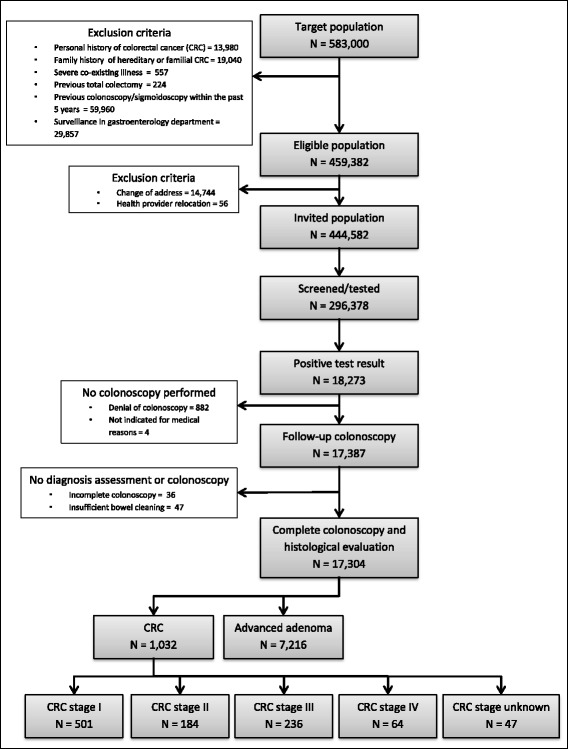
Prospective cohort study using a single-sample faecal immunochemical test (FIT) on 444,582 invited average-risk subjects aged 50-69 years. A result was considered positive at ≥20 μg Hb/g faeces. Outcome measures were analysed by sex and age for a wide range of f-Hb cut-offs.
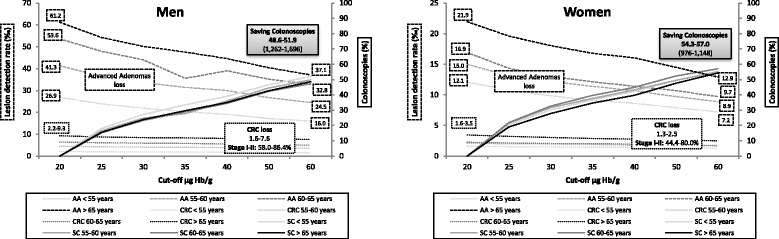
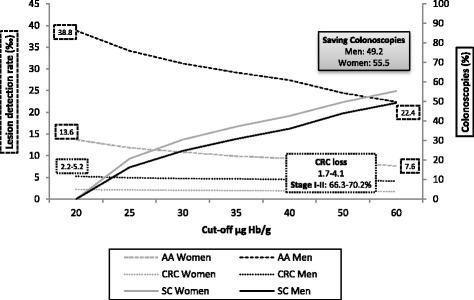
We analysed 17,387 positive participants in the programme who underwent colonoscopy. Participation rate was 66.5%. Men had a positivity rate for f-Hb of 8.3% and women 4.8% (p < 0.0001). The detection rate for advanced neoplasia (cancer plus advanced adenoma) was 44.0‰ for men and 15.9‰ for women (p < 0.0001). The number of colonoscopies required decreased in both sexes and all age groups through increasing the f-Hb cut-off. However, the loss in CRC detection increased by up to 28.1% in men and 22.9% in women. CRC missed were generally at early stages (Stage I-II: from 70.2% in men to 66.3% in women).
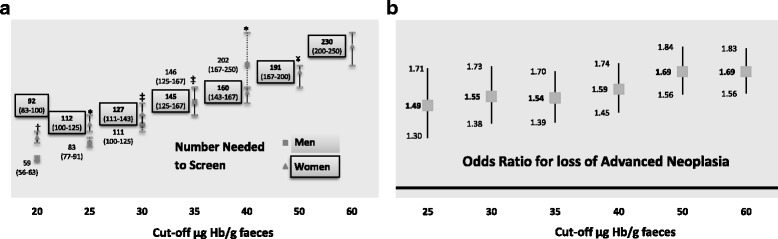
This study provides detailed outcomes in men and women of different ages at a range of f-Hb cut-offs. We found differences in positivity rates, neoplasia detection rate, number needed to screen, and interval cancers in men and women and in younger and older groups. However, there are factors other than sex and age to consider when consideration is given to setting the f-Hb cut-off.
巴斯克地区结直肠癌筛查项目在粪便潜血试验(FIT)呈阳性后,结肠镜检查的参与率和依从率都很高。尽管每两年进行一次FIT的结直肠癌(CRC)筛查已显示可降低CRC死亡率,但筛查项目的最终效果取决于FIT及FIT后结肠镜检查的准确性,因此,与假结果相关的危害不可低估。当前的CRC筛查项目对所有年龄和性别的结肠镜检查转诊均采用单一的粪便血红蛋白浓度(f-Hb)临界值。我们旨在确定按性别和年龄划分的最佳f-Hb临界值,同时不影响肿瘤的检测及间期癌比例。
对444,582名受邀的50-69岁平均风险受试者进行前瞻性队列研究,采用单样本粪便免疫化学检测(FIT)。粪便中血红蛋白(Hb)≥20μg/g时结果被视为阳性。针对一系列f-Hb临界值,按性别和年龄对结局指标进行分析。
我们分析了该项目中17,387名接受结肠镜检查的阳性参与者。参与率为66.5%。男性f-Hb阳性率为8.3%,女性为4.8%(p<0.0001)。男性高级别肿瘤(癌症加高级别腺瘤)的检出率为44.0‰,女性为15.9‰(p<0.0001)。通过提高f-Hb临界值,男女及各年龄组所需的结肠镜检查数量均减少。然而,男性CRC检测的损失增加了28.1%,女性增加了22.9%。漏诊的CRC通常处于早期阶段(I-II期:男性为70.2%,女性为66.3%)。
本研究提供了不同年龄男女在一系列f-Hb临界值下的详细结局。我们发现男女之间以及年轻和老年组在阳性率、肿瘤检出率、筛查所需人数和间期癌方面存在差异。然而,在考虑设定f-Hb临界值时,除了性别和年龄外,还有其他因素需要考虑。