Zapatero-Solana Elisabeth, García-Giménez Jose Luis, Guerrero-Aspizua Sara, García Marta, Toll Agustí, Baselga Eulalia, Durán-Moreno Maria, Markovic Jelena, García-Verdugo Jose Manuel, Conti Claudio J, Has Cristina, Larcher Fernando, Pallardó Federico V, Del Rio Marcela
Centre for Biomedical Network Research on Rare Diseases (CIBERER), ISCIII, Valencia, Spain.
Regenerative Medicine Unit. Departament of Basic Research, Centro de Investigaciones Energéticas, Medioambientales y Tecnológicas (CIEMAT), Madrid, Spain.
Orphanet J Rare Dis. 2014 Dec 21;9:211. doi: 10.1186/s13023-014-0211-8.
Kindler Syndrome (KS) is an autosomal recessive skin disorder characterized by skin blistering, photosensitivity, premature aging, and propensity to skin cancer. In spite of the knowledge underlying cause of this disease involving mutations of FERMT1 (fermitin family member 1), and efforts to characterize genotype-phenotype correlations, the clinical variability of this genodermatosis is still poorly understood. In addition, several pathognomonic features of KS, not related to skin fragility such as aging, inflammation and cancer predisposition have been strongly associated with oxidative stress. Alterations of the cellular redox status have not been previously studied in KS. Here we explored the role of oxidative stress in the pathogenesis of this rare cutaneous disease.
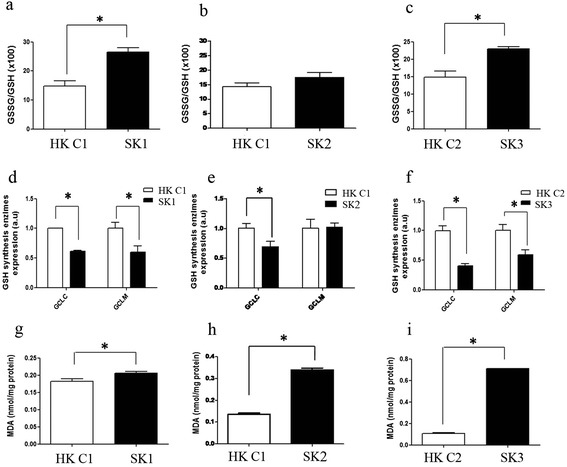
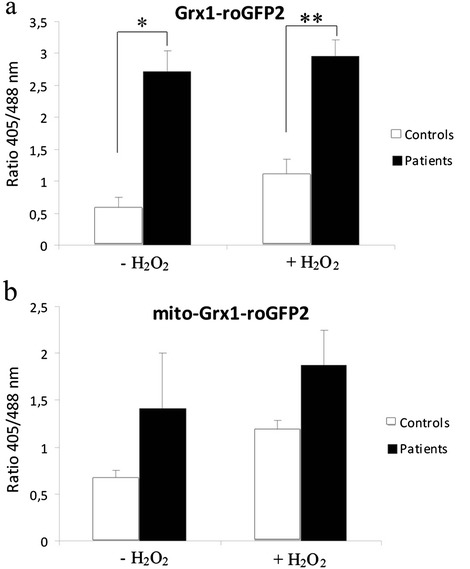
Patient-derived keratinocytes and their respective controls were cultured and classified according to their different mutations by PCR and western blot, the oxidative stress biomarkers were analyzed by spectrophotometry and qPCR and additionally redox biosensors experiments were also performed. The mitochondrial structure and functionality were analyzed by confocal microscopy and electron microscopy.
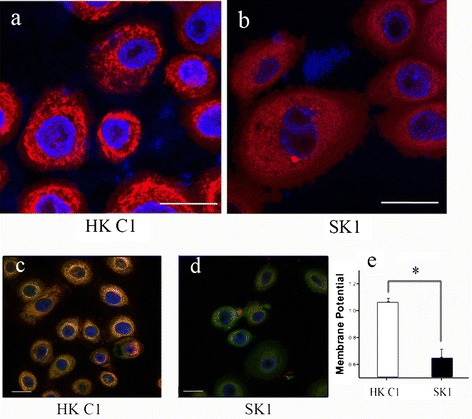
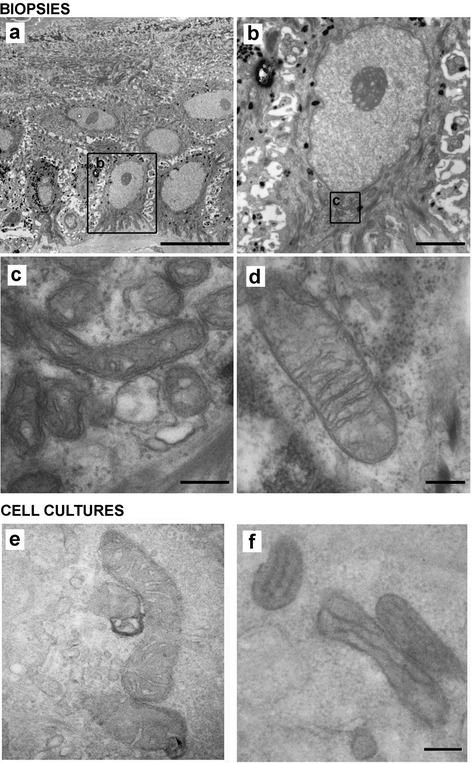
Patient-derived keratinocytes showed altered levels of several oxidative stress biomarkers including MDA (malondialdehyde), GSSG/GSH ratio (oxidized and reduced glutathione) and GCL (gamma-glutamyl cysteine ligase) subunits. Electron microscopy analysis of both, KS skin biopsies and keratinocytes showed marked morphological mitochondrial abnormalities. Consistently, confocal microscopy studies of mitochondrial fluorescent probes confirmed the mitochondrial derangement. Imbalance of oxidative stress biomarkers together with abnormalities in the mitochondrial network and function are consistent with a pro-oxidant state.
This is the first study to describe mitochondrial dysfunction and oxidative stress involvement in KS.
Kindler综合征(KS)是一种常染色体隐性遗传性皮肤病,其特征为皮肤水疱、光敏性、早衰以及患皮肤癌的倾向。尽管已知该疾病的潜在病因涉及FERMT1(fermitin家族成员1)基因突变,并且人们努力对基因型 - 表型相关性进行特征描述,但对这种遗传性皮肤病的临床变异性仍了解不足。此外,KS的一些特征性表现,如衰老、炎症和癌症易感性等与皮肤脆弱性无关的特征,与氧化应激密切相关。此前尚未对KS患者细胞内氧化还原状态的改变进行研究。在此,我们探讨了氧化应激在这种罕见皮肤病发病机制中的作用。
培养源自患者的角质形成细胞及其相应对照,并通过聚合酶链反应(PCR)和蛋白质免疫印迹法根据其不同突变进行分类,通过分光光度法和定量聚合酶链反应(qPCR)分析氧化应激生物标志物,此外还进行了氧化还原生物传感器实验。通过共聚焦显微镜和电子显微镜分析线粒体的结构和功能。
源自患者的角质形成细胞显示出几种氧化应激生物标志物水平的改变,包括丙二醛(MDA)、氧化型谷胱甘肽/还原型谷胱甘肽(GSSG/GSH)比值以及γ-谷氨酰半胱氨酸连接酶(GCL)亚基。对KS皮肤活检组织和角质形成细胞进行的电子显微镜分析均显示出线粒体明显的形态学异常。同样,线粒体荧光探针的共聚焦显微镜研究证实了线粒体的紊乱。氧化应激生物标志物的失衡以及线粒体网络和功能的异常与促氧化状态一致。
这是第一项描述线粒体功能障碍和氧化应激参与Kindler综合征发病机制的研究。