Chen Jian-jun, Huang Hua, Zhao Li-bo, Zhou De-zhi, Yang Yong-tao, Zheng Peng, Yang De-yu, He Peng, Zhou Jing-jing, Fang Liang, Xie Peng
Department of Neurology, Yongchuan Hospital of Chongqing Medical University, Chongqing, China; Chongqing Key Laboratory of Neurobiology, Chongqing, China; Institute of Neuroscience, Chongqing Medical University, Chongqing, China.
Department of Neurology, The First Affiliated Hospital of Chongqing Medical University, Chongqing, China; Chongqing Key Laboratory of Neurobiology, Chongqing, China; Institute of Neuroscience, Chongqing Medical University, Chongqing, China.
PLoS One. 2014 Dec 22;9(12):e115221. doi: 10.1371/journal.pone.0115221. eCollection 2014.
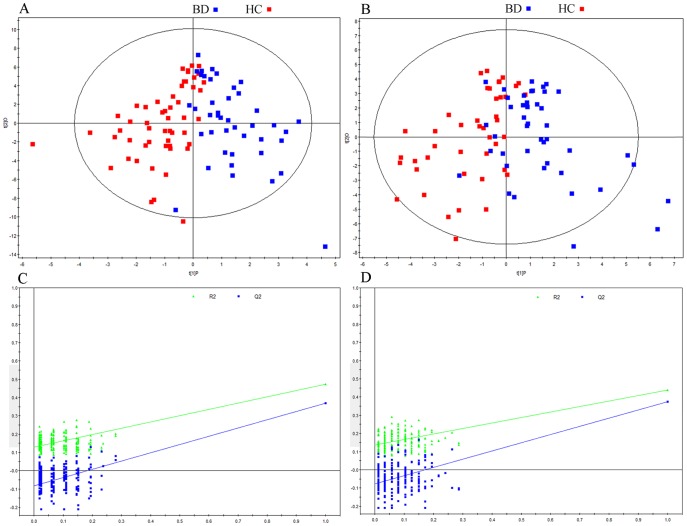
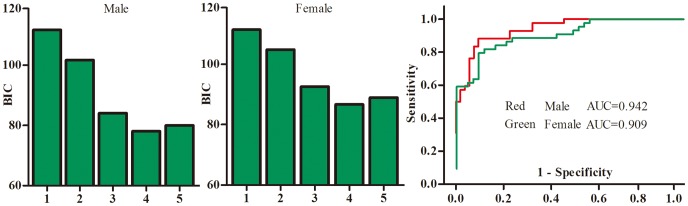
Sex-based differences are prominent in affective disorders, but there are no biomarkers available to support sex-specific, laboratory-based diagnostics for male and female bipolar disorder (BD) patients. Here, a NMR-based metabonomic approach was used to preliminarily identify sex-specific urinary metabolite biomarkers for diagnosing male and female BD patients. A male-specific biomarker panel consisting of four metabolites (α-hydroxybutyrate, choline, formate, and N-methylnicotinamide) effectively discriminated between male BD and healthy controls (HC) subjects, achieving an area under the receiver operating characteristic curve (AUC) of 0.942. A female-specific biomarkers panel consisting of four metabolites (α-hydroxybutyrate, oxalacetate, acetone, and N-methylnicotinamide) effectively discriminated between female BD and HC subjects, achieving an AUC of 0.909. The male-specific biomarker panel displayed low discriminatory power in the female group, and the female-specific biomarker panel displayed low discriminatory power in the male group. Moreover, several other metabolites showed different trends between male and female BD subjects. These findings suggest that male and female BD patients have distinct biomarker fingerprints and that these two sex-specific biomarker panels may serve as effective diagnostic tools in distinguishing male and female BD patients from their healthy counterparts. Our work may provide a window into the mechanisms underlying the pathoetiology of BD in both men and women.
性别差异在情感障碍中很突出,但目前尚无生物标志物可用于支持基于实验室的男性和女性双相情感障碍(BD)患者的性别特异性诊断。在此,采用基于核磁共振的代谢组学方法初步鉴定用于诊断男性和女性BD患者的性别特异性尿液代谢物生物标志物。由四种代谢物(α-羟基丁酸、胆碱、甲酸和N-甲基烟酰胺)组成的男性特异性生物标志物组能够有效区分男性BD患者和健康对照(HC)受试者,受试者工作特征曲线(AUC)下面积达到0.942。由四种代谢物(α-羟基丁酸、草酰乙酸、丙酮和N-甲基烟酰胺)组成的女性特异性生物标志物组能够有效区分女性BD患者和HC受试者,AUC为0.909。男性特异性生物标志物组在女性组中显示出较低的鉴别能力,而女性特异性生物标志物组在男性组中显示出较低的鉴别能力。此外,其他几种代谢物在男性和女性BD受试者之间呈现出不同的趋势。这些发现表明,男性和女性BD患者具有不同的生物标志物特征,这两个性别特异性生物标志物组可作为区分男性和女性BD患者与健康对照的有效诊断工具。我们的工作可能为男女BD病理病因学的潜在机制提供一个窗口。