United States Geological Survey, Patuxent Wildlife Research Center Laurel, Maryland, 20708.
Western EcoSystems Technology Inc. Bloomington, Indiana, 47404.
Ecol Evol. 2014 Sep;4(17):3482-93. doi: 10.1002/ece3.1201. Epub 2014 Aug 22.
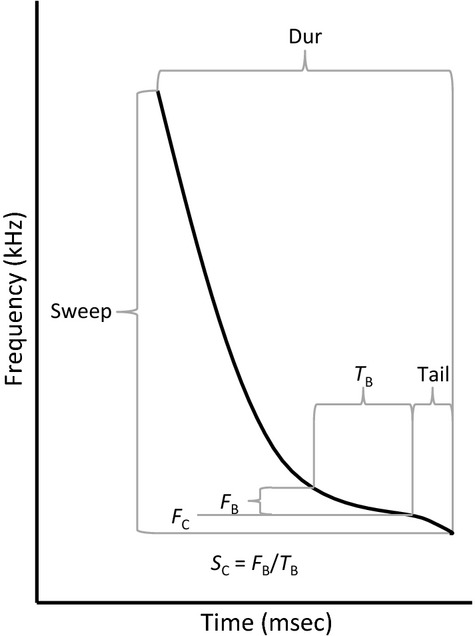
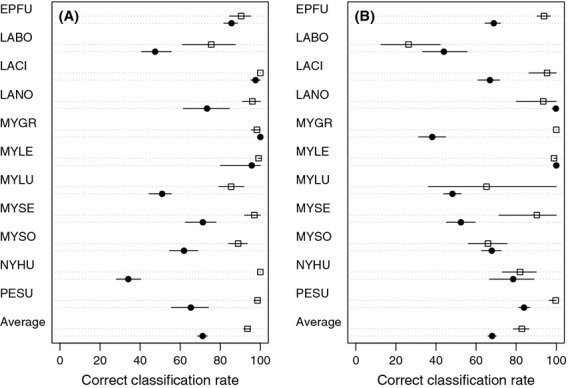
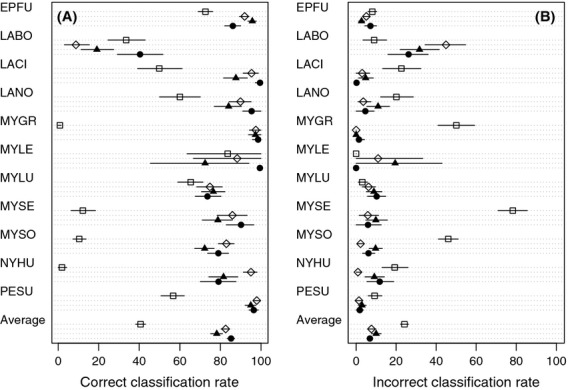
Quantitative methods for species identification are commonly used in acoustic surveys for animals. While various identification models have been studied extensively, there has been little study of methods for selecting calls prior to modeling or methods for validating results after modeling. We obtained two call libraries with a combined 1556 pulse sequences from 11 North American bat species. We used four acoustic filters to automatically select and quantify bat calls from the combined library. For each filter, we trained a species identification model (a quadratic discriminant function analysis) and compared the classification ability of the models. In a separate analysis, we trained a classification model using just one call library. We then compared a conventional model assessment that used the training library against an alternative approach that used the second library. We found that filters differed in the share of known pulse sequences that were selected (68 to 96%), the share of non-bat noises that were excluded (37 to 100%), their measurement of various pulse parameters, and their overall correct classification rate (41% to 85%). Although the top two filters did not differ significantly in overall correct classification rate (85% and 83%), rates differed significantly for some bat species. In our assessment of call libraries, overall correct classification rates were significantly lower (15% to 23% lower) when tested on the second call library instead of the training library. Well-designed filters obviated the need for subjective and time-consuming manual selection of pulses. Accordingly, researchers should carefully design and test filters and include adequate descriptions in publications. Our results also indicate that it may not be possible to extend inferences about model accuracy beyond the training library. If so, the accuracy of acoustic-only surveys may be lower than commonly reported, which could affect ecological understanding or management decisions based on acoustic surveys.
定量物种鉴定方法在动物声学调查中被广泛应用。虽然已经对各种鉴定模型进行了广泛研究,但对建模前选择叫声的方法或建模后验证结果的方法研究较少。我们从 11 种北美蝙蝠物种中获得了两个包含 1556 个脉冲序列的叫声库。我们使用四个声学滤波器自动从组合库中选择和量化蝙蝠叫声。对于每个滤波器,我们都训练了一个物种识别模型(二次判别函数分析),并比较了模型的分类能力。在单独的分析中,我们仅使用一个叫声库训练分类模型。然后,我们比较了传统的仅使用训练库进行模型评估的方法和使用第二个库的替代方法。我们发现滤波器在选择的已知脉冲序列的比例(68%至 96%)、排除的非蝙蝠噪声的比例(37%至 100%)、它们对各种脉冲参数的测量以及整体正确分类率(41%至 85%)方面存在差异。尽管两个最佳滤波器的整体正确分类率(85%和 83%)没有显著差异,但某些蝙蝠物种的分类率差异显著。在我们对叫声库的评估中,当在第二个叫声库而不是训练库上进行测试时,整体正确分类率显著降低(低 15%至 23%)。精心设计的滤波器可以避免对脉冲进行主观和耗时的手动选择。因此,研究人员应该仔细设计和测试滤波器,并在出版物中包含足够的描述。我们的结果还表明,可能无法将模型准确性的推断扩展到训练库之外。如果是这样,基于声学调查的生态理解或管理决策可能会受到影响,因为声学调查的准确性可能低于通常报道的水平。