Ahmed Nishat H, Hussain Tabish
Department of Laboratory Medicine, Delhi State Cancer Institute, Delhi, India.
Proteomics and Structural Biology Unit, Institute of Genomics and Integrative Biology, New Delhi, India.
J Glob Infect Dis. 2014 Oct;6(4):141-6. doi: 10.4103/0974-777X.145231.
Dealing with severe blood stream infections (BSI) is one of the intractable conditions in hospitals. The empirical treatment given remains pertinent in determining patient outcome, which becomes evidence based when substantiated by knowledge of susceptibility patterns of prevalent pathogenic organisms in the set up. This study was undertaken to determine the occurrence, species prevalence, and antibiotic susceptibility pattern of laboratory confirmed BSI (LCBSI) in patients admitted to our multi-specialty sanatorium.
Eight hundred and forty-six blood samples from 829 patients suspected of having BSI were cultured as per standard microbiological procedures. Antimicrobial susceptibility testing was done for bacterial isolates from positive blood cultures.
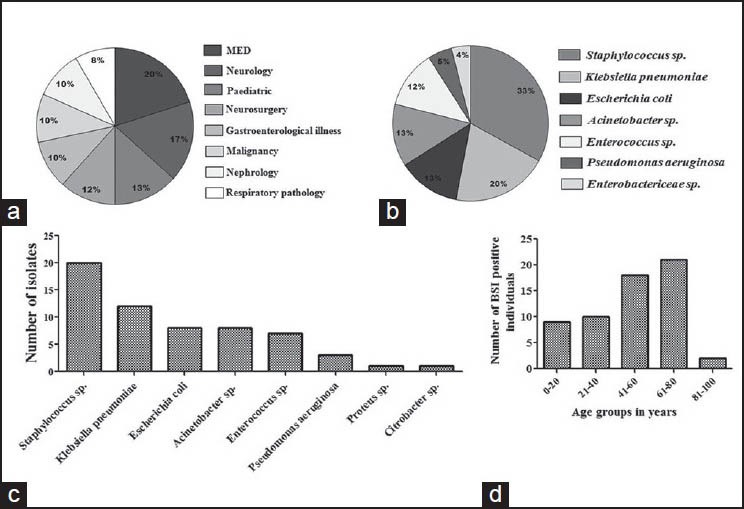
Sixty (7.2%) cases were established as LCBSI. A total of eight pathogenic bacterial genera were identified and their antimicrobial susceptibility pattern was noted. Staphylococcus spp. were most prevalent (33%), followed by Klebsiella pneumoniae (20%), Escherichia coli (13%), Acinetobacter spp. (13%), Enterococcus spp. (12%), Pseudomonas aeruginosa (3%), Proteus spp. (2%), and Citrobacter spp. (2%).
The study shows the prevalence of common bacterial pathogens causing BSI and their susceptibility patterns. Such studies provide benefit of instantaneous choice of antibiotic therapy aiming at improved patient management and reduced drug resistance.
应对严重血流感染(BSI)是医院中棘手的病症之一。给予的经验性治疗对于确定患者预后仍然至关重要,当依据所在机构中流行致病微生物的药敏模式知识加以证实时,该治疗就成为基于证据的治疗。本研究旨在确定入住我们多专科疗养院的患者中实验室确诊的血流感染(LCBSI)的发生率、菌种流行情况及抗生素药敏模式。
按照标准微生物学程序,对829例疑似患有BSI的患者的846份血样进行培养。对阳性血培养中的细菌分离株进行抗菌药敏试验。
60例(7.2%)确诊为LCBSI。共鉴定出8个致病细菌属,并记录了它们的抗菌药敏模式。葡萄球菌属最为常见(33%),其次是肺炎克雷伯菌(20%)、大肠埃希菌(13%)、不动杆菌属(13%)、肠球菌属(12%)、铜绿假单胞菌(3%)、变形杆菌属(2%)和柠檬酸杆菌属(2%)。
该研究显示了引起BSI的常见细菌病原体的流行情况及其药敏模式。此类研究有助于即时选择抗生素治疗,以改善患者管理并降低耐药性。