CNRS UMR-7104, Translational Medicine and Neurogenetics, Institut de Génétique et de Biologie Moléculaire et Cellulaire, INSERM U-964, Université de Strasbourg , Illkirch , France ; Department of Psychiatry, University Hospital of Strasbourg and Medical School of Strasbourg , Strasbourg , France.
CNRS UMR-7104, Translational Medicine and Neurogenetics, Institut de Génétique et de Biologie Moléculaire et Cellulaire, INSERM U-964, Université de Strasbourg , Illkirch , France ; Douglas Mental Health Institute, McGill University , Montréal, QC , Canada.
Front Psychiatry. 2014 Dec 8;5:170. doi: 10.3389/fpsyt.2014.00170. eCollection 2014.
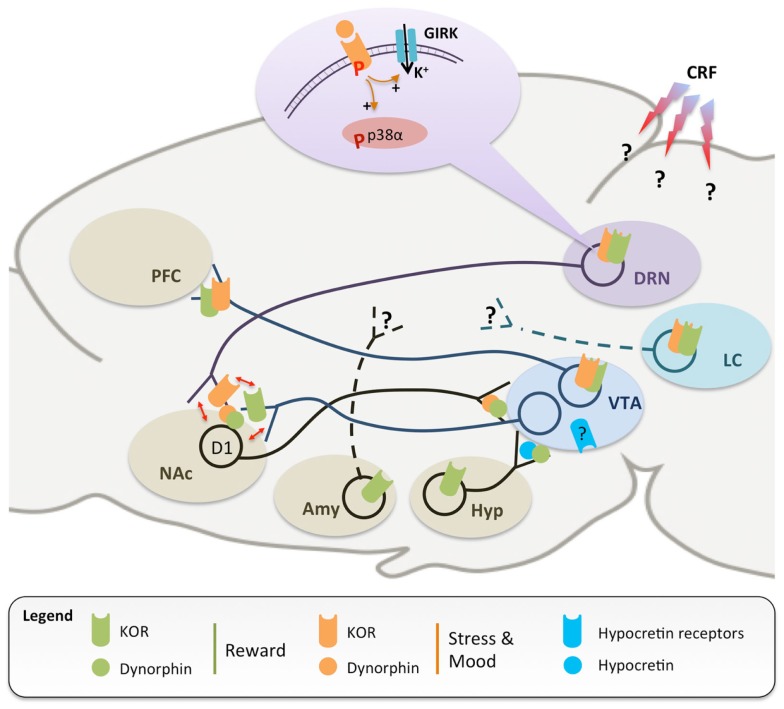
Comorbidity is a major issue in psychiatry that notably associates with more severe symptoms, longer illness duration, and higher service utilization. Therefore, identifying key clusters of comorbidity and exploring the underlying pathophysiological mechanisms represent important steps toward improving mental health care. In the present review, we focus on the frequent association between addiction and depression. In particular, we summarize the large body of evidence from preclinical models indicating that the kappa opioid receptor (KOR), a member of the opioid neuromodulatory system, represents a central player in the regulation of both reward and mood processes. Current data suggest that the KOR modulates overlapping neuronal networks linking brainstem monoaminergic nuclei with forebrain limbic structures. Rewarding properties of both drugs of abuse and natural stimuli, as well as the neurobiological effects of stressful experiences, strongly interact at the level of KOR signaling. In addiction models, activity of the KOR is potentiated by stressors and critically controls drug-seeking and relapse. In depression paradigms, KOR signaling is responsive to a variety of stressors, and mediates despair-like responses. Altogether, the KOR represents a prototypical substrate of comorbidity, whereby life experiences converge upon common brain mechanisms to trigger behavioral dysregulation and increased risk for distinct but interacting psychopathologies.
共病是精神病学中的一个主要问题,它与更严重的症状、更长的疾病持续时间和更高的服务利用率显著相关。因此,确定共病的关键聚类并探索潜在的病理生理机制是改善精神卫生保健的重要步骤。在本综述中,我们重点关注成瘾和抑郁之间的常见关联。具体来说,我们总结了大量来自临床前模型的证据,表明κ阿片受体(KOR)作为阿片类神经调质系统的一员,是调节奖励和情绪过程的核心参与者。现有数据表明,KOR 调节连接脑干单胺能核与前脑边缘结构的重叠神经元网络。药物滥用和自然刺激的奖赏特性以及应激体验的神经生物学效应在 KOR 信号水平上强烈相互作用。在成瘾模型中,应激源增强了 KOR 的活性,并严格控制觅药和复发。在抑郁模型中,KOR 信号对各种应激源有反应,并介导类似绝望的反应。总的来说,KOR 是共病的典型基质,生活经历汇聚到共同的大脑机制上,引发行为失调,并增加了不同但相互作用的精神病理的风险。