Laboratory of Hematology and Immunology, Myeloma Center Brussels, Vrije Universiteit Brussel , Brussels , Belgium.
Laboratory of Cellular and Molecular Immunology, Vrije Universiteit Brussel , Brussels , Belgium ; Laboratory of Myeloid Cell Immunology, VIB , Brussels , Belgium.
Front Oncol. 2014 Dec 8;4:349. doi: 10.3389/fonc.2014.00349. eCollection 2014.
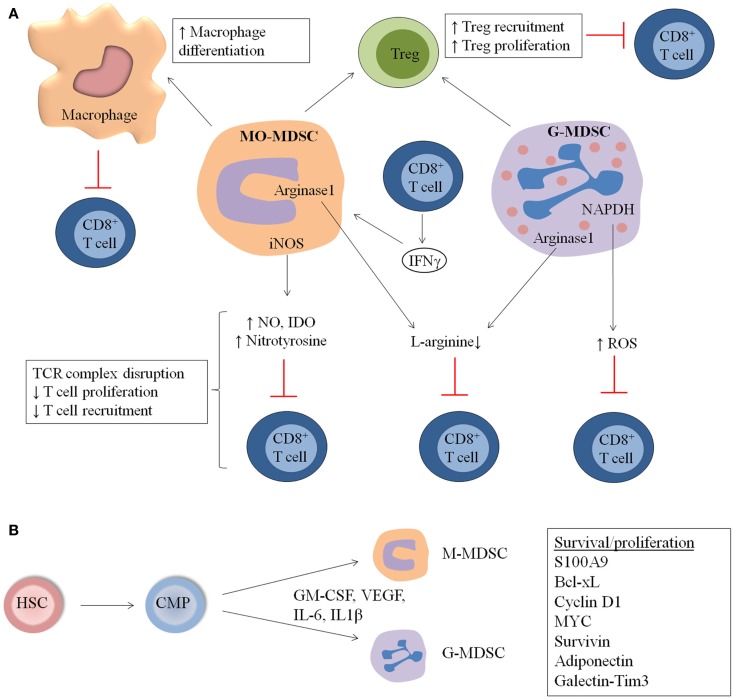
Myeloid-derived suppressor cells (MDSC) are a heterogeneous population of immature myeloid cells that accumulate during pathological conditions such as cancer and are associated with a poor clinical outcome. MDSC expansion hampers the host anti-tumor immune response by inhibition of T cell proliferation, cytokine secretion, and recruitment of regulatory T cells. In addition, MDSC exert non-immunological functions including the promotion of angiogenesis, tumor invasion, and metastasis. Recent years, MDSC are considered as a potential target in solid tumors and hematological malignancies to enhance the effects of currently used immune modulating agents. This review focuses on the characteristics, distribution, functions, cell-cell interactions, and targeting of MDSC in hematological malignancies including multiple myeloma, lymphoma, and leukemia.
髓源性抑制细胞(MDSC)是一种异质性的未成熟髓系细胞群体,在癌症等病理条件下积累,并与不良的临床结果相关。MDSC 的扩增通过抑制 T 细胞增殖、细胞因子分泌和调节性 T 细胞募集来抑制宿主的抗肿瘤免疫反应。此外,MDSC 还发挥非免疫功能,包括促进血管生成、肿瘤侵袭和转移。近年来,MDSC 被认为是实体瘤和血液恶性肿瘤的一个潜在靶点,以增强目前使用的免疫调节剂的作用。本文综述了 MDSC 在血液恶性肿瘤(包括多发性骨髓瘤、淋巴瘤和白血病)中的特征、分布、功能、细胞间相互作用以及靶向治疗。