Skvarova Kramarzova Karolina, Fiser Karel, Mejstrikova Ester, Rejlova Katerina, Zaliova Marketa, Fornerod Maarten, Drabkin Harry A, van den Heuvel-Eibrink Marry M, Stary Jan, Trka Jan, Starkova Julia
J Hematol Oncol. 2014 Dec 24;7:94. doi: 10.1186/s13045-014-0094-0.
Although distinct patterns of homeobox (HOX) gene expression have been described in defined cytogenetic and molecular subsets of patients with acute myeloid leukemia (AML), it is unknown whether these patterns are the direct result of transcriptional alterations or rather represent the differentiation stage of the leukemic cell.
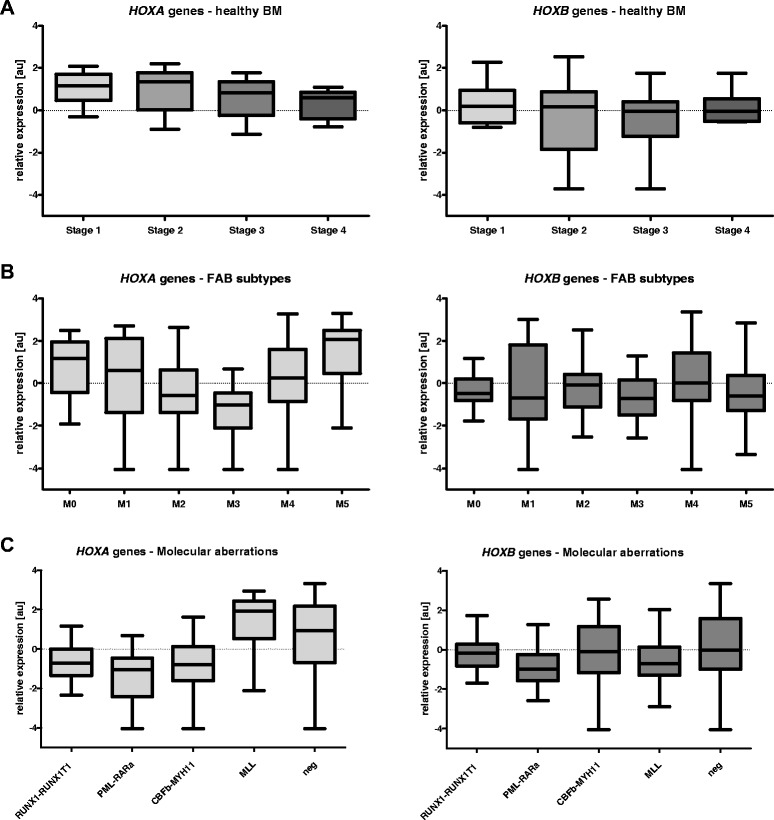
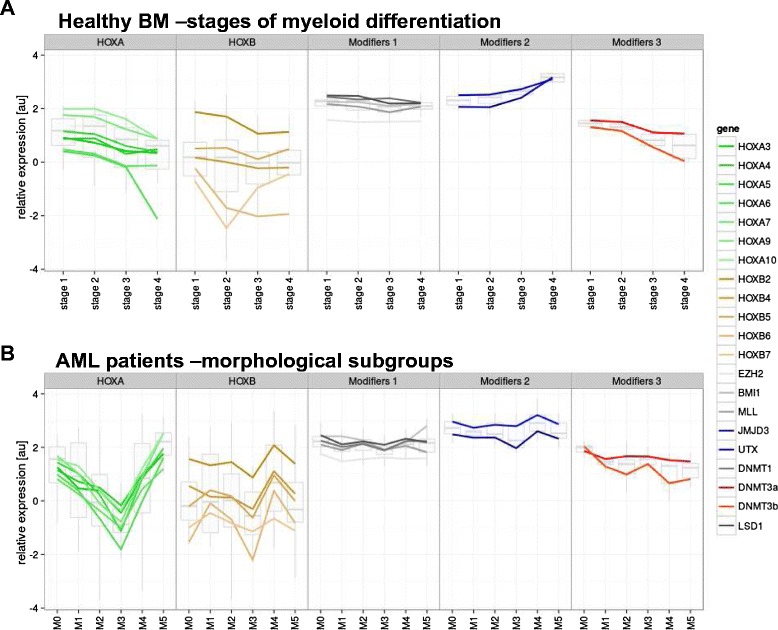
To address this question, we used qPCR to analyze mRNA expression of HOXA and HOXB genes in bone marrow (BM) samples of 46 patients with AML and sorted subpopulations of healthy BM cells. These various stages of myeloid differentiation represent matched counterparts of morphological subgroups of AML. To further study the transcriptional alterations of HOX genes in hematopoiesis, we also analyzed gene expression of epigenetic modifiers in the subpopluations of healthy BM and leukemic cells.
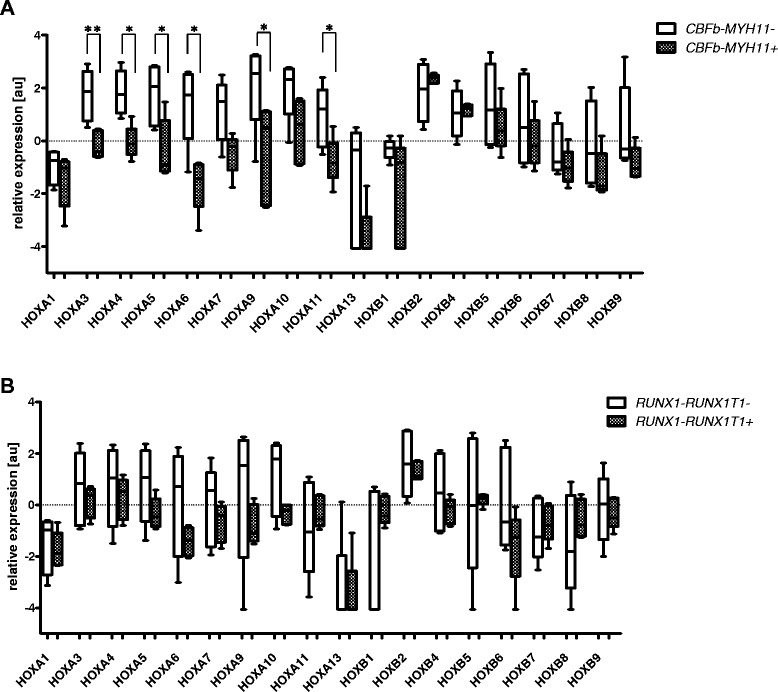
Unsupervised hierarchical clustering divided the AMLs into five clusters characterized by the presence of prevalent molecular genetic aberrations. Notably, the impact of genotype on HOX gene expression was significantly more pronounced than that of the differentiation stage of the blasts. This driving role of molecular aberrations was best exemplified by the repressive effect of the PML-RARa fusion gene on HOX gene expression, regardless of the presence of the FLT3/ITD mutation. Furthermore, HOX gene expression was positively correlated with mRNA levels of histone demethylases (JMJD3 and UTX) and negatively correlated with gene expression of DNA methyltranferases. No such relationships were observed in subpopulations of healthy BM cells.
Our results demonstrate that specific molecular genetic aberrations, rather than differentiation per se, underlie the observed differences in HOX gene expression in AML. Moreover, the observed correlations between epigenetic modifiers and HOX expression that are specific to malignant hematopoiesis, suggest their potential causal relationships.
尽管在急性髓系白血病(AML)患者特定的细胞遗传学和分子亚组中已描述了同源框(HOX)基因表达的不同模式,但尚不清楚这些模式是转录改变的直接结果,还是仅仅代表白血病细胞的分化阶段。
为了解决这个问题,我们使用定量聚合酶链反应(qPCR)分析了46例AML患者骨髓(BM)样本以及健康BM细胞分选亚群中HOXA和HOXB基因的mRNA表达。这些髓系分化的不同阶段代表了AML形态学亚组的匹配对应物。为了进一步研究造血过程中HOX基因的转录改变,我们还分析了健康BM和白血病细胞亚群中表观遗传修饰因子的基因表达。
无监督层次聚类将AML分为五个簇,其特征是存在普遍的分子遗传异常。值得注意的是,基因型对HOX基因表达的影响明显比原始细胞的分化阶段更为显著。分子异常的这种驱动作用最典型的例子是PML-RARa融合基因对HOX基因表达的抑制作用,无论是否存在FLT3/ITD突变。此外,HOX基因表达与组蛋白去甲基化酶(JMJD3和UTX)的mRNA水平呈正相关,与DNA甲基转移酶的基因表达呈负相关。在健康BM细胞亚群中未观察到此类关系。
我们的结果表明,特定的分子遗传异常而非分化本身是AML中HOX基因表达差异的基础。此外,在恶性造血中观察到的表观遗传修饰因子与HOX表达之间的相关性表明它们可能存在因果关系。