Shishodia Gauri, Verma Gaurav, Srivastava Yogesh, Mehrotra Ravi, Das Bhudev Chandra, Bharti Alok Chandra
Division of Molecular Oncology, Institute of Cytology and Preventive Oncology, I-7, Sector-39, Noida, Uttar Pradesh 201301, India.
BMC Cancer. 2014 Dec 23;14:996. doi: 10.1186/1471-2407-14-996.
Aberrantly expressed and constitutively active STAT3 signaling plays a pivotal role in initiation and progression of human papillomavirus-induced cervical carcinogenesis. However, the underlying mechanism(s) responsible for pleiotropic effects of STAT3 signaling is poorly understood. In view of emerging regulatory role of microRNAs, Let-7a and miR-21 that may interact with STAT3 signaling and/or its downstream effectors, present study was designed in HPV16-positive cervical cancer cells to assess the functional contribution of these miRs in STAT3 signaling in cervical cancer.
Functional silencing of STAT3 signaling and HPV16 oncoprotein expression in SiHa cells was done by STAT3-specific and 16 E6 siRNAs. Pharmacological intervention of STAT3 was done using specific inhibitors like curcumin and stattic. Loss-of-function study of miR-21 using miR-21 inhibitor and gain-of-function study of let-7a was done using let-7a mimic in SiHa cells.
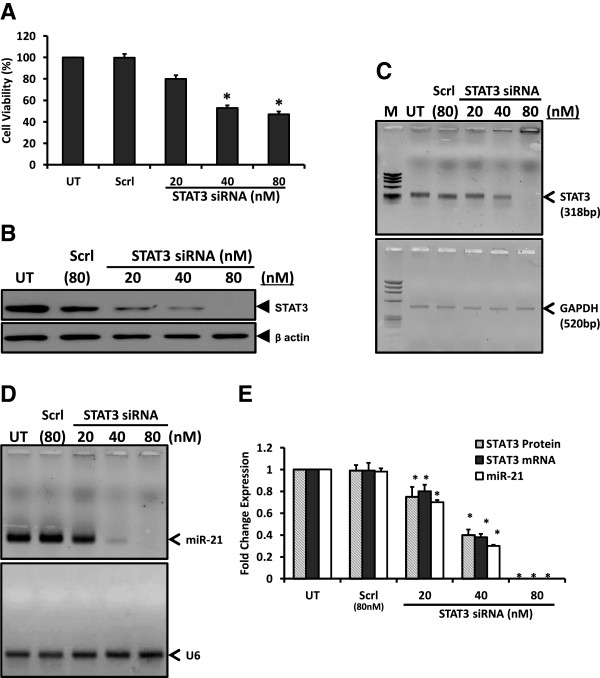
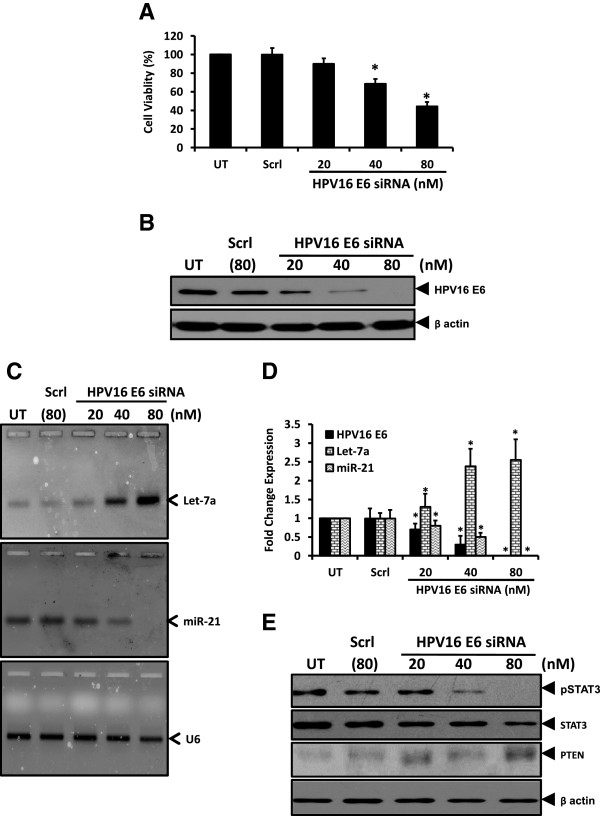
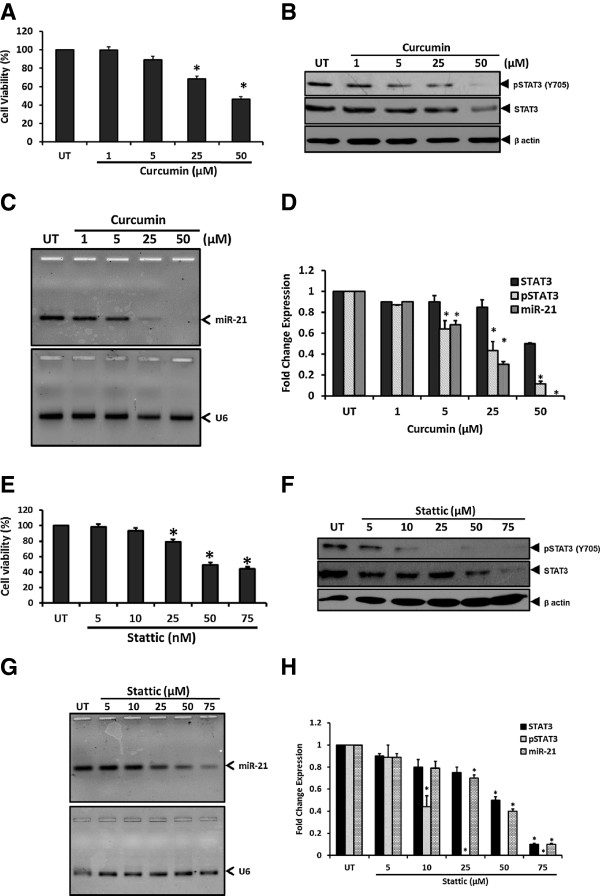
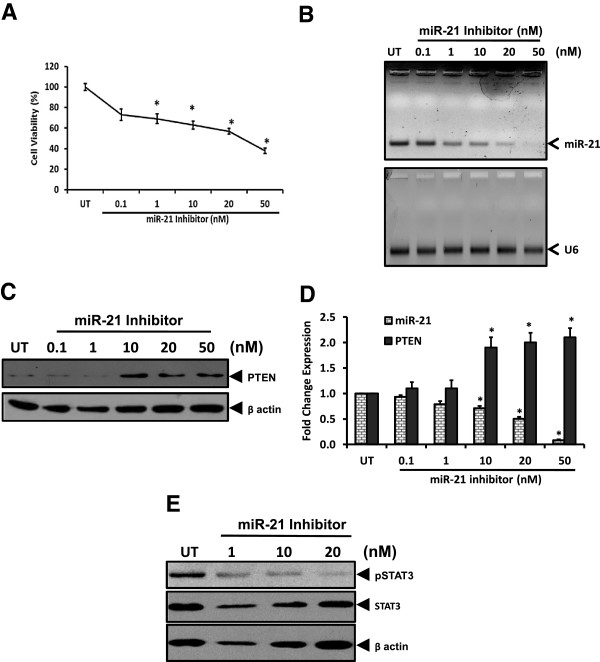
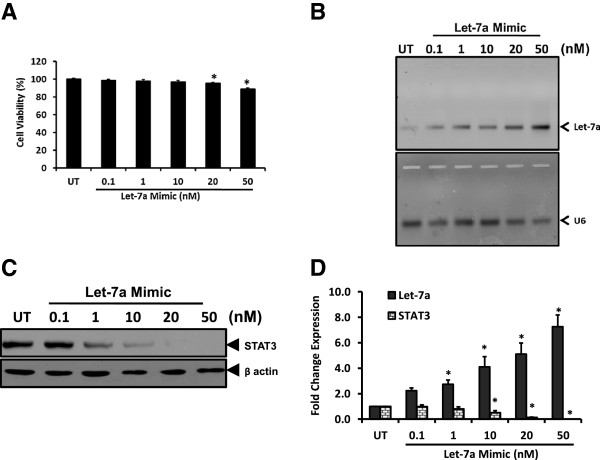
Functional silencing of STAT3 signaling in SiHa cells by STAT3-specific siRNA resulted in a dose-dependent decrease in cellular miR-21 level. Pharmacological intervention of STAT3 using specific inhibitors like curcumin and Stattic that abrogated STAT3 activation resulted in loss of cellular miR-21 pool. Contrary to this, specific targeting of miR-21 using miR-21 inhibitor resulted in an increased level of PTEN, a negative regulator of STAT3, and reduced active pSTAT3 level. Besides miR-21, restoration of cellular Let-7a using chemically synthesized Let-7a mimic reduced overall STAT3 level. Abrogation of HPV oncoprotein E6 by specific siRNA resulted in increased Let-7a but loss of miR-21 and a correspondingly reduced pSTAT3/STAT3 and elevated the level of cellular PTEN.
Our results demonstrate existence of a functional loop involving Let-7a, STAT3 and miR-21 which were found potentially regulated by viral oncoprotein E6.
miR-21 and Let-7a along with STAT3 may prove useful targets for pharmacological intervention for management of cervical cancer.
异常表达且持续激活的信号转导和转录激活因子3(STAT3)信号通路在人乳头瘤病毒诱导的宫颈癌发生和发展过程中起关键作用。然而,对STAT3信号通路产生多效性作用的潜在机制仍知之甚少。鉴于微小RNA(miRNA)的新兴调控作用,可能与STAT3信号通路和/或其下游效应器相互作用的Let-7a和miR-21,本研究在人乳头瘤病毒16型(HPV16)阳性宫颈癌细胞中开展,以评估这些miRNA在宫颈癌STAT3信号通路中的功能作用。
通过STAT3特异性和16 E6小干扰RNA(siRNA)在SiHa细胞中对STAT3信号通路和HPV16癌蛋白表达进行功能沉默。使用姜黄素和Stattic等特异性抑制剂对STAT3进行药理学干预。在SiHa细胞中使用miR-21抑制剂对miR-21进行功能缺失研究,并使用Let-7a模拟物对Let-7a进行功能获得研究。
通过STAT3特异性siRNA在SiHa细胞中对STAT3信号通路进行功能沉默导致细胞miR-21水平呈剂量依赖性下降。使用姜黄素和Stattic等特异性抑制剂对STAT3进行药理学干预,消除STAT3激活,导致细胞miR-21库减少。与此相反,使用miR-21抑制剂对miR-21进行特异性靶向导致PTEN水平升高,PTEN是STAT3的负调节因子,同时活性磷酸化STAT3(pSTAT3)水平降低。除了miR-21,使用化学合成的Let-7a模拟物恢复细胞Let-7a可降低总体STAT3水平。通过特异性siRNA消除HPV癌蛋白E6导致Let-7a增加,但miR-21减少,相应地pSTAT3/STAT3降低,细胞PTEN水平升高。
我们的结果表明存在一个涉及Let-7a、STAT3和miR-21的功能环,发现它们可能受病毒癌蛋白E6调控。
miR-21和Let-7a以及STAT3可能被证明是宫颈癌药物干预的有用靶点。