Probst Michael, Injan Natcha, Megyes Tünde, Bako Imre, Balint Szabolcz, Limtrakul Jumras, Nazmutdinov Renat, Mitev Pavlin D, Hermansson Kersti
Institute of Ion Physics and Applied Physics, Innsbruck University, Austria.
Institute of Ion Physics and Applied Physics, Innsbruck University, Austria ; Department of Chemistry, Faculty of Science and Center of Nanotechnology, Kasetsart University, Bangkok, Thailand.
Chem Phys Lett. 2012 Jun 29;539-540:24-29. doi: 10.1016/j.cplett.2012.04.044.
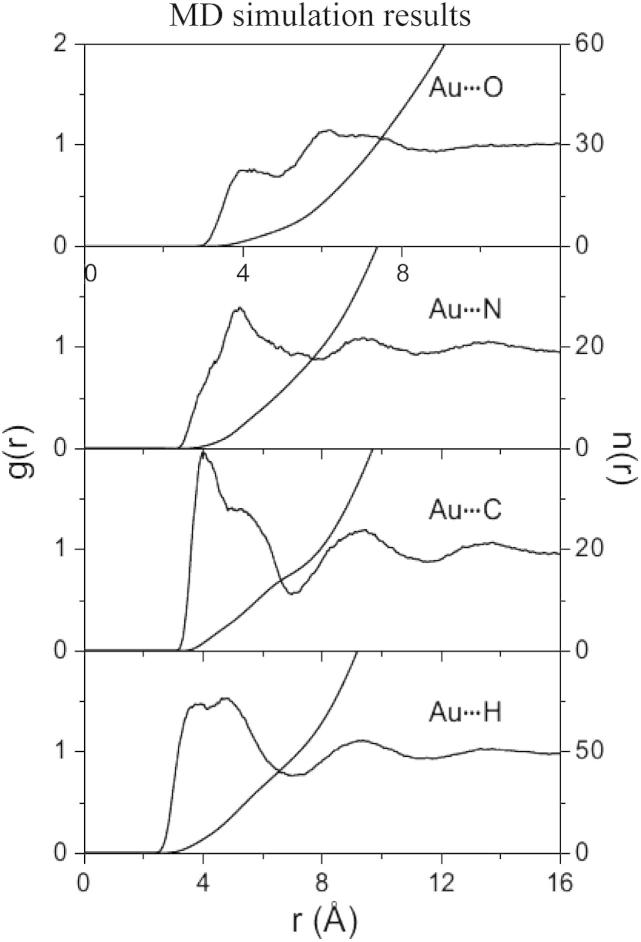
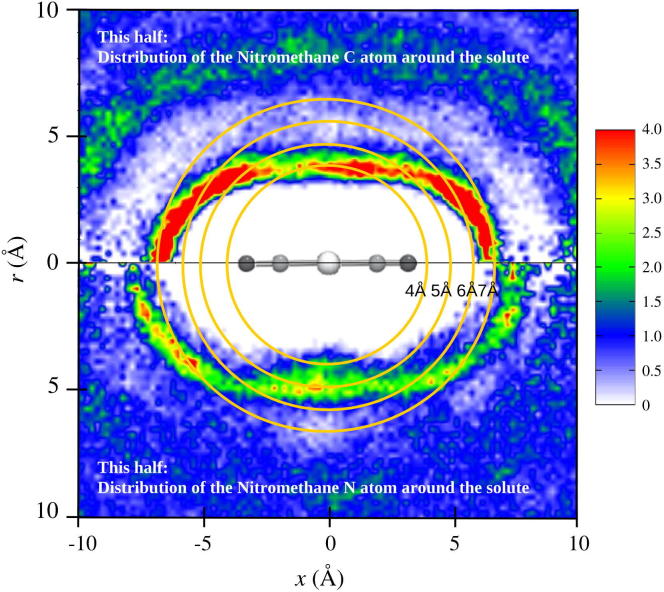
The solvation structure around the dicyanoaurate(I) anion (Au(CN)) in a dilute nitromethane (CHNO) solution is presented from X-ray diffraction measurements and molecular dynamics simulation (NVT ensemble, 460 nitromethane molecules at room temperature). The simulations are based on a new solute-solvent force-field fitted to a training set of quantum-chemically derived interaction energies. Radial distribution functions from experiment and simulation are in good agreement. The solvation structure has been further elucidated from MD data. Several shells can be identified. We obtain a solvation number of 13-17 nitromethane molecules with a strong preference to be oriented with their methyl groups towards the solute.
通过X射线衍射测量和分子动力学模拟(NVT系综,室温下460个硝基甲烷分子),给出了稀硝基甲烷(CH₃NO₂)溶液中氰基aurate(I)阴离子(Au(CN)₂⁻)周围的溶剂化结构。模拟基于一种新的溶质-溶剂力场,该力场拟合了一组量子化学推导的相互作用能训练集。实验和模拟得到的径向分布函数吻合良好。从分子动力学数据进一步阐明了溶剂化结构。可以识别出几个壳层。我们得到溶剂化数为13 - 17个硝基甲烷分子,这些分子强烈倾向于使其甲基朝向溶质排列。