Department of Biology, University of Eastern Finland P.O. Box 111, Joensuu, FI-80101, Finland ; Centre for Evolutionary Biology, School of Animal Biology, University of Western Australia Crawley, WA, Australia.
Department of Biological and Environmental Sciences, University of Jyväskylä Jyväskylä, Finland.
Ecol Evol. 2014 Nov;4(22):4237-46. doi: 10.1002/ece3.1267. Epub 2014 Oct 21.
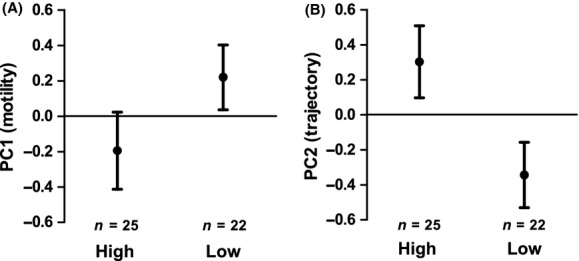
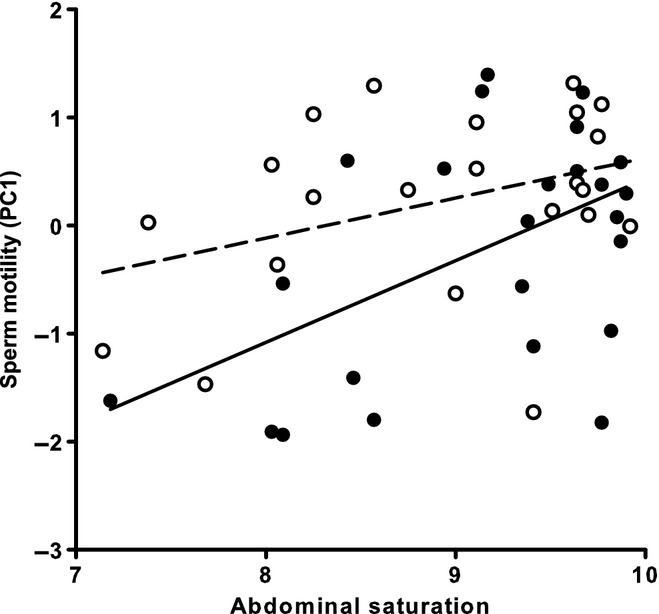
Parasites take their resources from hosts and thus directly reduce available resources for hosts' own body functions, such as growth and reproduction. Furthermore, parasite infections cause significant indirect costs to their hosts in terms of increased investments on immune defense. In this study, we investigated the impact of parasite infection on the sperm quality and expression of secondary sexual ornamentation (saturation of the red abdominal colouration and number of breeding tubercles) in the Eurasian minnow (Phoxinus phoxinus). We exposed minnows to a high and low dose of common nonspecific fish ectoparasite, the glochidia larvae of duck mussel (Anodonta anatina) and tested whether parasite infection leads to trade-off in sperm quality and/or ornamental expression. We found that glochidia infection reduces the curvature of the sperm swimming trajectory, number of breeding tubercles, and possibly male competitive ability, but does not affect expression of male color ornamentation. Furthermore, glochidia infection was found to reduce sperm motility, but only when all the noninfected individuals were excluded from the model. Supporting one of the predictions by phenotype-linked fertility hypothesis both in high-infection and low-infection group male breeding colouration was positively associated with sperm quality. Our results suggest that although glochidia infection may have negative impact on male reproductive success, parasite-induced costs may not create strong trade-off between breeding colouration and sperm quality or that such trade-off become detectable only in resource-limited conditions.
寄生虫从宿主身上获取资源,从而直接减少宿主自身身体功能(如生长和繁殖)可用的资源。此外,寄生虫感染会导致宿主在免疫防御方面增加投资,从而产生重大的间接成本。在这项研究中,我们调查了寄生虫感染对欧亚鱲(Phoxinus phoxinus)精子质量和第二性征(腹部红色饱和度和繁殖结节数量)表达的影响。我们将小鱼暴露于高剂量和低剂量的常见非特异性鱼类外寄生虫,即鸭嘴贝(Anodonta anatina)的钩介幼虫,并测试寄生虫感染是否会导致精子质量和/或装饰表达的权衡。我们发现钩介幼虫感染会降低精子游动轨迹的曲率、繁殖结节的数量,并且可能会降低雄性的竞争能力,但不会影响雄性颜色装饰的表达。此外,只有当所有未感染的个体都从模型中排除时,钩介幼虫感染才会降低精子的运动能力。支持表型相关生育力假说的一个预测,在高感染和低感染组中,雄性繁殖颜色都与精子质量呈正相关。我们的研究结果表明,尽管钩介幼虫感染可能对雄性生殖成功产生负面影响,但寄生虫引起的成本可能不会在繁殖颜色和精子质量之间造成强烈的权衡,或者只有在资源有限的情况下才能检测到这种权衡。