Gonçalves-Souza Thiago, Romero Gustavo Q, Cottenie Karl
Programa de Pós-Graduação em Biologia Animal, Departamento de Zoologia e Botânica, IBILCE, Universidade Estadual Paulista, UNESP, São José do Rio Preto, SP, Brasil.
Departamento de Biologia Animal, Instituto de Biologia, Universidade Estadual de Campinas (UNICAMP), Campinas, SP, Brasil.
PLoS One. 2014 Dec 30;9(12):e115137. doi: 10.1371/journal.pone.0115137. eCollection 2014.
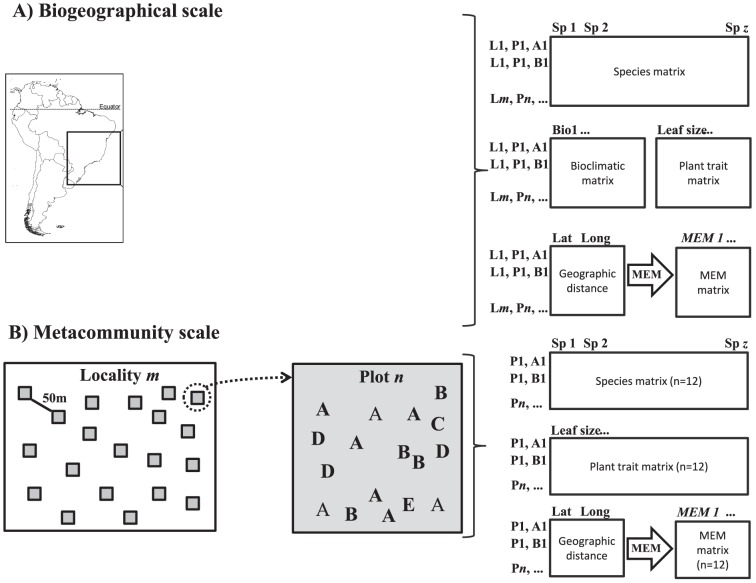
Biogeography and metacommunity ecology provide two different perspectives on species diversity. Both are spatial in nature but their spatial scales do not necessarily match. With recent boom of metacommunity studies, we see an increasing need for clear discrimination of spatial scales relevant for both perspectives. This discrimination is a necessary prerequisite for improved understanding of ecological phenomena across scales. Here we provide a case study to illustrate some spatial scale-dependent concepts in recent metacommunity studies and identify potential pitfalls. We presented here the diversity patterns of Neotropical lepidopterans and spiders viewed both from metacommunity and biogeographical perspectives. Specifically, we investigated how the relative importance of niche- and dispersal-based processes for community assembly change at two spatial scales: metacommunity scale, i.e. within a locality, and biogeographical scale, i.e. among localities widely scattered along a macroclimatic gradient. As expected, niche-based processes dominated the community assembly at metacommunity scale, while dispersal-based processes played a major role at biogeographical scale for both taxonomical groups. However, we also observed small but significant spatial effects at metacommunity scale and environmental effects at biogeographical scale. We also observed differences in diversity patterns between the two taxonomical groups corresponding to differences in their dispersal modes. Our results thus support the idea of continuity of processes interactively shaping diversity patterns across scales and emphasize the necessity of integration of metacommunity and biogeographical perspectives.
生物地理学和集合群落生态学为物种多样性提供了两种不同的视角。两者本质上都具有空间性,但它们的空间尺度不一定匹配。随着集合群落研究的近期蓬勃发展,我们越发需要清晰地区分与这两种视角相关的空间尺度。这种区分是跨尺度更好地理解生态现象的必要前提。在此,我们提供一个案例研究,以说明近期集合群落研究中一些与空间尺度相关的概念,并识别潜在的陷阱。我们在此呈现了从集合群落和生物地理学视角观察到的新热带地区鳞翅目昆虫和蜘蛛的多样性模式。具体而言,我们研究了基于生态位和扩散的群落构建过程的相对重要性在两个空间尺度上是如何变化的:集合群落尺度,即在一个地点内;以及生物地理学尺度,即在沿着宏观气候梯度广泛分布的不同地点之间。正如预期的那样,基于生态位的过程在集合群落尺度上主导着群落构建,而基于扩散的过程在生物地理学尺度上对这两个分类群都起着主要作用。然而,我们也在集合群落尺度上观察到了微小但显著的空间效应,在生物地理学尺度上观察到了环境效应。我们还观察到这两个分类群之间多样性模式的差异,这与它们扩散模式的差异相对应。因此,我们的结果支持了跨尺度交互塑造多样性模式的过程具有连续性的观点,并强调了整合集合群落和生物地理学视角的必要性。