Wagenaar Timothy R, Tolstykh Tatiana, Shi Chaomei, Jiang Lan, Zhang JingXin, Li Zhifang, Yu Qunyan, Qu Hui, Sun Fangxian, Cao Hui, Pollard Jack, Dai Shujia, Gao Qiang, Zhang Bailin, Arlt Heike, Cindhuchao May, Hoffmann Dietmar, Light Madelyn, Jensen Karin, Hopke Joern, Newcombe Richard, Garcia-Echeverria Carlos, Winter Christopher, Zabludoff Sonya, Wiederschain Dmitri
Sanofi Oncology, Cambridge, MA 02139, USA.
Regulus Therapeutics, San Diego, CA 92121, USA.
Nucleic Acids Res. 2015 Jan;43(2):1204-15. doi: 10.1093/nar/gku1367. Epub 2014 Dec 30.
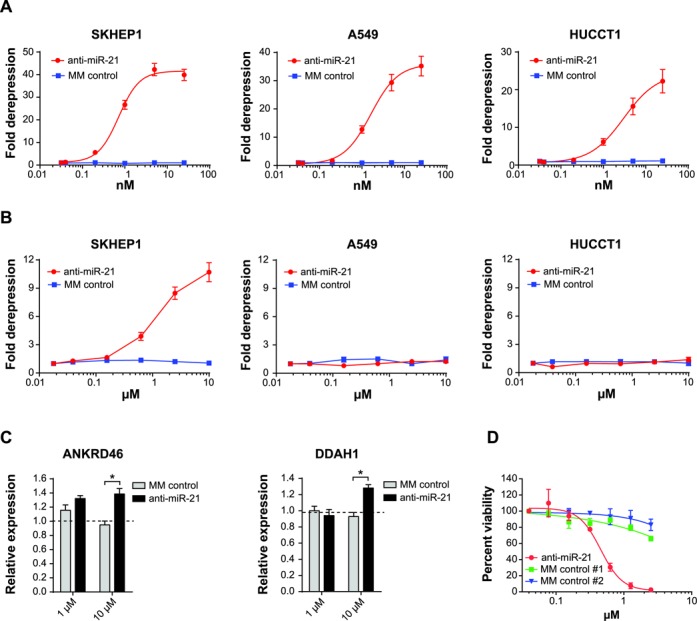
Mechanisms of unassisted delivery of RNA therapeutics, including inhibitors of microRNAs, remain poorly understood. We observed that the hepatocellular carcinoma cell line SKHEP1 retains productive free uptake of a miR-21 inhibitor (anti-miR-21). Uptake of anti-miR-21, but not a mismatch (MM) control, induces expression of known miR-21 targets (DDAH1, ANKRD46) and leads to dose-dependent inhibition of cell growth. To elucidate mechanisms of SKHEP1 sensitivity to anti-miR-21, we conducted an unbiased shRNA screen that revealed tumor susceptibility gene 101 (TSG101), a component of the endosomal sorting complex required for transport (ESCRT-I), as an important determinant of anti-proliferative effects of anti-miR-21. RNA interference-mediated knockdown of TSG101 and another ESCRT-I protein, VPS28, improved uptake of anti-miR-21 in parental SKHEP1 cells and restored productive uptake to SKHEP1 clones with acquired resistance to anti-miR-21. Depletion of ESCRT-I in several additional cancer cell lines with inherently poor uptake resulted in improved activity of anti-miR-21. Finally, knockdown of TSG101 increased uptake of anti-miR-21 by cancer cells in vivo following systemic delivery. Collectively, these data support an important role for the ESCRT-I complex in the regulation of productive free uptake of anti-miRs and reveal potential avenues for improving oligonucleotide free uptake by cancer cells.
包括微小RNA抑制剂在内的RNA治疗药物的非辅助递送机制仍知之甚少。我们观察到,肝癌细胞系SKHEP1能够有效摄取游离的miR-21抑制剂(抗miR-21)。抗miR-21的摄取而非错配(MM)对照诱导了已知miR-21靶标(DDAH1、ANKRD46)的表达,并导致细胞生长的剂量依赖性抑制。为了阐明SKHEP1对抗miR-21敏感的机制,我们进行了一项无偏倚的shRNA筛选,结果显示肿瘤易感基因101(TSG101),即转运所需的内体分选复合物(ESCRT-I)的一个组成部分,是抗miR-21抗增殖作用的重要决定因素。RNA干扰介导的TSG101和另一种ESCRT-I蛋白VPS28的敲低,改善了亲代SKHEP1细胞对抗miR-21的摄取,并使对抗miR-21获得抗性的SKHEP1克隆恢复了有效摄取。在其他几种固有摄取能力较差的癌细胞系中耗尽ESCRT-I导致抗miR-21的活性提高。最后,在全身给药后,TSG101的敲低增加了癌细胞在体内对抗miR-21的摄取。总的来说,这些数据支持了ESCRT-I复合物在调节抗miRs有效游离摄取中的重要作用,并揭示了改善癌细胞对寡核苷酸游离摄取的潜在途径。