Macedo Camila, Gazzola Juliana Maria, Ricci Natalia Aquaroni, Doná Flávia, Ganança Fernando Freitas
Department of Otorhinolaryngology and Head and Neck Surgery, Universidade Federal de São Paulo (UNIFESP), São Paulo, SP, Brazil.
Department of Otorhinolaryngology and Head and Neck Surgery, Universidade Federal de São Paulo (UNIFESP), São Paulo, SP, Brazil.
Braz J Otorhinolaryngol. 2015 Jan-Feb;81(1):50-7. doi: 10.1016/j.bjorl.2014.11.004. Epub 2014 Nov 21.
With aging, the sensory systems suffer an accumulation of degenerative, infectious and/or traumatic processes that may hinder the body balance maintenance.
To assess the influence of sensory information on static body balance of elderly individuals with vestibular disorders.
Cross-sectional study of elderly individuals with vestibular disorders. The Clinical Test of Sensory Interaction and Balance and posturography integrated with virtual reality (Balance Rehabilitation Unit) were used. Posturography parameters analyzed included center of pressure and velocity of body sway.
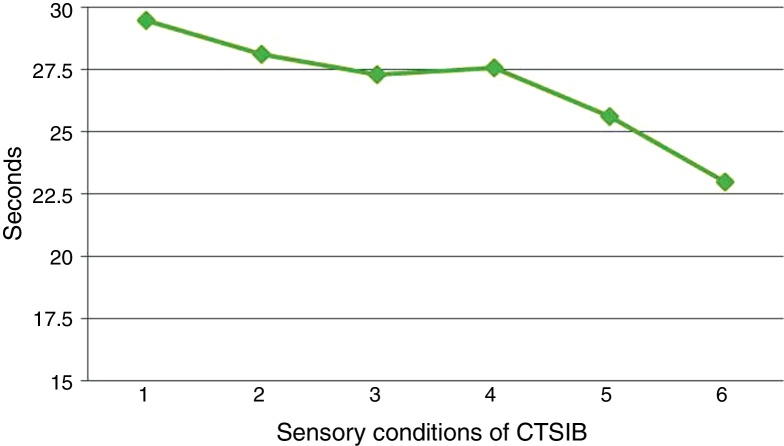
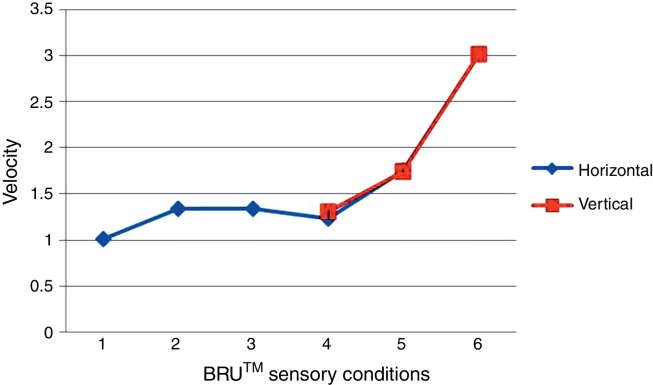
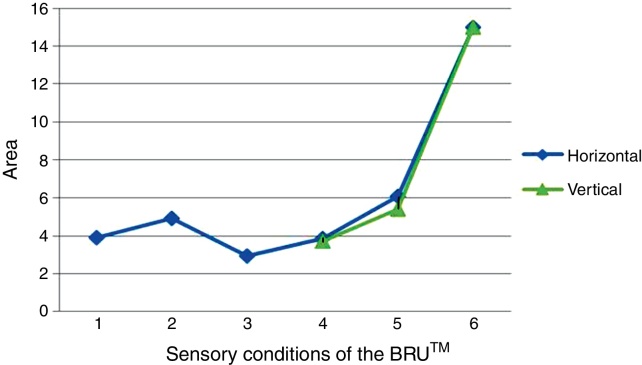
123 individuals with mean age of 73.11 were assessed. Worst performance was observed in the Clinical Test of Sensory Interaction and Balance condition of visual dome-unstable surface. Differences between conditions were: firm surface-open eyes/firm surface-closed eyes, unstable surface-open eyes/unstable surface-closed eyes (p<0.001), and unstable surface-closed eyes/unstable surface-visual dome. Considering center of pressure and velocity of body sway, significant differences were observed between the following conditions: firm surface-open eyes/firm surface-closed eyes: firm surface-saccadic stimulus/firm surface-vertical optokinetic stimulus; firm surface-optokinetic stimuli/firm surface-visual-vestibular interaction; and firm surface-visual-vestibular interaction/unstable surface. Worse performances were observed in conditions firm surface-closed eyes, firm surface-vertical optokinetic stimulus, F-visual-vestibular interaction, and unstable surface-closed eyes. There was a difference in the center of pressure between firm surface-closed eyes/firm surface-saccadic stimulus, with a worse performance in the condition of firm surface-closed eyes, and of velocity of body sway, between firm surface-saccadic stimulus/firm surface-horizontal optokinetic stimulus (p<0.001).
Static body balance in elderly individuals with vestibular disorders is worse when the sensory conditions are more challenging, i.e. stable and unstable surfaces, visual stimuli, such as optokinetic and visual-vestibular interaction, and with the eyes closed.
随着年龄增长,感觉系统会累积退行性、感染性和/或创伤性过程,这些可能会妨碍身体平衡的维持。
评估感觉信息对患有前庭疾病的老年人静态身体平衡的影响。
对患有前庭疾病的老年人进行横断面研究。使用了感觉交互与平衡临床测试以及与虚拟现实相结合的姿势描记法(平衡康复单元)。分析的姿势描记法参数包括压力中心和身体摆动速度。
评估了123名平均年龄为73.11岁的个体。在视觉圆顶 - 不稳定表面的感觉交互与平衡临床测试条件下观察到最差表现。各条件之间的差异为:坚实表面 - 睁眼/坚实表面 - 闭眼、不稳定表面 - 睁眼/不稳定表面 - 闭眼(p<0.001)以及不稳定表面 - 闭眼/不稳定表面 - 视觉圆顶。考虑压力中心和身体摆动速度,在以下条件之间观察到显著差异:坚实表面 - 睁眼/坚实表面 - 闭眼;坚实表面 - 扫视刺激/坚实表面 - 垂直视动刺激;坚实表面 - 视动刺激/坚实表面 - 视觉 - 前庭相互作用;以及坚实表面 - 视觉 - 前庭相互作用/不稳定表面。在坚实表面 - 闭眼、坚实表面 - 垂直视动刺激、F - 视觉 - 前庭相互作用和不稳定表面 - 闭眼条件下观察到更差的表现。在坚实表面 - 闭眼/坚实表面 - 扫视刺激之间的压力中心存在差异,在坚实表面 - 闭眼条件下表现更差,在坚实表面 - 扫视刺激/坚实表面 - 水平视动刺激之间的身体摆动速度也存在差异(p<0.001)。
当感觉条件更具挑战性时,即稳定和不稳定表面、视觉刺激(如视动和视觉 - 前庭相互作用)以及闭眼时,患有前庭疾病的老年人的静态身体平衡更差。