Duff Fiona J, Reen Gurpreet, Plunkett Kim, Nation Kate
Department of Experimental Psychology, University of Oxford, Oxford, UK.
J Child Psychol Psychiatry. 2015 Aug;56(8):848-56. doi: 10.1111/jcpp.12378. Epub 2015 Jan 4.
Strong associations between infant vocabulary and school-age language and literacy skills would have important practical and theoretical implications: Preschool assessment of vocabulary skills could be used to identify children at risk of reading and language difficulties, and vocabulary could be viewed as a cognitive foundation for reading. However, evidence to date suggests predictive ability from infant vocabulary to later language and literacy is low. This study provides an investigation into, and interpretation of, the magnitude of such infant to school-age relationships.
Three hundred British infants whose vocabularies were assessed by parent report in the 2nd year of life (between 16 and 24 months) were followed up on average 5 years later (ages ranged from 4 to 9 years), when their vocabulary, phonological and reading skills were measured.
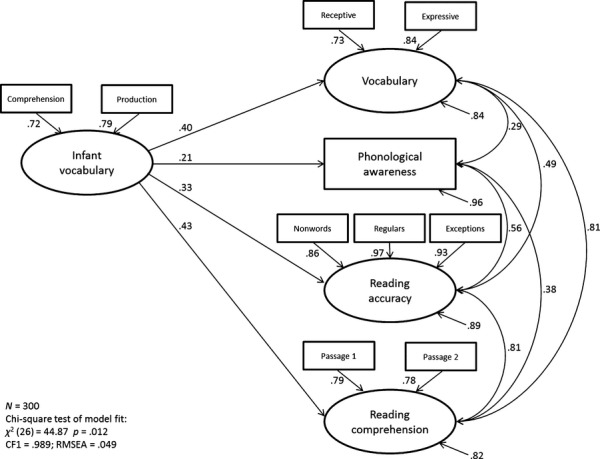
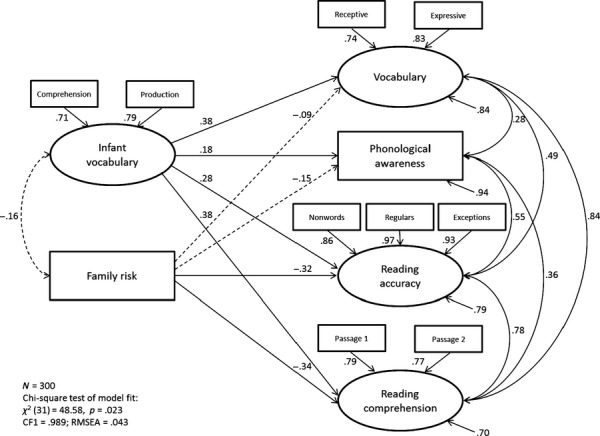
Structural equation modelling of age-regressed scores was used to assess the strength of longitudinal relationships. Infant vocabulary (a latent factor of receptive and expressive vocabulary) was a statistically significant predictor of later vocabulary, phonological awareness, reading accuracy and reading comprehension (accounting for between 4% and 18% of variance). Family risk for language or literacy difficulties explained additional variance in reading (approximately 10%) but not language outcomes.
Significant longitudinal relationships between preliteracy vocabulary knowledge and subsequent reading support the theory that vocabulary is a cognitive foundation of both reading accuracy and reading comprehension. Importantly however, the stability of vocabulary skills from infancy to later childhood is too low to be sufficiently predictive of language outcomes at an individual level - a finding that fits well with the observation that the majority of 'late talkers' resolve their early language difficulties. For reading outcomes, prediction of future difficulties is likely to be improved when considering family history of language/literacy difficulties alongside infant vocabulary levels.
婴儿词汇量与学龄期语言和读写能力之间的紧密关联具有重要的实践和理论意义:学龄前词汇技能评估可用于识别有阅读和语言困难风险的儿童,并且词汇可被视为阅读的认知基础。然而,迄今为止的证据表明,从婴儿词汇量到后期语言和读写能力的预测能力较低。本研究对这种从婴儿期到学龄期的关系的程度进行了调查和解读。
300名英国婴儿在其生命的第二年(16至24个月)通过家长报告评估了词汇量,平均5年后(年龄在4至9岁之间)进行随访,测量他们的词汇量、语音意识和阅读技能。
使用年龄回归分数的结构方程模型来评估纵向关系的强度。婴儿词汇量(接受性和表达性词汇量的潜在因素)是后期词汇量、语音意识、阅读准确性和阅读理解的统计学显著预测指标(解释了4%至18%的方差)。语言或读写困难的家庭风险解释了阅读方面的额外方差(约10%),但未解释语言结果方面的方差。
学前词汇知识与后续阅读之间存在显著的纵向关系,支持了词汇是阅读准确性和阅读理解的认知基础这一理论。然而,重要的是,从婴儿期到儿童后期词汇技能的稳定性过低,无法在个体层面充分预测语言结果——这一发现与大多数“说话晚的孩子”解决其早期语言困难的观察结果非常吻合。对于阅读结果,在考虑婴儿词汇水平的同时考虑语言/读写困难的家族史,可能会改善对未来困难的预测。