Bozkurt Aras Adem, Mustafa Guven, Tarık Akman, Adile Ozkan, Murat Sen Halil, Mesut Kılıcoglu, Yıldıray Kalkan, Coskun Silan, Murat Cosar
Department of Neurosurgery, Çanakkale Onsekiz Mart University, Canakkale, Turkey.
Department of Neurology, Çanakkale Onsekiz Mart University, Canakkale, Turkey.
Neural Regen Res. 2014 Nov 1;9(21):1884-90. doi: 10.4103/1673-5374.145353.
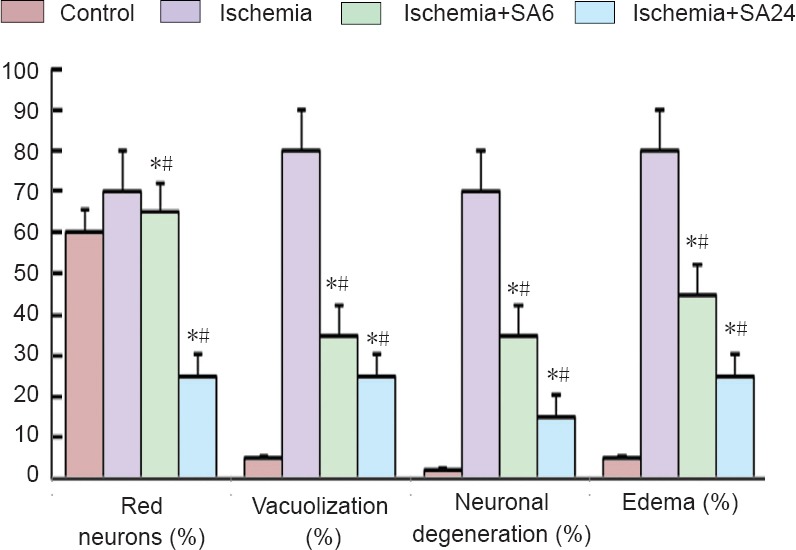
There are few studies on the neuroprotective effects of syringaldehyde in a rat model of cerebral ischemia. The study aimed to elucidate the mechanisms underlying the neuroprotective effects of syringaldehyde on ischemic brain cells. Rat models of cerebral ischemia were intraperitoneally administered syringaldehyde. At 6 and 24 hours after syringaldehyde administration, cell damage in the brain of cerebral ischemia rats was obviously reduced, superoxide dismutase activity and nuclear respiratory factor 1 expression in the brain tissue were markedly increased, malondiadehyde level was obviously decreased, apoptosis-related cysteine peptidase caspase-3 and -9 immunoreactivity was obviously decreased, and neurological function was markedly improved. These findings suggest that syringaldehyde exerts neuroprotective effects on cerebral ischemia injury through anti-oxidation and anti-apoptosis.
关于丁香醛对大鼠脑缺血模型神经保护作用的研究较少。本研究旨在阐明丁香醛对缺血脑细胞神经保护作用的潜在机制。对大鼠脑缺血模型腹腔注射丁香醛。在注射丁香醛后6小时和24小时,脑缺血大鼠脑内的细胞损伤明显减轻,脑组织中超氧化物歧化酶活性和核呼吸因子1表达显著增加,丙二醛水平明显降低,凋亡相关半胱氨酸蛋白酶caspase-3和-9免疫反应性明显降低,神经功能显著改善。这些结果表明,丁香醛通过抗氧化和抗凋亡对脑缺血损伤发挥神经保护作用。