Normandeau Eric, Hutchings Jeffrey A, Fraser Dylan J, Bernatchez Louis
Département de Biologie, Université Laval Québec, Canada.
Department of Biology, Dalhousie University Halifax, Nova Scotia, Canada.
Evol Appl. 2009 Nov;2(4):489-503. doi: 10.1111/j.1752-4571.2009.00074.x. Epub 2009 Jul 3.
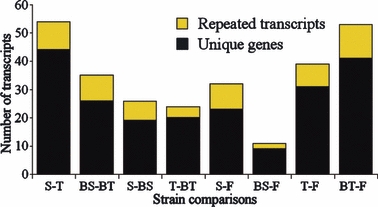
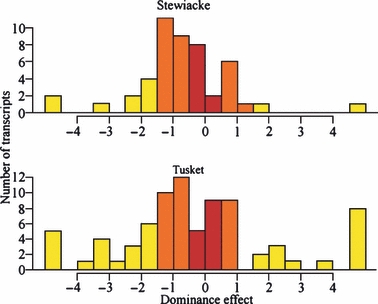
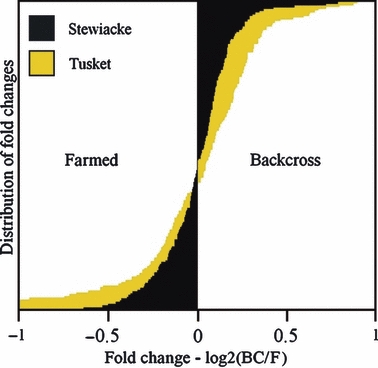
Because of intrinsic differences in their genetic architectures, wild populations invaded by domesticated individuals could experience population-specific consequences following introgression by genetic material of domesticated origin. Expression levels of 16 000 transcripts were quantified by microarrays in liver tissue from farm, wild, and farm-wild backcross (i.e. F1 farm-wild hybrid × wild; total n = 50) Atlantic salmon (Salmo salar) raised under common environmental conditions. The wild populations and farm strain originated from three North American rivers in eastern Canada (Stewiacke, Tusket, and Saint John rivers, respectively). Analysis of variance revealed 177 transcripts with different expression levels among the five strains compared. Five times more of these transcripts were differentiated between farmed parents and Tusket backcrosses (n = 53) than between Stewiacke backcrosses and their farmed parents (n = 11). Altered biological processes in backcrosses also differed between populations both in number and in the type of processes impacted (metabolism vs immunity). Over-dominant gene expression regulation in backcrosses varied considerably between populations (23% in Stewiacke vs 44% in Tusket). Hence, the consequences of introgression of farm genetic material on gene expression depended on population-specific genetic architectures. These results support the need to evaluate impacts of farm-wild genetic interactions at the population scale.
由于其基因结构存在内在差异,被驯化个体入侵的野生种群在被驯化来源的遗传物质渗入后可能会经历特定种群的后果。通过微阵列对在共同环境条件下饲养的养殖、野生和养殖 - 野生回交(即 F1 养殖 - 野生杂交种×野生;总数 n = 50)大西洋鲑(Salmo salar)肝脏组织中 16000 个转录本的表达水平进行了定量。野生种群和养殖品系分别起源于加拿大东部的三条北美河流(分别为斯特维亚克河、塔斯凯特河和圣约翰河)。方差分析显示,在比较的五个品系中,有 177 个转录本具有不同的表达水平。在养殖亲本与塔斯凯特回交后代(n = 53)之间区分出的这些转录本数量是斯特维亚克回交后代与其养殖亲本(n = 11)之间的五倍。回交后代中生物过程的改变在不同种群之间也存在数量和受影响过程类型(代谢与免疫)的差异。回交后代中显性超亲基因表达调控在不同种群之间差异很大(斯特维亚克为 23%,塔斯凯特为 44%)。因此,养殖遗传物质渗入对基因表达的影响取决于特定种群的基因结构。这些结果支持了在种群规模上评估养殖 - 野生基因相互作用影响的必要性。