
一项关于地诺单抗对印度绝经后骨质疏松症女性疗效的随机安慰剂对照试验。
A randomized placebo-controlled trial of the efficacy of denosumab in Indian postmenopausal women with osteoporosis.
作者信息
Pitale Shailesh, Thomas Mathew, Rathi Gaurav, Deshmukh Vaishali, Kumar Prasanna, Reddy Sanjay, Shetty Naresh, Kakar Atul, Babhulkar Sushrut, Mody Bharat, Chacko Jacob, Acharya Sudeep, Joglekar Sadhna, Halbe Vipul, Kravitz Barbara G, Waterhouse Brian, Nino Antonio J, Fitzpatrick Lorraine A
机构信息
Pitale Diabetes and Hormone Centre, Nagpur, Maharashtra, India.
Health and Research Centre, Trivandrum, Kerala, India.
出版信息
Indian J Endocrinol Metab. 2015 Jan-Feb;19(1):148-54. doi: 10.4103/2230-8210.146871.
INTRODUCTION
Osteoporosis is a serious condition affecting up to 50% of Indian postmenopausal women. Denosumab reduces bone resorption by targeting the receptor activator of nuclear factor-κB ligand. This study assessed the efficacy and safety of denosumab in Indian postmenopausal women with osteoporosis.
MATERIALS AND METHODS
In this double-blind, multicenter, phase 3 study, 250 Indian postmenopausal women aged 55 to 75 years (T-score <-2.5 and >-4.0 at the lumbar spine or total hip; serum 25(OH) D levels ≥20 ng/mL) were randomized to receive one subcutaneous dose of denosumab 60 mg or placebo. All subjects received oral calcium ≥1000 mg and vitamin D3 ≥ 400 IU daily. The primary end point was mean percent change in bone mineral density (BMD) at the lumbar spine from baseline to Month 6. Secondary end points included mean percent change from baseline in BMD at total hip, femoral neck, and trochanter at Month 6 and median percent change from baseline in bone turnover markers at Months 1, 3, and 6.
RESULTS
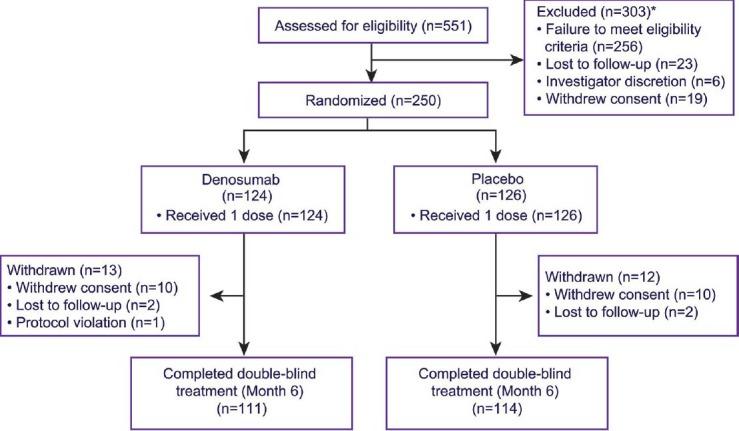
Total 225 subjects (denosumab = 111, placebo = 114) completed the six-month study. Baseline demographics were similar between groups. A 3.1% (95% confidence interval, 1.9%, 4.2%) increase favoring denosumab versus placebo was seen for the primary end point (P < 0.0001). Denosumab demonstrated a significant treatment benefit over placebo for the secondary end points. There were no fractures or withdrawals due to adverse events.
CONCLUSIONS
Consistent with results from studies conducted in other parts of the world, denosumab was well tolerated and effective in increasing BMD and decreasing bone turnover markers over a six-month period in Indian postmenopausal women.
引言
骨质疏松症是一种严重疾病,影响着多达50%的印度绝经后女性。地诺单抗通过作用于核因子κB受体活化因子配体来减少骨吸收。本研究评估了地诺单抗在患有骨质疏松症的印度绝经后女性中的疗效和安全性。
材料与方法
在这项双盲、多中心、3期研究中,250名年龄在55至75岁之间的印度绝经后女性(腰椎或全髋部的T值<-2.5且>-4.0;血清25(OH)D水平≥20 ng/mL)被随机分配接受一次皮下注射60 mg地诺单抗或安慰剂。所有受试者每天口服钙≥1000 mg和维生素D3≥400 IU。主要终点是从基线到第6个月时腰椎骨密度(BMD)的平均变化百分比。次要终点包括第6个月时全髋部、股骨颈和大转子处BMD相对于基线的平均变化百分比,以及第1、3和6个月时骨转换标志物相对于基线的中位变化百分比。
结果
共有225名受试者(地诺单抗组 = 111名,安慰剂组 = 114名)完成了为期6个月的研究。两组之间的基线人口统计学特征相似。主要终点显示,与安慰剂相比,地诺单抗组有3.1%(95%置信区间,1.9%,4.2%)的增加(P<0.0001)。地诺单抗在次要终点上显示出比安慰剂显著的治疗优势。没有因不良事件导致的骨折或退出研究的情况。
结论
与在世界其他地区进行的研究结果一致,在印度绝经后女性中,地诺单抗在6个月期间耐受性良好,在增加骨密度和降低骨转换标志物方面有效。




 Zotero 插件