Department of Geriatrics, Neurosciences and Orthopedics, Catholic University of the Sacred Heart , Rome , Italy.
Department of Chemistry, Sapienza University of Rome , Rome , Italy.
Front Med (Lausanne). 2014 Sep 1;1:27. doi: 10.3389/fmed.2014.00027. eCollection 2014.
Chronic, low-grade inflammation and declining physical function are hallmarks of the aging process. However, previous attempts to correlate individual inflammatory biomarkers with physical performance in older people have produced mixed results. Given the complexity of the inflammatory response, the simultaneous analysis of an array of inflammatory mediators may provide more insights into the relationship between inflammation and age-related physical function decline. This study was designed to explore the association between a panel of inflammatory markers and physical performance in older adults through a multivariate statistical approach.
Community-dwelling older persons were categorized into "normal walkers" (NWs; n = 27) or "slow walkers" (SWs; n = 11) groups using 0.8 m s(-1) as the 4-m gait speed cutoff. A panel of 14 circulating inflammatory biomarkers was assayed by multiplex analysis. Partial least squares-discriminant analysis (PLS-DA) was used to identify patterns of inflammatory mediators associated with gait speed categories.
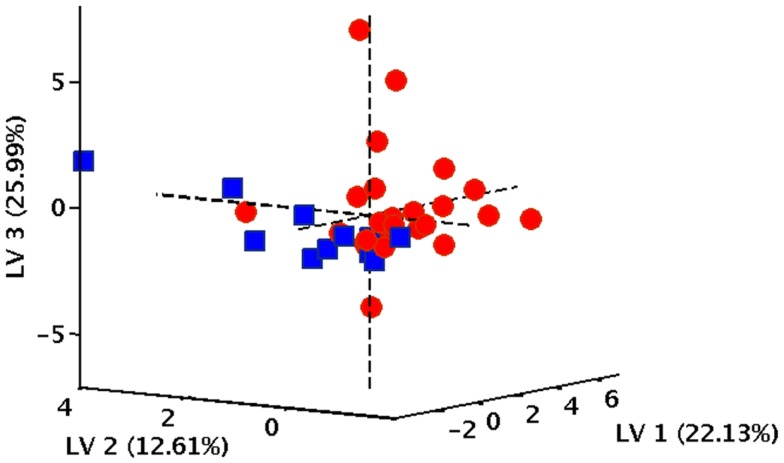
The optimal complexity of the PLS-DA model was found to be five latent variables. The proportion of correct classification was 88.9% for NW subjects (74.1% in cross-validation) and 90.9% for SW individuals (81.8% in cross-validation). Discriminant biomarkers in the model were interleukin 8, myeloperoxidase, and tumor necrosis factor alpha (all higher in the SW group), and P-selectin, interferon gamma, and granulocyte-macrophage colony-stimulating factor (all higher in the NW group).
Distinct profiles of circulating inflammatory biomarkers characterize older subjects with different levels of physical performance. The dissection of these patterns may provide novel insights into the role played by inflammation in the disabling cascade and possible new targets for interventions.
慢性、低水平炎症和身体功能下降是衰老过程的标志。然而,先前将个体炎症生物标志物与老年人身体表现相关联的尝试得出了混合结果。鉴于炎症反应的复杂性,同时分析一系列炎症介质可能会更深入地了解炎症与与年龄相关的身体功能下降之间的关系。本研究旨在通过多变量统计方法探讨炎症标志物与老年人身体表现之间的关联。
通过 0.8 m/s 作为 4 米步行速度的截值,将社区居住的老年人分为“正常步行者”(NW;n=27)或“缓慢步行者”(SW;n=11)组。通过多重分析测定了 14 种循环炎症生物标志物的面板。偏最小二乘判别分析(PLS-DA)用于识别与步行速度类别相关的炎症介质模式。
发现 PLS-DA 模型的最佳复杂度为五个潜在变量。NW 受试者的正确分类比例为 88.9%(交叉验证中为 74.1%),SW 个体为 90.9%(交叉验证中为 81.8%)。模型中的判别生物标志物为白细胞介素 8、髓过氧化物酶和肿瘤坏死因子-α(所有这些标志物在 SW 组中更高),以及 P 选择素、干扰素-γ和粒细胞-巨噬细胞集落刺激因子(所有这些标志物在 NW 组中更高)。
具有不同身体表现水平的老年人具有不同的循环炎症生物标志物特征。对这些模式的剖析可能会深入了解炎症在致残级联反应中所起的作用,并为干预提供新的可能靶点。