
一氧化氮供体增加多发性骨髓瘤细胞中PVR/CD155 DNAM-1配体的表达:DNA损伤反应激活的作用
Nitric oxide donors increase PVR/CD155 DNAM-1 ligand expression in multiple myeloma cells: role of DNA damage response activation.
作者信息
Fionda Cinzia, Abruzzese Maria Pia, Zingoni Alessandra, Soriani Alessandra, Ricci Biancamaria, Molfetta Rosa, Paolini Rossella, Santoni Angela, Cippitelli Marco
机构信息
Department of Molecular Medicine, Istituto Pasteur-Fondazione Cenci Bolognetti, Sapienza University of Rome, Viale Regina Elena 291, 00161, Rome, Italy.
Istituto Mediterraneo di Neuroscienze Neuromed, Pozzilli, IS, Italy.
出版信息
BMC Cancer. 2015 Jan 22;15:17. doi: 10.1186/s12885-015-1023-5.
BACKGROUND
DNAX accessory molecule-1 (DNAM-1) is an activating receptor constitutively expressed by macrophages/dendritic cells and by T lymphocytes and Natural Killer (NK) cells, having an important role in anticancer responses; in this regard, combination therapies able to enhance the expression of DNAM-1 ligands on tumor cells are of therapeutic interest. In this study, we investigated the effect of different nitric oxide (NO) donors on the expression of the DNAM-1 ligand Poliovirus Receptor/CD155 (PVR/CD155) in multiple myeloma (MM) cells.
METHODS
Six MM cell lines, SKO-007(J3), U266, OPM-2, RPMI-8226, ARK and LP1 were used to investigate the activity of different nitric oxide donors [DETA-NO and the NO-releasing prodrugs NCX4040 (NO-aspirin) and JS-K] on the expression of PVR/CD155, using Flow Cytometry and Real-Time PCR. Western-blot and specific inhibitors were employed to investigate the role of soluble guanylyl cyclase/cGMP and activation of the DNA damage response (DDR).
RESULTS
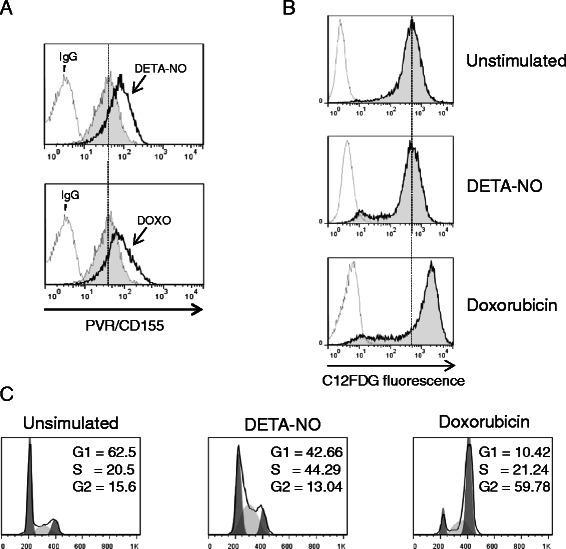
Our results indicate that increased levels of nitric oxide can upregulate PVR/CD155 cell surface and mRNA expression in MM cells; in addition, exposure to nitric oxide donors renders myeloma cells more efficient to activate NK cell degranulation and enhances their ability to trigger NK cell-mediated cytotoxicity. We found that activation of the soluble guanylyl cyclase and increased cGMP concentrations by nitric oxide is not involved in the up-regulation of ligand expression. On the contrary, treatment of MM cells with nitric oxide donors correlated with the activation of a DNA damage response pathway and inhibition of the ATM /ATR/Chk1/2 kinase activities by specific inhibitors significantly abrogates up-regulation.
CONCLUSIONS
The present study provides evidence that regulation of the PVR/CD155 DNAM-1 ligand expression by nitric oxide may represent an additional immune-mediated mechanism and supports the anti-myeloma activity of nitric oxide donors.
背景
DNAX辅助分子-1(DNAM-1)是一种激活受体,由巨噬细胞/树突状细胞、T淋巴细胞和自然杀伤(NK)细胞组成性表达,在抗癌反应中起重要作用;在这方面,能够增强肿瘤细胞上DNAM-1配体表达的联合疗法具有治疗意义。在本研究中,我们研究了不同一氧化氮(NO)供体对多发性骨髓瘤(MM)细胞中DNAM-1配体脊髓灰质炎病毒受体/CD155(PVR/CD155)表达的影响。
方法
使用六种MM细胞系SKO-007(J3)、U266、OPM-2、RPMI-8226、ARK和LP1,采用流式细胞术和实时定量PCR研究不同一氧化氮供体[DETA-NO以及释放NO的前药NCX4040(NO-阿司匹林)和JS-K]对PVR/CD155表达的活性。采用蛋白质免疫印迹法和特异性抑制剂研究可溶性鸟苷酸环化酶/cGMP的作用以及DNA损伤反应(DDR)的激活。
结果
我们的结果表明,一氧化氮水平的升高可上调MM细胞中PVR/CD155的细胞表面和mRNA表达;此外,暴露于一氧化氮供体使骨髓瘤细胞更有效地激活NK细胞脱颗粒,并增强其触发NK细胞介导的细胞毒性的能力。我们发现一氧化氮激活可溶性鸟苷酸环化酶并增加cGMP浓度与配体表达的上调无关。相反,用一氧化氮供体处理MM细胞与DNA损伤反应途径的激活相关,并且特异性抑制剂抑制ATM /ATR/Chk1/2激酶活性可显著消除上调。
结论
本研究提供了证据,表明一氧化氮对PVR/CD155 DNAM-1配体表达的调节可能代表一种额外的免疫介导机制,并支持一氧化氮供体的抗骨髓瘤活性。


 Zotero 插件