Stoltey Juliet E, Li Ye, Bernstein Kyle T, Philip Susan S
Division of Infectious Diseases, University of California, San Francisco, California, USA.
Public Health Ontario, Toronto, Ontario, Canada Dalla Lana School of Public Health, University of Toronto, Toronto, Ontario, Canada.
Sex Transm Infect. 2015 Aug;91(5):370-4. doi: 10.1136/sextrans-2014-051740. Epub 2015 Jan 21.
Incarceration has been linked to increased risk of sexually transmitted infections (STIs). We conducted a census tract-level ecological analysis to explore the relationship between neighbourhood incarceration rates and chlamydia incidence among adolescent girls and young women under age 25 in San Francisco in 2010 to focus public health efforts in neighbourhoods at risk.
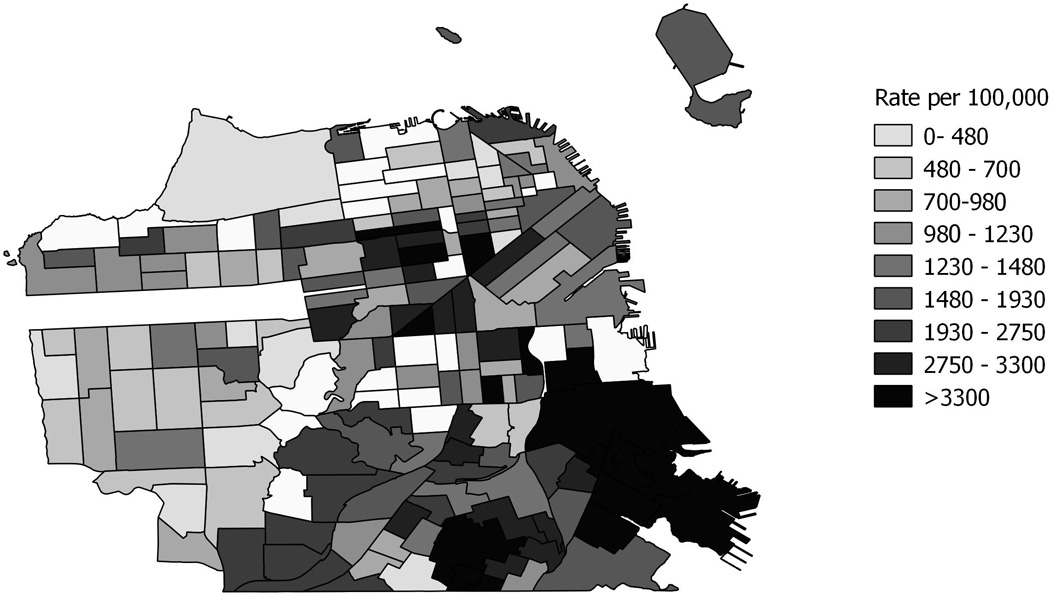
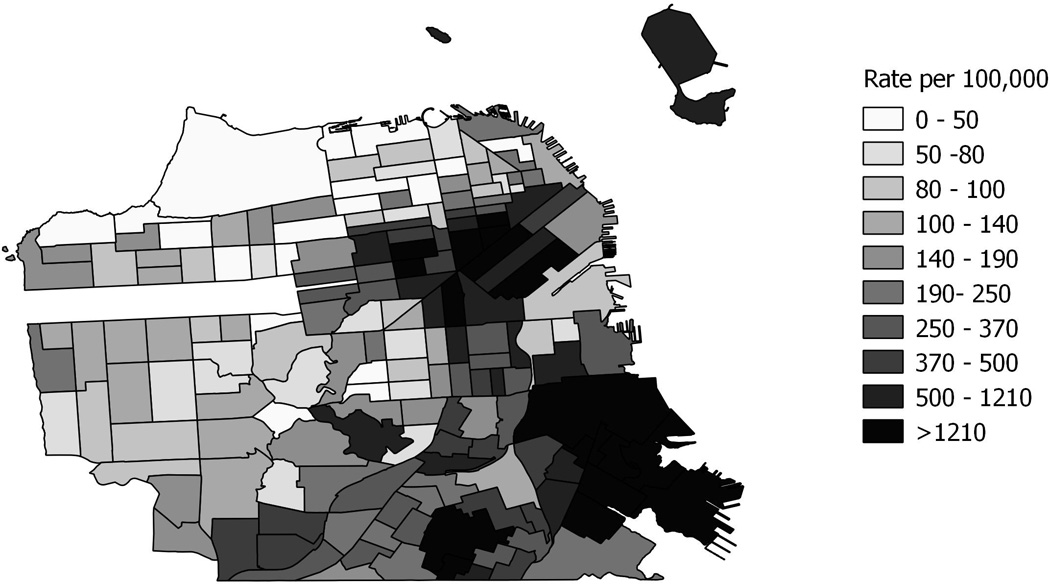
Female chlamydial cases under age 25 that were reported to the San Francisco Department of Public Health in 2010 were geocoded to census tract, and chlamydia incidence was calculated. Addresses of incarcerated individuals were geocoded, and census tract-specific incarceration was estimated. American Community Survey data from 2005 to 2009 provided tract-specific survey estimates of demographic and socioeconomic characteristics of communities to allow for evaluation of potential census tract-level confounders. A Poisson mixed model was used to assess the relationship of census tract-level incarceration rate with chlamydial case rate.
Accounting for spatial dependence in neighbouring regions, there was a positive association between incarceration rates and chlamydia incidence in young women under age 25 in San Francisco, and this association decreased as poverty increased, after controlling for other risk factors in the model.
This ecological analysis supports the neighbourhood role of incarceration in the risk of chlamydia among young women. These results have important implications for directing limited public health resources to local areas at risk in order to geographically focus prevention interventions and provide improved access to STI services in specific neighbourhoods with high incarceration rates.
监禁与性传播感染(STIs)风险增加有关。我们进行了一项普查区层面的生态分析,以探究2010年旧金山25岁以下少女和年轻女性的邻里监禁率与衣原体发病率之间的关系,从而将公共卫生工作重点放在有风险的邻里地区。
2010年向旧金山公共卫生部报告的25岁以下女性衣原体病例被地理编码到普查区,并计算衣原体发病率。被监禁者的地址进行了地理编码,并估计了特定普查区的监禁情况。2005年至2009年的美国社区调查数据提供了特定普查区对社区人口和社会经济特征的调查估计,以便评估潜在的普查区层面的混杂因素。使用泊松混合模型评估普查区层面的监禁率与衣原体病例率之间的关系。
考虑到相邻地区的空间依赖性,旧金山25岁以下年轻女性的监禁率与衣原体发病率之间存在正相关,并且在控制模型中的其他风险因素后,这种关联随着贫困程度的增加而减弱。
这项生态分析支持监禁在年轻女性衣原体风险中的邻里作用。这些结果对于将有限的公共卫生资源导向有风险的当地地区具有重要意义,以便在地理上集中预防干预措施,并在监禁率高的特定邻里地区改善性传播感染服务的可及性。