Nyati Kishan Kumar, Prasad Kashi Nath
Laboratory of Immune Regulation, Immunology Frontier Research Center, Osaka University, Osaka 5650871, Japan.
Department of Microbiology, Sanjay Gandhi Postgraduate Institute of Medical Sciences, Raebareli Road, Lucknow 226014, India.
Mediators Inflamm. 2014;2014:758639. doi: 10.1155/2014/758639. Epub 2014 Sep 22.
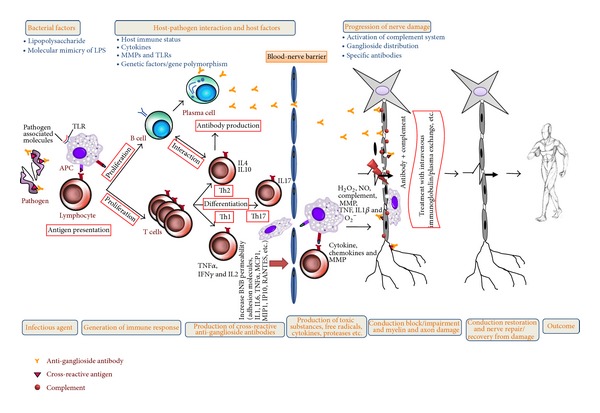
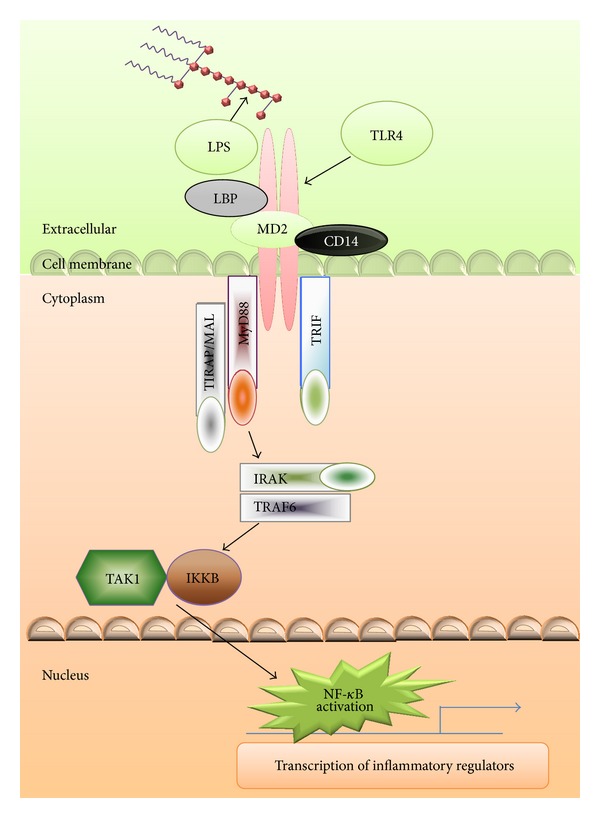
Guillain-Barré syndrome (GBS) is an autoimmune disease of the peripheral nervous system, mostly triggered by an aberrant immune response to an infectious pathogen. Although several infections have been implicated in the pathogenesis of GBS, not all such infected individuals develop this disease. Moreover, infection with a single agent might also lead to different subtypes of GBS emphasizing the role of host factors in the development of GBS. The host factors regulate a broad range of inflammatory processes that are involved in the pathogenesis of autoimmune diseases including GBS. Evidences suggest that systemically and locally released cytokines and their involvement in immune-mediated demyelination and axonal damage of peripheral nerves are important in the pathogenesis of GBS. Toll-like receptors (TLRs) link innate and adaptive immunity through transcription of several proinflammatory cytokines. TLR genes may increase susceptibility to microbial infections; an attenuated immune response towards antigen and downregulation of cytokines occurs due to mutation in the gene. Herein, we discuss the crucial role of host factors such as cytokines and TLRs that activate the immune response and are involved in the pathogenesis of the disease.
吉兰-巴雷综合征(GBS)是一种外周神经系统的自身免疫性疾病,主要由对感染性病原体的异常免疫反应引发。尽管几种感染与GBS的发病机制有关,但并非所有受感染个体都会患上这种疾病。此外,感染单一病原体也可能导致不同亚型的GBS,这凸显了宿主因素在GBS发病过程中的作用。宿主因素调节着广泛的炎症过程,这些过程参与包括GBS在内的自身免疫性疾病的发病机制。有证据表明,全身和局部释放的细胞因子及其参与外周神经免疫介导的脱髓鞘和轴突损伤在GBS的发病机制中很重要。Toll样受体(TLR)通过几种促炎细胞因子的转录连接天然免疫和适应性免疫。TLR基因可能会增加对微生物感染的易感性;由于基因中的突变,对抗原的免疫反应减弱以及细胞因子下调。在此,我们讨论细胞因子和TLR等宿主因素在激活免疫反应并参与疾病发病机制中的关键作用。