Poisot Timothée, Bever James D, Thrall Peter H, Hochberg Michael E
Université Montpellier II, Institut des Sciences de l'Evolution, UMR 5554 Place Eugène Bataillon, 34095, Montpellier, CEDEX 05, France ; Département de Biologie, Université du Québec à Rimouski 300 Allée des Ursulines, Rimouski, Quebec, G5L 3A1, Canada ; Québec Centre for Biodiversity Sciences Montréal (QC), Canada ; School of Biological Sciences, University of Canterbury Private Bag, 4800, Christchurch, 8140, New Zealand.
Department of Biology, Indiana University Bloomington, Indiana, 47405.
Ecol Evol. 2014 Oct;4(19):3841-50. doi: 10.1002/ece3.1151.
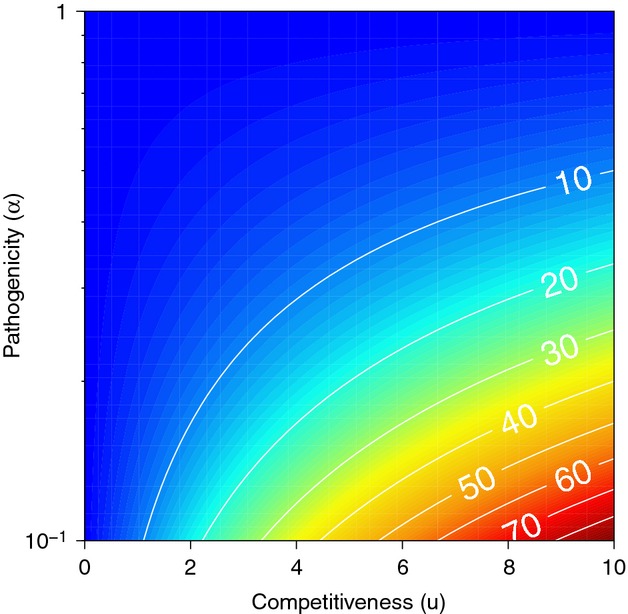
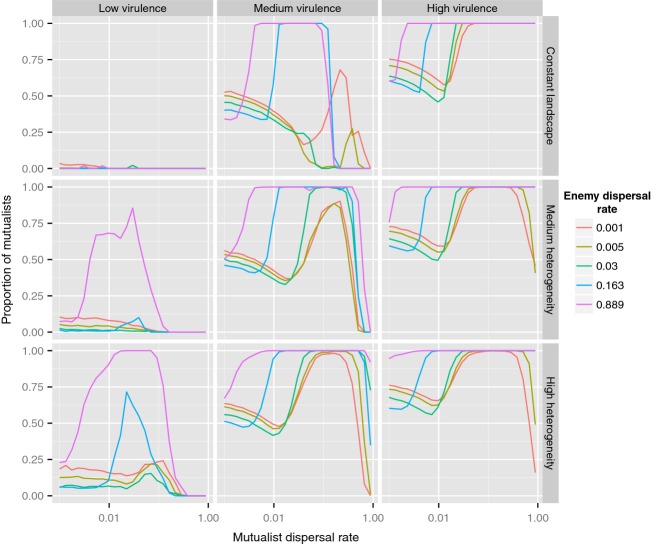
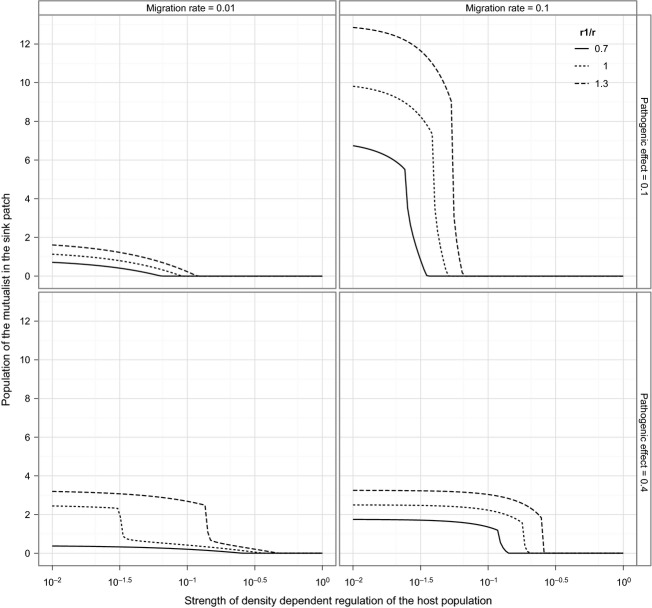
Protective mutualisms, where a symbiont reduces the negative effects of another species on a shared host, represent a common type of species interaction in natural communities, yet it is still unclear what ecological conditions might favor their emergence. Studies suggest that the initial evolution of protective mutualists might involve closely related pathogenic variants with similar life histories, but different competitive abilities and impacts on host fitness. We derive a model to evaluate this hypothesis and show that, in general, a protective variant cannot spread from rarity or exclude a more pathogenic strain. While the conditions allowing mutualist invasion are more likely with increased environmental productivity, they still depend on initial densities in the invaded patch exceeding a threshold, highlighting the likely importance of spatial structure and demographic stochasticity. Using a numerical simulation approach, we show that regional coexistence is in fact possible in an explicitly spatial system and that, under some circumstances, the mutualist population can exclude the enemy. More broadly, the establishment of protective mutualists may be favored when there are other life-history differences from more pathogenic symbionts, such as vertical transmission or additional direct benefits to hosts.
保护性共生关系是指共生体减少另一个物种对共享宿主的负面影响,这是自然群落中常见的一种物种相互作用类型,但目前仍不清楚哪些生态条件可能有利于其出现。研究表明,保护性共生体的最初进化可能涉及具有相似生活史,但竞争能力和对宿主适应性影响不同的密切相关的致病变体。我们推导了一个模型来评估这一假设,并表明,一般来说,一个保护性变体不能从稀有状态传播开来,也不能排除更具致病性的菌株。虽然随着环境生产力的提高,共生体入侵的条件更有可能出现,但它们仍然取决于被入侵斑块中的初始密度超过一个阈值,这突出了空间结构和种群统计学随机性的可能重要性。使用数值模拟方法,我们表明,在一个明确的空间系统中,区域共存实际上是可能的,并且在某些情况下,共生体种群可以排除敌人。更广泛地说,当与更具致病性的共生体存在其他生活史差异时,如垂直传播或对宿主的额外直接益处,保护性共生体的建立可能会受到青睐。