Prochaska Jürgen H, Göbel Sebastian, Keller Karsten, Coldewey Meike, Ullmann Alexander, Lamparter Heidrun, Jünger Claus, Al-Bayati Zaid, Baer Christina, Walter Ulrich, Bickel Christoph, ten Cate Hugo, Münzel Thomas, Wild Philipp S
Center for Thrombosis and Hemostasis, University Medical Center Mainz, Johannes Gutenberg University Mainz, Langenbeckstr. 1, 55131, Mainz, Germany.
2. Medizinische Klinik und Poliklinik, University Medical Center Mainz, Johannes Gutenberg University Mainz, Langenbeckstr. 1, 55131, Mainz, Germany.
BMC Med. 2015 Jan 23;13:14. doi: 10.1186/s12916-015-0268-9.
The majority of studies on quality of oral anticoagulation (OAC) therapy with vitamin K-antagonists are performed with short-acting warfarin. Data on long-acting phenprocoumon, which is frequently used in Europe for OAC therapy and is considered to enable more stable therapy adjustment, are scarce. In this study, we aimed to assess quality of OAC therapy with phenprocoumon in regular medical care and to evaluate its potential for optimization in a telemedicine-based coagulation service.
In the prospective observational cohort study program thrombEVAL we investigated 2,011 patients from regular medical care in a multi-center cohort study and 760 patients from a telemedicine-based coagulation service in a single-center cohort study. Data were obtained from self-reported data, computer-assisted personal interviews, and laboratory measurements according to standard operating procedures with detailed quality control. Time in therapeutic range (TTR) was calculated by linear interpolation method to assess quality of OAC therapy. Study monitoring was carried out by an independent institution.
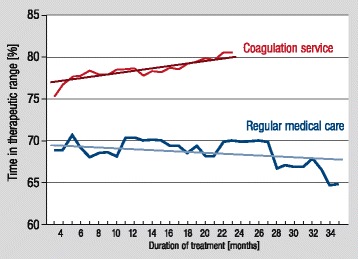
Overall, 15,377 treatment years and 48,955 international normalized ratio (INR) measurements were analyzed. Quality of anticoagulation, as measured by median TTR, was 66.3% (interquartile range (IQR) 47.8/81.9) in regular medical care and 75.5% (IQR 64.2/84.4) in the coagulation service (P <0.001). Stable anticoagulation control within therapeutic range was achieved in 63.8% of patients in regular medical care with TTR at 72.1% (IQR 58.3/84.7) as compared to 96.4% of patients in the coagulation service with TTR at 76.2% [(IQR 65.6/84.7); P = 0.001)]. Prospective follow-up of coagulation service patients with pretreatment in regular medical care showed an improvement of the TTR from 66.2% (IQR 49.0/83.6) to 74.5% (IQR 62.9/84.2; P <0.0001) in the coagulation service. Treatment in the coagulation service contributed to an optimization of the profile of time outside therapeutic range, a 2.2-fold increase of stabile INR adjustment and a significant decrease in TTR variability by 36% (P <0.001).
Quality of anticoagulation with phenprocoumon was comparably high in this real-world sample of regular medical care. Treatment in a telemedicine-based coagulation service substantially improved quality of OAC therapy with regard to TTR level, frequency of stable anticoagulation control, and TTR variability.
ClinicalTrials.gov, unique identifier NCT01809015, March 8, 2013.
大多数关于维生素K拮抗剂口服抗凝(OAC)治疗质量的研究是使用短效华法林进行的。在欧洲,长效苯丙香豆素常用于OAC治疗,且被认为能使治疗调整更稳定,但相关数据较少。在本研究中,我们旨在评估常规医疗中苯丙香豆素的OAC治疗质量,并评估其在基于远程医疗的凝血服务中优化的潜力。
在“thrombEVAL”前瞻性观察队列研究项目中,我们在一项多中心队列研究中调查了2011例来自常规医疗的患者,在一项单中心队列研究中调查了760例来自基于远程医疗的凝血服务的患者。数据通过自我报告数据、计算机辅助个人访谈以及根据详细质量控制的标准操作程序进行的实验室测量获得。通过线性插值法计算治疗范围内时间(TTR)以评估OAC治疗质量。研究监测由一个独立机构进行。
总体而言,共分析了15377个治疗年和48955次国际标准化比值(INR)测量值。以TTR中位数衡量的抗凝质量,在常规医疗中为66.3%(四分位间距(IQR)47.8/81.9),在凝血服务中为75.5%(IQR 64.2/84.4)(P<0.001)。在常规医疗中,63.8%的患者在治疗范围内实现了稳定的抗凝控制,TTR为72.1%(IQR 58.3/84.7),相比之下,在凝血服务中,96.4%的患者TTR为76.2%(IQR 65.6/84.7)(P = 0.001)。对在常规医疗中进行预处理的凝血服务患者进行前瞻性随访显示,在凝血服务中TTR从66.2%(IQR 49.0/83.6)提高到74.5%(IQR 62.9/84.2;P<0.0001)。凝血服务中的治疗有助于优化治疗范围外时间的分布,使稳定的INR调整增加2.2倍,并使TTR变异性显著降低36%(P<0.001)。
在这个常规医疗的真实世界样本中,苯丙香豆素的抗凝质量相当高。基于远程医疗的凝血服务中的治疗在TTR水平、稳定抗凝控制频率和TTR变异性方面显著提高了OAC治疗质量。
ClinicalTrials.gov,唯一标识符NCT01809015,2013年3月8日。