Hatano Kentaro, Sekimata Katsuhiko, Yamada Takashi, Abe Junichiro, Ito Kengo, Ogawa Mikako, Magata Yasuhiro, Toyohara Jun, Ishiwata Kiichi, Biggio Giovanni, Serra Mariangela, Laquintana Valentino, Denora Nunzio, Latrofa Andrea, Trapani Giuseppe, Liso Gaetano, Suzuki Hiromi, Sawada Makoto, Nomura Masahiko, Toyama Hiroshi
Department of Clinical and Experimental Neuroimaging, Center for Development of Advanced Medicine for Dementia, National Center for Geriatrics and Gerontology, Obu, Aichi, 474-8522, Japan,
Ann Nucl Med. 2015 May;29(4):325-35. doi: 10.1007/s12149-015-0948-8. Epub 2015 Jan 24.
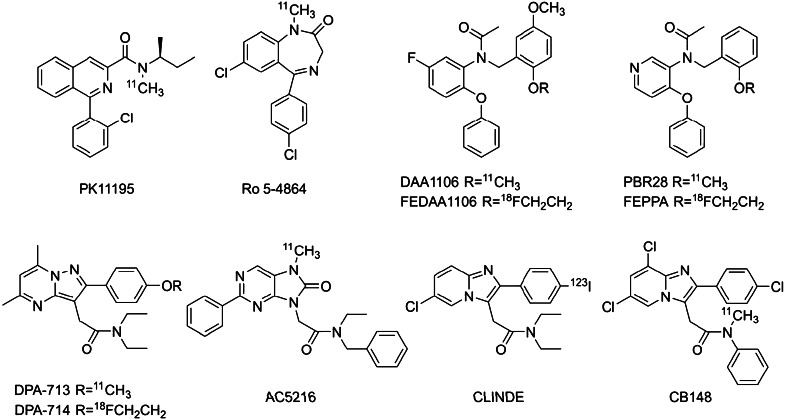
We report synthesis of two carbon-11 labeled imidazopyridines TSPO ligands, [(11)C]CB184 and [(11)C]CB190, for PET imaging of inflammatory process along with neurodegeneration, ischemia or brain tumor. Biodistribution of these compounds was compared with that of [(11)C]CB148 and (11)C-PK11195.
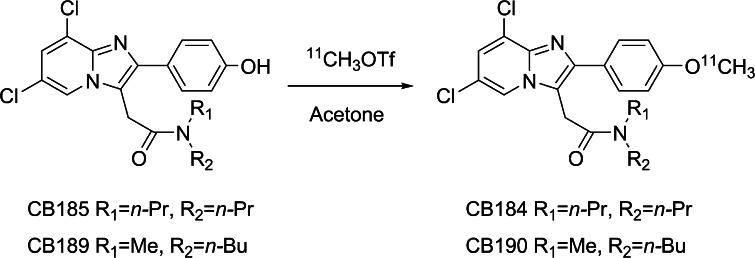
Both [(11)C]CB184 and [(11)C]CB190 having (11)C-methoxyl group on an aromatic ring were readily prepared using [(11)C]methyl triflate. Biodistribution and metabolism of the compounds were examined with normal mice. An animal PET study using 6-hydroxydopamine treated rats as a model of neurodegeneration was pursued for proper estimation of feasibility of the radioligands to determine neuroinflammation process.
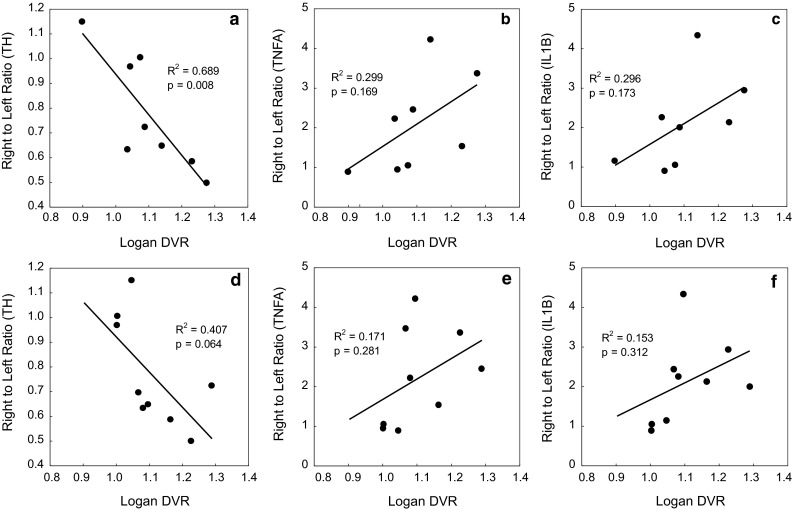
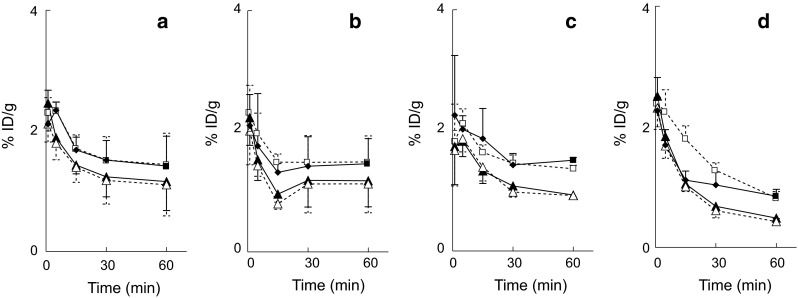
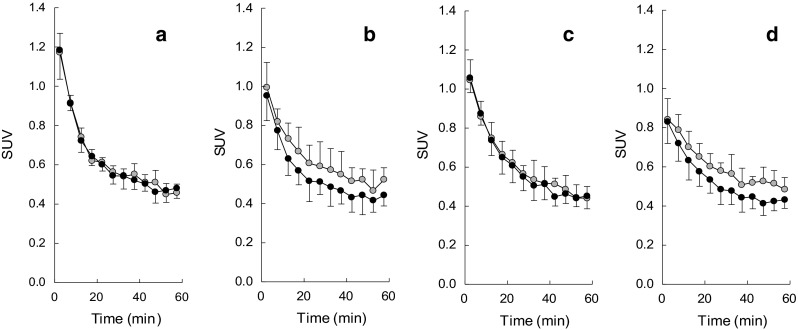
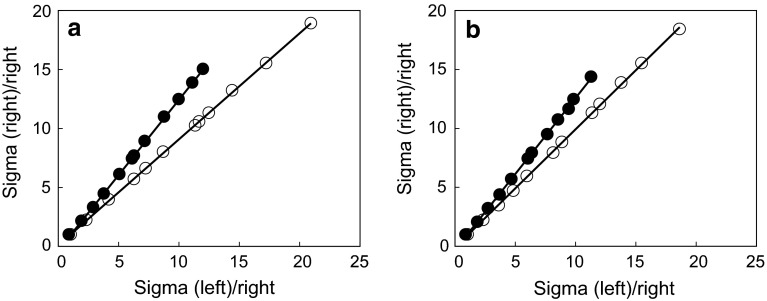
[(11)C]CB184 and [(11)C]CB190 were obtained via O-methylation of corresponding desmethyl precursor using [(11)C]methyl triflate in radiochemical yield of 73 % (decay-corrected). In vivo validation as a TSPO radioligand was carried out using normal mice and lesioned rats. In mice, [(11)C]CB184 showed more uptake and specific binding than [(11)C]CB190. Metabolism studies showed that 36 % and 25 % of radioactivity in plasma remained unchanged 30 min after intravenous injection of [(11)C]CB184 and [(11)C]CB190, respectively. In the PET study using rats, lesioned side of the brain showed significantly higher uptake than contralateral side after i.v. injection of either [(11)C]CB184 or (11)C-PK11195. Indirect Logan plot analysis revealed distribution volume ratio (DVR) between the two sides which might indicate lesion-related elevation of TSPO binding. The DVR was 1.15 ± 0.10 for (11)C-PK11195 and was 1.15 ± 0.09 for [(11)C]CB184.
The sensitivity to detect neuroinflammation activity was similar for [(11)C]CB184 and (11)C-PK11195.
我们报告了两种碳 - 11标记的咪唑并吡啶TSPO配体[(11)C] CB184和[(11)C] CB190的合成,用于炎症过程以及神经退行性变、局部缺血或脑肿瘤的正电子发射断层显像(PET)成像。将这些化合物的生物分布与[(11)C] CB148和[(11)C](R) - PK11195的生物分布进行了比较。
使用[(11)C]三氟甲磺酸甲酯可轻松制备在芳香环上带有(11)C - 甲氧基的[(11)C] CB184和[(11)C] CB190。用正常小鼠检查了这些化合物的生物分布和代谢情况。以6 - 羟基多巴胺处理的大鼠作为神经退行性变模型进行了动物PET研究,以适当评估放射性配体确定神经炎症过程的可行性。
通过使用[(11)C]三氟甲磺酸甲酯对相应的去甲基前体进行O - 甲基化,以73%(衰变校正)的放射化学产率获得了[(11)C] CB184和[(11)C] CB190。使用正常小鼠和损伤大鼠进行了作为TSPO放射性配体的体内验证。在小鼠中,[(11)C] CB184比[(11)C] CB190表现出更多的摄取和特异性结合。代谢研究表明,静脉注射[(11)C] CB184和[(11)C] CB190后30分钟,血浆中分别有36%和25%的放射性保持不变。在使用大鼠的PET研究中,静脉注射[(11)C] CB成了作为TSPO放射性配体的体内验证。在小鼠中,[(11)C] CB184比[(11)C] CB190表现出更多的摄取和特异性结合。代谢研究表明,静脉注射[(11)C] CB184和[(11)C] CB190后30分钟,血浆中分别有36%和25%的放射性保持不变。在使用大鼠的PET研究中,静脉注射[(11)C] CB184或[(11)C](R) - PK11195后,脑损伤侧的摄取明显高于对侧。间接洛根图分析显示两侧之间的分布体积比(DVR),这可能表明与损伤相关的TSPO结合升高。[(11)C](R) - PK1119 的DVR为1.15±0.10,[(11)C] CB184的DVR为1.15±0.09。
[(11)C] CB184和[(11)C](R) - PK11195检测神经炎症活性的灵敏度相似。