Pasricha Sarina, Kenney-Hunt Jane, Anderson Kristy, Jafari Nadereh, Hall Rabea A, Lammert Frank, Cheverud James, Green Richard M
Department of Internal Medicine, Northwestern University, Chicago, Illinois Department of Internal Medicine, University of North Carolina, Chapel Hill, North Carolina.
Department of Biology and Environmental Science, Westminster College, Fulton, Missouri.
G3 (Bethesda). 2015 Jan 23;5(4):487-96. doi: 10.1534/g3.115.016626.
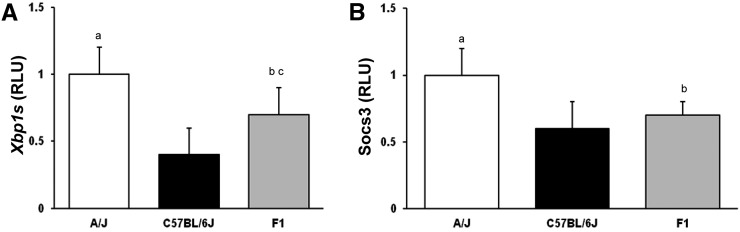
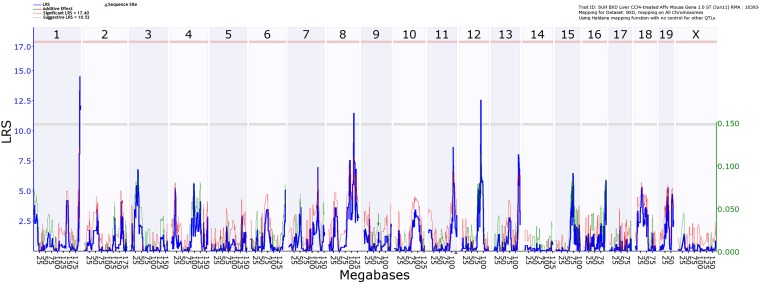
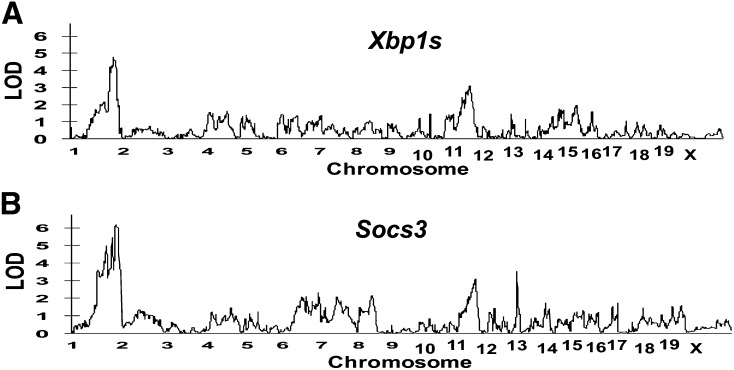
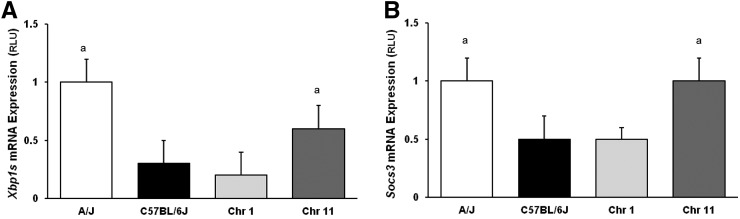
Nonalcoholic fatty liver disease (NAFLD) is a highly prevalent form of human hepatic disease and feeding mice a high-fat, high-caloric (HFHC) diet is a standard model of NAFLD. To better understand the genetic basis of NAFLD, we conducted an expression quantitative trait locus (eQTL) analysis of mice fed a HFHC diet. Two-hundred sixty-five (A/J × C57BL/6J) F2 male mice were fed a HFHC diet for 8 wk. eQTL analysis was utilized to identify genomic regions that regulate hepatic gene expression of Xbp1s and Socs3. We identified two overlapping loci for Xbp1s and Socs3 on Chr 1 (164.0-185.4 Mb and 174.4-190.5 Mb, respectively) and Chr 11 (41.1-73.1 Mb and 44.0-68.6 Mb, respectively), and an additional locus for Socs3 on Chr 12 (109.9-117.4 Mb). C57BL/6J-Chr 11(A/J)/ NaJ mice fed a HFHC diet manifested the A/J phenotype of increased Xbp1s and Socs3 gene expression (P < 0.05), whereas C57BL/6J-Chr 1(A/J)/ NaJ mice retained the C57BL/6J phenotype. In addition, we replicated the eQTLs on Chr 1 and Chr 12 (LOD scores ≥3.5) using mice from the BXD murine reference panel challenged with CCl4 to induce chronic liver injury and fibrosis. We have identified overlapping eQTLs for Xbp1 and Socs3 on Chr 1 and Chr 11, and consomic mice confirmed that replacing the C57BL/6J Chr 11 with the A/J Chr 11 resulted in an A/J phenotype for Xbp1 and Socs3 gene expression. Identification of the genes for these eQTLs will lead to a better understanding of the genetic factors responsible for NAFLD and potentially other hepatic diseases.
非酒精性脂肪性肝病(NAFLD)是一种在人类肝脏疾病中高度普遍的形式,给小鼠喂食高脂肪、高热量(HFHC)饮食是NAFLD的标准模型。为了更好地理解NAFLD的遗传基础,我们对喂食HFHC饮食的小鼠进行了表达定量性状基因座(eQTL)分析。265只(A/J×C57BL/6J)F2雄性小鼠被喂食HFHC饮食8周。利用eQTL分析来鉴定调控Xbp1s和Socs3肝脏基因表达的基因组区域。我们在1号染色体(分别为164.0 - 185.4 Mb和174.4 - 190.5 Mb)和11号染色体(分别为41.1 - 73.1 Mb和44.0 - 68.6 Mb)上鉴定出两个与Xbp1s和Socs3重叠的基因座,以及在12号染色体(109.9 - 117.4 Mb)上一个额外的Socs3基因座。喂食HFHC饮食的C57BL/6J - Chr 11(A/J)/NaJ小鼠表现出Xbp1s和Socs3基因表达增加的A/J表型(P < 0.05),而C57BL/6J - Chr 1(A/J)/NaJ小鼠保留了C57BL/6J表型。此外,我们使用来自BXD小鼠参考品系并经四氯化碳诱导慢性肝损伤和纤维化的小鼠,在1号和12号染色体上重复了eQTL(LOD分数≥3.5)。我们在1号和11号染色体上鉴定出了与Xbp1和Socs3重叠的eQTL,并且代换系小鼠证实,用A/J的11号染色体替换C57BL/6J的11号染色体导致Xbp1和Socs3基因表达呈现A/J表型。鉴定这些eQTL的基因将有助于更好地理解导致NAFLD以及潜在其他肝脏疾病的遗传因素。