State Key Laboratory of Medicinal Chemical Biology, Department of Cancer Research, College of Life Sciences, Nankai University, Tianjin, China.
State Key Laboratory of Medicinal Chemical Biology, Department of Biochemistry, College of Life Sciences, Nankai University, Tianjin, China.
Neoplasia. 2015 Jan;17(1):79-88. doi: 10.1016/j.neo.2014.11.004.
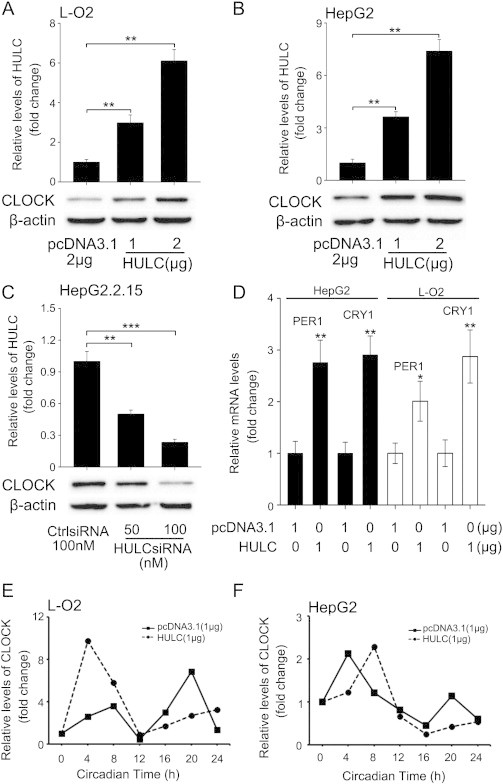
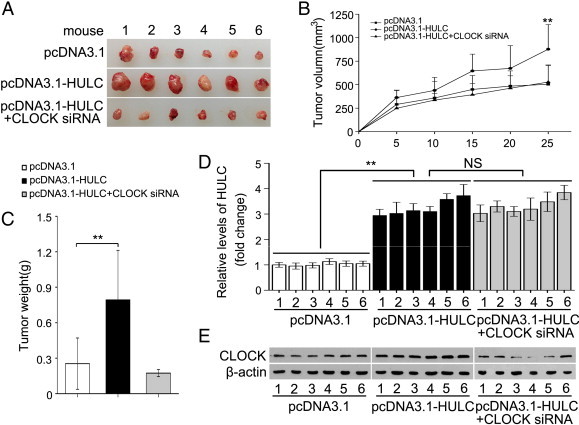
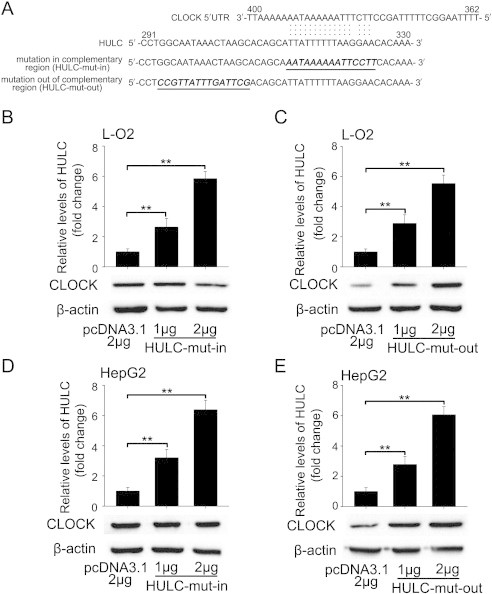
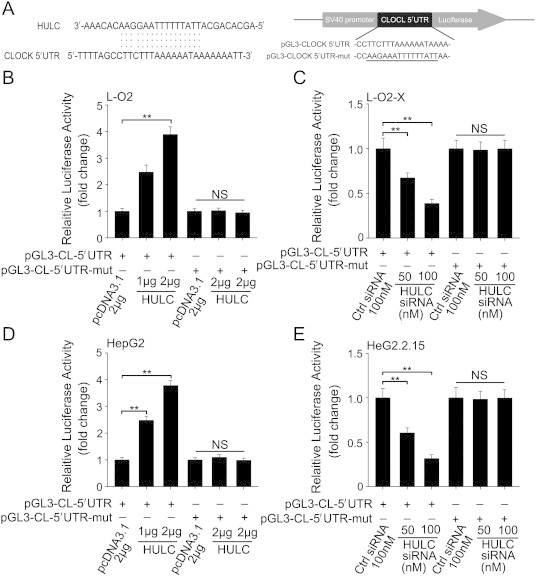
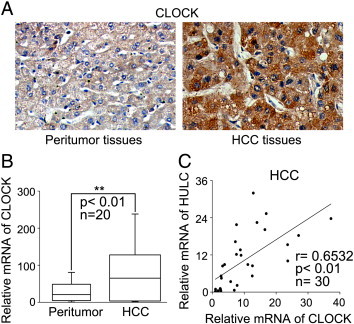
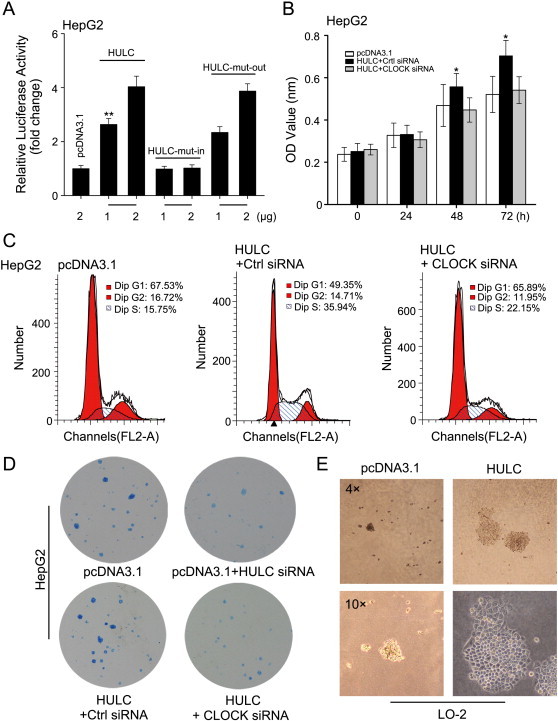
Clock circadian regulator (CLOCK)/brain and muscle arnt-like protein-1 (BMAL1) complex governs the regulation of circadian rhythm through triggering periodic alterations of gene expression. However, the underlying mechanism of circadian clock disruption in hepatocellular carcinoma (HCC) remains unclear. Here, we report that a long noncoding RNA (lncRNA), highly upregulated in liver cancer (HULC), contributes to the perturbations in circadian rhythm of hepatoma cells. Our observations showed that HULC was able to heighten the expression levels of CLOCK and its downstream circadian oscillators, such as period circadian clock 1 and cryptochrome circadian clock 1, in hepatoma cells. Strikingly, HULC altered the expression pattern and prolonged the periodic expression of CLOCK in hepatoma cells. Mechanistically, the complementary base pairing between HULC and the 5' untranslated region of CLOCK mRNA underlay the HULC-modulated expression of CLOCK, and the mutants in the complementary region failed to achieve the event. Moreover, immunohistochemistry staining and quantitative real-time polymerase chain reaction validated that the levels of CLOCK were elevated in HCC tissues, and the expression levels of HULC were positively associated with those of CLOCK in clinical HCC samples. In functional experiments, our data exhibited that CLOCK was implicated in the HULC-accelerated proliferation of hepatoma cells in vitro and in vivo. Taken together, our data show that an lncRNA, HULC, is responsible for the perturbations in circadian rhythm through upregulating circadian oscillator CLOCK in hepatoma cells, resulting in the promotion of hepatocarcinogenesis. Thus, our finding provides new insights into the mechanism by which lncRNA accelerates hepatocarcinogenesis through disturbing circadian rhythm of HCC.
时钟昼夜调节因子(CLOCK)/脑和肌肉异型蛋白-1(BMAL1)复合物通过触发基因表达的周期性改变来调节昼夜节律。然而,肝细胞癌(HCC)中昼夜节律钟破坏的潜在机制尚不清楚。在这里,我们报告一种长链非编码 RNA(lncRNA),在肝癌中高度上调(HULC),有助于肝癌细胞昼夜节律的波动。我们的观察表明,HULC 能够提高肝癌细胞中 CLOCK 及其下游昼夜振荡器的表达水平,如周期昼夜时钟 1 和隐色素昼夜时钟 1。引人注目的是,HULC 改变了 CLOCK 在肝癌细胞中的表达模式并延长了其周期性表达。在机制上,HULC 与 CLOCK mRNA 5'非翻译区之间的互补碱基配对是 HULC 调节 CLOCK 表达的基础,互补区的突变体无法实现这一事件。此外,免疫组织化学染色和定量实时聚合酶链反应验证了 CLOCK 在 HCC 组织中的水平升高,并且在临床 HCC 样本中,HULC 的表达水平与 CLOCK 的表达水平呈正相关。在功能实验中,我们的数据表明,CLOCK 参与了 HULC 在体外和体内加速肝癌细胞增殖的过程。总之,我们的数据表明,一种 lncRNA,HULC,通过上调肝癌细胞中的昼夜振荡器 CLOCK 来负责昼夜节律的波动,从而促进肝癌的发生。因此,我们的发现提供了新的见解,即 lncRNA 通过扰乱 HCC 的昼夜节律来加速肝癌发生的机制。