Department of General and Visceral Surgery, University Hospital Ulm, Albert-Einstein-Allee 23, 89081 Ulm Germany.
Department of Surgery, District-Hospital St. Gallen, Rorschacher Strasse 95, 9007 St.Gallen, Switzerland.
Neoplasia. 2015 Jan;17(1):134-40. doi: 10.1016/j.neo.2014.12.001.
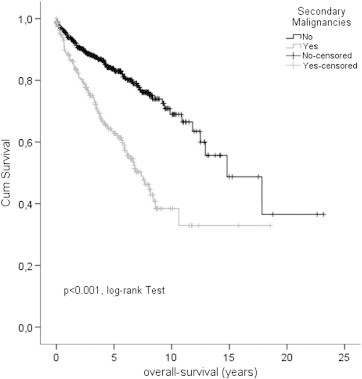
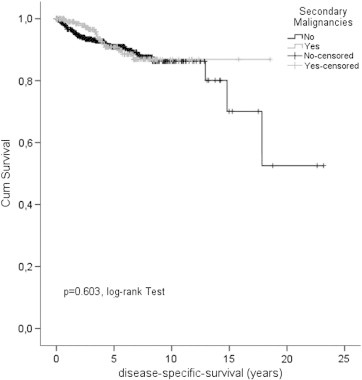
Currently available data on prognostic implication of additional neoplasms in GIST miss comprehensive information on patient outcome with regard to overall or disease specific and disease free survival. Registry data of GIST patients with and without additional neoplasm were compared in retrospective case series. We investigated a total of 836 patients from the multi-center Ulmer GIST registry. Additionally, a second cohort encompassing 143 consecutively recruited patients of a single oncology center were analyzed. The frequency of additional malignant neoplasms in GIST patients was 31.9% and 42.0% in both cohorts with a mean follow-up time of 54 and 65 months (median 48 and 60 months), respectively. The spectrum of additional neoplasms in both cohorts encompasses gastrointestinal tumors (43.5%), uro-genital and breast cancers (34.1%), hematological malignancies (7.3%), skin cancer (7.3%) and others. Additional neoplasms have had a significant impact on patient outcome. The five year overall survival in GIST with additional malignant neoplasms (n = 267) was 62.8% compared to 83.4% in patients without other tumors (n = 569) (P < .001, HR=0.397, 95% CI: 0.298-0.530). Five-year disease specific survival was not different between both groups (90.8% versus 90.9%). 34.2% of all deaths (n = 66 of n = 193) were GIST-related. The presented data suggest a close association between the duration of follow-up and the rate of additional malignancies in GIST patients. Moreover the data indicate a strong impact of additional malignant neoplasms in GIST on patient outcome. A comprehensive follow-up strategy of GIST patients appears to be warranted.
目前关于 GIST 中附加肿瘤的预后意义的数据,缺乏关于患者总生存、疾病特异性生存和无病生存的全面信息。本回顾性病例系列研究比较了有和无附加肿瘤的 GIST 患者的注册数据。我们共分析了来自乌尔姆 GIST 注册中心的 836 例患者的数据,此外还分析了单一肿瘤中心连续招募的 143 例患者的第二队列。两个队列中 GIST 患者附加恶性肿瘤的频率分别为 31.9%和 42.0%,平均随访时间分别为 54 和 65 个月(中位数分别为 48 和 60 个月)。两个队列中附加肿瘤的谱包括胃肠道肿瘤(43.5%)、泌尿生殖和乳腺癌(34.1%)、血液系统恶性肿瘤(7.3%)、皮肤癌(7.3%)和其他肿瘤。附加肿瘤对患者的预后有显著影响。在有附加恶性肿瘤的 GIST 患者(n = 267)中,5 年总生存率为 62.8%,而无其他肿瘤的患者(n = 569)为 83.4%(P <.001,HR = 0.397,95%CI:0.298-0.530)。两组 5 年疾病特异性生存率无差异(90.8%比 90.9%)。所有死亡患者(n = 193,n = 66)中有 34.2%与 GIST 相关。本研究数据提示,GIST 患者的随访时间与附加恶性肿瘤的发生率密切相关。此外,数据表明,附加恶性肿瘤对 GIST 患者的预后有很大影响。GIST 患者的综合随访策略似乎是必要的。