Xu Hao-Liang, Pelligrino Dale A, Paisansathan Chanannait, Testai Fernando D
Neuroanesthesia Research Laboratory, University of Illinois College of Medicine, Chicago, IL, USA.
Department of Anesthesiology of the University of Illinois College of Medicine, Chicago, IL, USA.
J Neuroinflammation. 2015 Jan 27;12:16. doi: 10.1186/s12974-015-0234-7.
Subarachnoid hemorrhage (SAH) is a neurological emergency with limited pharmacological treatment options. Inflammation is increasingly recognized as a key pathogenic contributor to brain injury in this condition. In the present study, we examined the neuroprotective effects of the immunomodulatory agent, fingolimod, in rats subjected to SAH.
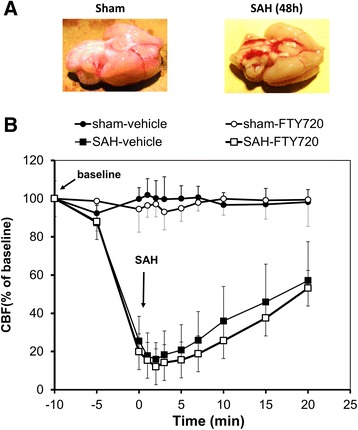
We utilized an endovascular rat perforation model of SAH. Animals were divided into four groups: (1) sham-vehicle; (2) sham-fingolimod; (3) SAH-vehicle; and (4) SAH-fingolimod. Rats received either vehicle solution or fingolimod (0.5 mg/kg) intraperitoneally 3 hours after sham surgery or SAH. A closed cranial window and intravital microscope system was used at 48 hours to assess neuroinflammation, which was represented by rhodamine-6G-labeled leukocyte trafficking in pial venules, and pial arteriolar dilating responses to a variety of vasodilators, including hypercapnia, and topically-applied acetylcholine, adenosine, and S-nitroso-N-acetyl penicillamine. In addition, motor-sensory function was evaluated.
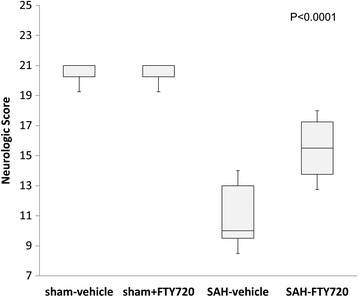
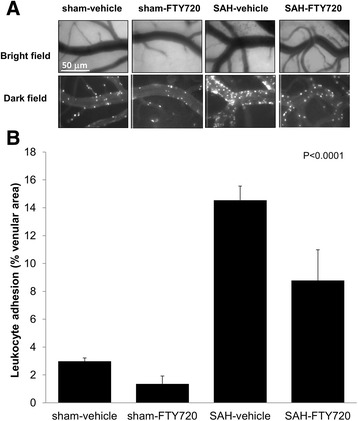
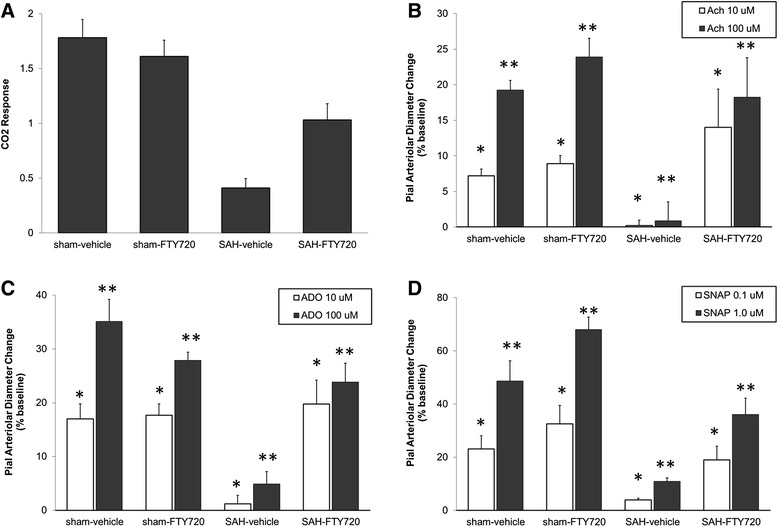
Compared to sham-vehicle rats, SAH-vehicle animals displayed a four-times greater increase in pial venular intraluminal leukocyte adhesion. Treatment with fingolimod largely reduced the intravascular leukocyte adhesion. Vehicle-treated SAH animals displayed a significant decrease in pial arteriolar responses to all the vasodilators tested and vascular reactivity was preserved, to a significant degree, in the presence of fingolimod. In addition, neurological scores obtained at 48 hours post-SAH indicated significant neurological deficits in the vehicle-treated group (versus sham-vehicle surgical control). Those deficiencies were partially reduced by fingolimod (P < 0.0001 compared to the vehicle-treated SAH group).
Treatment of rats with fingolimod was associated with a marked limitation in the intravascular adhesion of leukocytes to pial venules, preserved pial arteriolar dilating function, and improved neurological outcome in rats subjected to SAH.
蛛网膜下腔出血(SAH)是一种神经急症,药物治疗选择有限。炎症越来越被认为是这种情况下脑损伤的关键致病因素。在本研究中,我们研究了免疫调节剂芬戈莫德对SAH大鼠的神经保护作用。
我们采用了SAH的血管内大鼠穿孔模型。动物分为四组:(1)假手术-溶剂组;(2)假手术-芬戈莫德组;(3)SAH-溶剂组;(4)SAH-芬戈莫德组。大鼠在假手术或SAH后3小时腹腔内注射溶剂或芬戈莫德(0.5mg/kg)。在48小时时使用封闭的颅骨视窗和活体显微镜系统评估神经炎症,其表现为罗丹明-6G标记的白细胞在软脑膜小静脉中的运输,以及软脑膜小动脉对多种血管扩张剂(包括高碳酸血症以及局部应用的乙酰胆碱、腺苷和S-亚硝基-N-乙酰青霉胺)的扩张反应。此外,还评估了运动感觉功能。
与假手术-溶剂组大鼠相比,SAH-溶剂组动物软脑膜小静脉腔内白细胞粘附增加了四倍。芬戈莫德治疗大大降低了血管内白细胞粘附。溶剂处理的SAH动物对所有测试的血管扩张剂的软脑膜小动脉反应均显著降低,而在芬戈莫德存在的情况下,血管反应性在很大程度上得以保留。此外,SAH后48小时获得的神经学评分表明,溶剂处理组(与假手术-溶剂手术对照组相比)存在显著的神经功能缺损。芬戈莫德部分减轻了这些缺陷(与溶剂处理的SAH组相比,P<0.0001)。
用芬戈莫德治疗大鼠与显著限制白细胞在软脑膜小静脉中的血管内粘附、保留软脑膜小动脉扩张功能以及改善SAH大鼠的神经学结局相关。