Matsumoto Yoshihiro, Samma Shoji, Fukui Shinji, Nakai Yasushi, Kagebayashi Yoriaki, Torimoto Kazumasa
Department of Urology, Nara Prefectural Nara Hospital, Nara, Japan.
Department of Urology, Nara Medical University, Kashihara, Japan.
Indian J Urol. 2015 Jan-Mar;31(1):52-6. doi: 10.4103/0970-1591.139563.
We aimed to investigate the long-term outcome of trimodality therapy consisting of transurethral resection of bladder tumor, external beam radiation therapy, and concurrent intra-arterial low dose cisplatin for patients with muscle invasive bladder cancer.
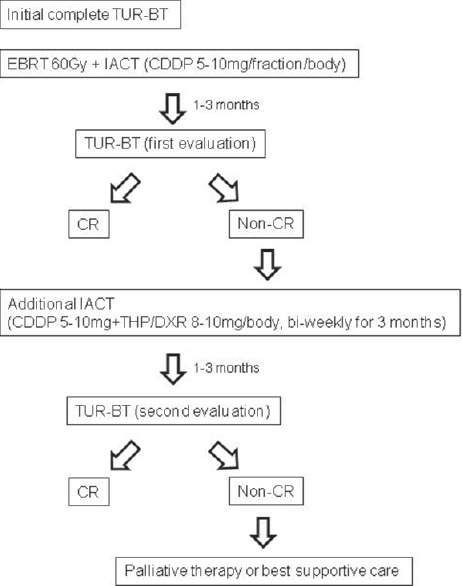
We retrospectively reviewed the medical records of 37 consecutive patients (28 men and 9 women) who underwent trimodality therapy for T2-3N0M0 bladder cancer at our hospital between 1996 and 2011. A total of 60Gy of external beam radiation therapy was administered. A daily low dose of cisplatin was administered intra-arterially through a subcutaneously placed reservoir on the days of radiation therapy. Complete response was defined as no residual cancer in transurethral resection specimens and negative cytology. When a complete response could not be achieved, patients underwent additional intra-arterial chemotherapy.
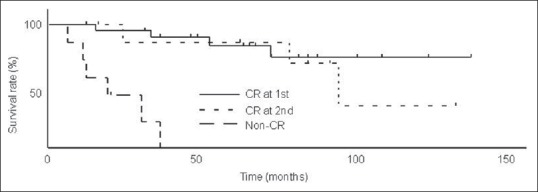
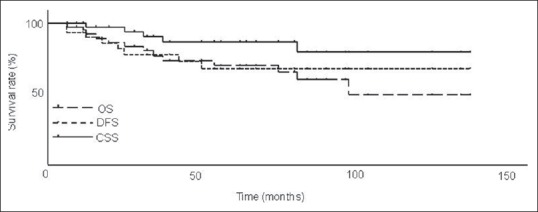
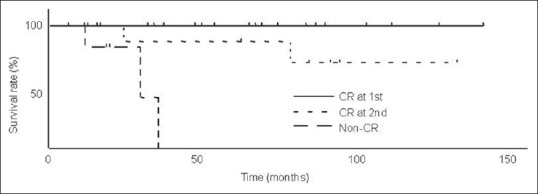
Five-year cause specific, disease free, and overall survival rates were 86.4%, 69.7%, and 69.6%, respectively, with a mean follow-up period of 56.5 ± 6.1 months. Five-year cause specific survivals of the complete response group after the trimodality therapy, the complete response group after additional intra-arterial chemotherapy and the non-complete response group were 100% (n = 21), 85.9% (n = 9) and 0% (n = 7), respectively. Five-year overall survivals of the complete response group after the trimodality therapy, the complete response group after additional intra-arterial chemotherapy and the non-complete response group were 82.8%, 85.3% and 0%, respectively.
This trimodality therapy for muscle invasive bladder cancer could achieve favorable survival rates with bladder preservation and minimal adverse events. This trimodality therapy can be one of the useful treatment options.
我们旨在研究经尿道膀胱肿瘤切除术、体外照射放疗以及同期动脉内低剂量顺铂治疗组成的三联疗法对肌层浸润性膀胱癌患者的长期疗效。
我们回顾性分析了1996年至2011年间在我院接受三联疗法治疗T2-3N0M0期膀胱癌的37例连续患者(28例男性和9例女性)的病历。总共给予60Gy的体外照射放疗。在放疗期间,通过皮下置入的储液器每日动脉内给予低剂量顺铂。完全缓解定义为经尿道切除标本中无残留癌且细胞学检查阴性。若无法实现完全缓解,则患者接受额外的动脉内化疗。
五年病因特异性生存率、无病生存率和总生存率分别为86.4%、69.7%和69.6%,平均随访期为56.5±6.1个月。三联疗法后完全缓解组、额外动脉内化疗后完全缓解组和未完全缓解组的五年病因特异性生存率分别为100%(n = 21)、85.9%(n = 9)和0%(n = 7)。三联疗法后完全缓解组、额外动脉内化疗后完全缓解组和未完全缓解组的五年总生存率分别为82.8%、85.3%和0%。
这种针对肌层浸润性膀胱癌的三联疗法可在保留膀胱的情况下实现良好的生存率,且不良事件最少。这种三联疗法可以成为一种有效的治疗选择。