Thomas Owain, Lybeck Emanuel, Strandberg Karin, Tynngård Nahreen, Schött Ulf
Medical Faculty, University of Lund, Lund, Sweden; Department of Paediatric Anaesthesia and Intensive Care, SUS Lund University Hospital, Lund, Sweden.
Medical Faculty, University of Lund, Lund, Sweden.
PLoS One. 2015 Jan 27;10(1):e0116835. doi: 10.1371/journal.pone.0116835. eCollection 2015.
Low molecular weight heparins (LMWH's) are used to prevent and treat thrombosis. Tests for monitoring LMWH's include anti-factor Xa (anti-FXa), activated partial thromboplastin time (aPTT) and thrombin generation. Anti-FXa is the current gold standard despite LMWH's varying affinities for FXa and thrombin.
To examine the effects of two different LMWH's on the results of 4 different aPTT-tests, anti-FXa activity and thrombin generation and to assess the tests' concordance.
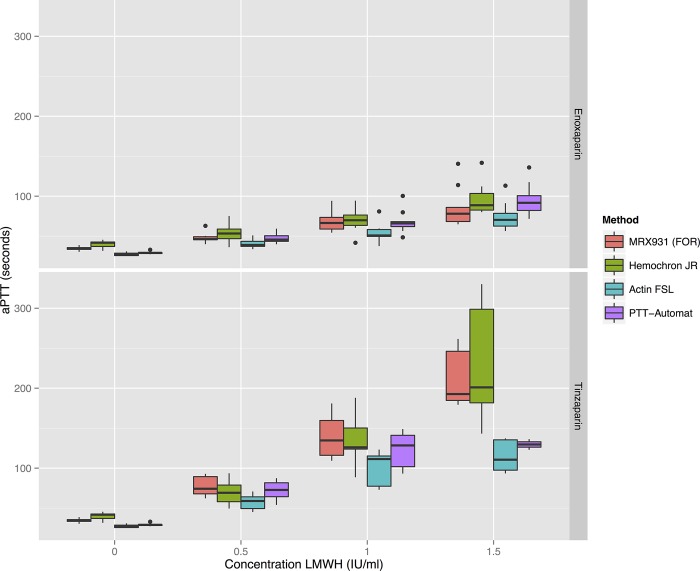
Enoxaparin and tinzaparin were added ex-vivo in concentrations of 0.0, 0.5, 1.0 and 1.5 anti-FXa international units (IU)/mL, to blood from 10 volunteers. aPTT was measured using two whole blood methods (Free oscillation rheometry (FOR) and Hemochron Jr (HCJ)) and an optical plasma method using two different reagents (ActinFSL and PTT-Automat). Anti-FXa activity was quantified using a chromogenic assay. Thrombin generation (Endogenous Thrombin Potential, ETP) was measured on a Ceveron Alpha instrument using the TGA RB and more tissue-factor rich TGA RC reagents.
Methods' mean aPTT at 1.0 IU/mL LMWH varied between 54s (SD 11) and 69s (SD 14) for enoxaparin and between 101s (SD 21) and 140s (SD 28) for tinzaparin. ActinFSL gave significantly shorter aPTT results. aPTT and anti-FXa generally correlated well. ETP as measured with the TGA RC reagent but not the TGA RB reagent showed an inverse exponential relationship to the concentration of LMWH. The HCJ-aPTT results had the weakest correlation to anti-FXa and thrombin generation (Rs0.62-0.87), whereas the other aPTT methods had similar correlation coefficients (Rs0.80-0.92).
aPTT displays a linear dose-response to LMWH. There is variation between aPTT assays. Tinzaparin increases aPTT and decreases thrombin generation more than enoxaparin at any given level of anti-FXa activity, casting doubt on anti-FXa's present gold standard status. Thrombin generation with tissue factor-rich activator is a promising method for monitoring LMWH's.
低分子量肝素(LMWH)用于预防和治疗血栓形成。监测LMWH的检测方法包括抗Xa因子(抗FXa)、活化部分凝血活酶时间(aPTT)和凝血酶生成检测。尽管LMWH对FXa和凝血酶的亲和力不同,但抗FXa是目前的金标准。
研究两种不同的LMWH对4种不同aPTT检测结果、抗FXa活性和凝血酶生成的影响,并评估这些检测方法的一致性。
将依诺肝素和替扎肝素以0.0、0.5、1.0和1.5抗FXa国际单位(IU)/mL的浓度体外添加到10名志愿者的血液中。使用两种全血方法(自由振荡流变学(FOR)和Hemochron Jr(HCJ))以及使用两种不同试剂(ActinFSL和PTT-Automat)的光学血浆方法测量aPTT。使用显色测定法定量抗FXa活性。使用TGA RB和组织因子含量更高的TGA RC试剂在Ceveron Alpha仪器上测量凝血酶生成(内源性凝血酶潜力,ETP)。
对于依诺肝素,在1.0 IU/mL LMWH时,各方法的平均aPTT在54秒(标准差11)至69秒(标准差14)之间变化;对于替扎肝素,在101秒(标准差21)至140秒(标准差28)之间变化。ActinFSL得出的aPTT结果明显较短。aPTT和抗FXa通常具有良好的相关性。使用TGA RC试剂而非TGA RB试剂测量的ETP与LMWH浓度呈反指数关系。HCJ-aPTT结果与抗FXa和凝血酶生成的相关性最弱(Rs 0.62 - 0.87),而其他aPTT方法具有相似的相关系数(Rs 0.80 - 0.92)。
aPTT对LMWH呈线性剂量反应。aPTT检测方法之间存在差异。在任何给定的抗FXa活性水平下,替扎肝素比依诺肝素更能延长aPTT并降低凝血酶生成,这使抗FXa目前的金标准地位受到质疑。使用富含组织因子的激活剂进行凝血酶生成检测是监测LMWH的一种有前景的方法。