Hays Sean M, Aylward Lesa L, Blount Benjamin C
Summit Toxicology, LLP, Lyons, Colorado, USA.
Environ Health Perspect. 2015 Apr;123(4):293-300. doi: 10.1289/ehp.1408944. Epub 2015 Jan 27.
Urinary analyte concentrations are affected both by exposure level and by urinary flow rate (UFR). Systematic variations in UFR with demographic characteristics or body mass index (BMI) could confound assessment of associations between health outcomes and biomarker concentrations.
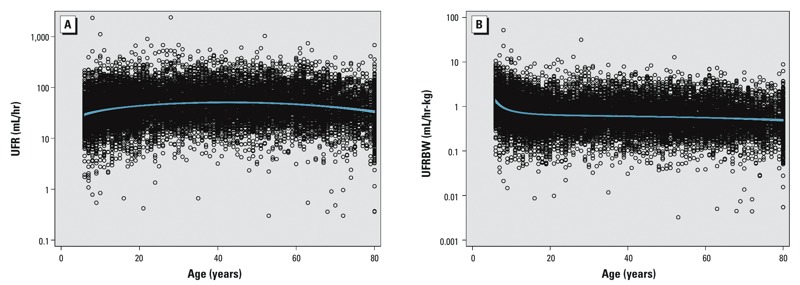
We assessed patterns of UFR (milliliters per hour) and body weight-adjusted UFR (UFRBW; milliliters per kilogram per hour) across age, sex, race/ethnicity, and BMI category in the NHANES (National Health and Nutrition Examination Survey) 2009-2012 data sets.
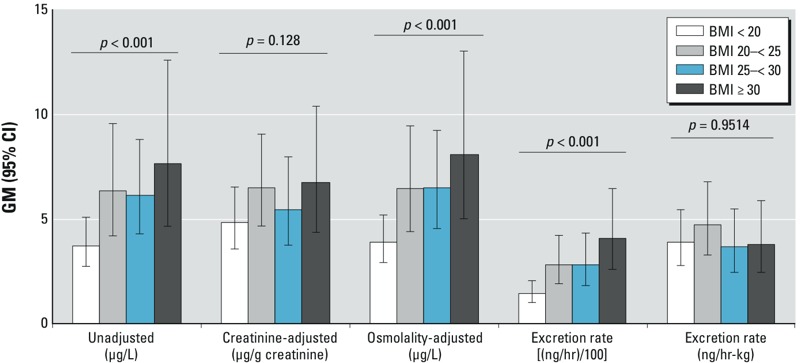
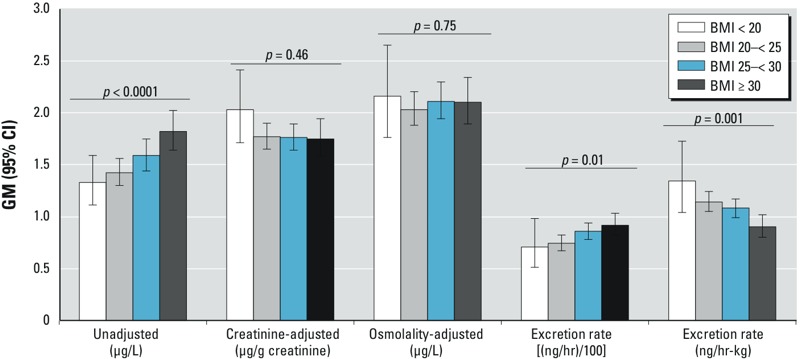
Geometric mean (GM) UFR and UFRBW were compared across age-stratified (6-11, 12-19, 20-39, 40-59, and ≥ 60 years) subgroups (sex, race/ethnicity, and BMI category). Patterns of analyte urinary concentration or mass excretion rates (nanograms per hour and nanograms per kilogram per hour BW) were assessed in sample age groups for case study chemicals bisphenol A and 2,5-dichlorophenol.
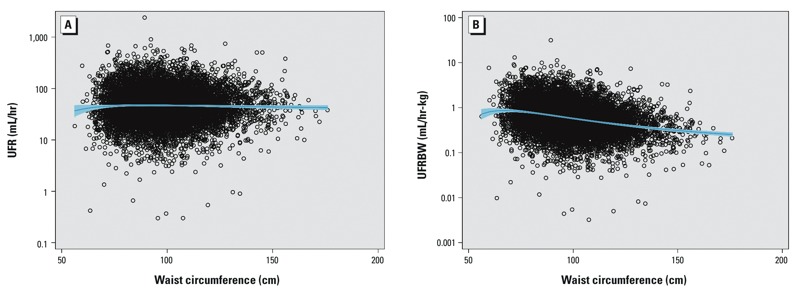
UFR increased from ages 6 to 60 years and then declined with increasing age. UFRBW varied inversely with age. UFR, but not UFRBW, differed significantly by sex (males > females after age 12 years). Differences in both metrics were observed among categories of race/ethnicity. UFRBW, but not UFR, varied inversely with BMI category and waist circumference in all age groups. Urinary osmolality increased with increasing BMI. Case studies demonstrated different exposure-outcome relationships depending on exposure metric. Conventional hydration status adjustments did not fully address the effect of flow rate variations.
UFR and UFRBW exhibit systematic variations with age, sex, race/ethnicity, and BMI category. These variations can confound assessments of potential exposure-health outcome associations based on urinary concentration. Analyte excretion rates are valuable exposure metrics in such assessments.
尿液分析物浓度受暴露水平和尿流率(UFR)的影响。尿流率随人口统计学特征或体重指数(BMI)的系统性变化可能会混淆健康结果与生物标志物浓度之间关联的评估。
我们在2009 - 2012年美国国家健康与营养检查调查(NHANES)数据集中,评估了不同年龄、性别、种族/族裔和BMI类别下的尿流率(每小时毫升数)及体重校正尿流率(UFRBW;每千克每小时毫升数)模式。
比较了按年龄分层(6 - 11岁、12 - 19岁、20 - 39岁、40 - 59岁和≥60岁)的亚组(性别、种族/族裔和BMI类别)的几何平均(GM)尿流率和UFRBW。针对案例研究化学品双酚A和2,5 - 二氯苯酚,在样本年龄组中评估了分析物尿浓度或质量排泄率(每小时纳克数和每千克每小时BW纳克数)模式。
尿流率从6岁至60岁增加,然后随年龄增长而下降。UFRBW与年龄呈反比。尿流率在12岁后因性别而异(男性>女性),但UFRBW无此差异。在种族/族裔类别中观察到两种指标的差异。在所有年龄组中,UFRBW与BMI类别和腰围呈反比,但尿流率无此差异。尿渗透压随BMI增加而升高。案例研究表明,根据暴露指标不同,暴露 - 结果关系也不同。传统的水合状态调整并未完全解决流速变化的影响。
尿流率和UFRBW随年龄、性别、种族/族裔和BMI类别呈现系统性变化。这些变化可能会混淆基于尿浓度的潜在暴露 - 健康结果关联评估。在这类评估中,分析物排泄率是有价值的暴露指标。