Hauser Sheketha R, Hedlund Peter B, Roberts Amanda J, Sari Youssef, Bell Richard L, Engleman Eric A
Department of Psychiatry, Indiana University School of Medicine Indianapolis, IN, USA.
Department of Molecular and Cellular Neuroscience, The Scripps Research Institute La Jolla, CA, USA.
Front Neurosci. 2015 Jan 13;8:448. doi: 10.3389/fnins.2014.00448. eCollection 2014.
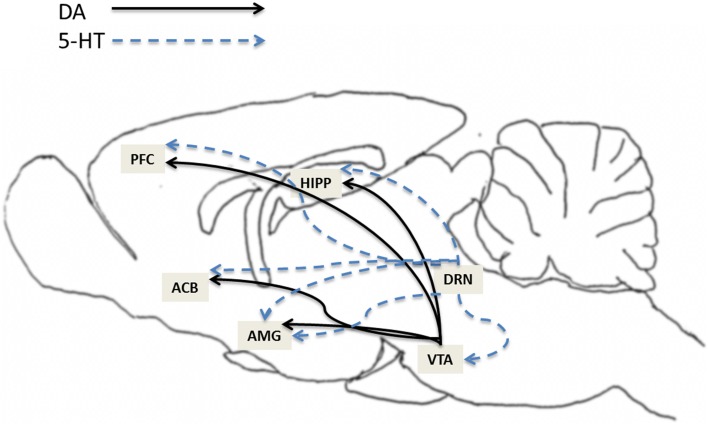
Alcohol and drug abuse take a large toll on society and affected individuals. However, very few effective treatments are currently available to treat alcohol and drug addiction. Basic and clinical research has begun to provide some insights into the underlying neurobiological systems involved in the addiction process. Several neurotransmitter pathways have been implicated and distinct reward neurocircuitry have been proposed-including the mesocorticolimbic dopamine (MCL-DA) system and the extended amygdala. The serotonin (5-HT) neurotransmitter system is of particular interest and multiple 5-HT receptors are thought to play significant roles in alcohol and drug self-administration and the development of drug dependence. Among the 5-HT receptors, the 5-HT7 receptor is currently undergoing characterization as a potential target for the treatment of several psychiatric disorders. Although this receptor has received only limited research regarding addictive behaviors, aspects of its neuroanatomical, biochemical, physiological, pharmacological, and behavioral profiles suggest that it could play a key role in the addiction process. For instance, genomic studies in humans have suggested a link between variants in the gene encoding the 5-HT7 receptor and alcoholism. Recent behavioral testing using high-affinity antagonists in mice and preliminary tests with alcohol-preferring rats suggest that this receptor could mediate alcohol consumption and/or reinforcement and play a role in seeking/craving behavior. Interest in the development of new and more selective pharmacological agents for this receptor will aid in examining the 5-HT7 receptor as a novel target for treating addiction.
酒精和药物滥用给社会及受影响的个人造成了巨大损失。然而,目前几乎没有有效的治疗方法来治疗酒精和药物成瘾。基础和临床研究已开始为成瘾过程中涉及的潜在神经生物学系统提供一些见解。几种神经递质途径已被牵连其中,并且有人提出了不同的奖赏神经回路,包括中脑皮质边缘多巴胺(MCL-DA)系统和扩展杏仁核。血清素(5-HT)神经递质系统尤其受关注,多种5-HT受体被认为在酒精和药物自我给药以及药物依赖的发展中起重要作用。在5-HT受体中,5-HT7受体目前正在被确定为治疗几种精神疾病的潜在靶点。尽管关于这种受体在成瘾行为方面的研究有限,但其神经解剖学、生物化学、生理学、药理学和行为特征方面表明它可能在成瘾过程中起关键作用。例如,人类基因组研究表明编码5-HT7受体的基因变体与酒精中毒之间存在联系。最近在小鼠中使用高亲和力拮抗剂进行的行为测试以及对嗜酒大鼠的初步测试表明,该受体可能介导酒精消费和/或强化作用,并在寻求/渴望行为中发挥作用。对开发针对该受体的新型、更具选择性的药物制剂的兴趣将有助于将5-HT7受体作为治疗成瘾的新靶点进行研究。