Losensky Gerald, Vidakovic Lucia, Klingl Andreas, Pfeifer Felicitas, Fröls Sabrina
Microbiology and Archaea, Department of Biology, Technische Universität Darmstadt Darmstadt, Germany.
Cell Biology and LOEWE Research Centre for Synthetic Microbiology, Philipps-Universität Marburg Marburg, Germany ; Department of Biology I, Biozentrum, University of Munich Planegg-Martinsried, Germany.
Front Microbiol. 2015 Jan 13;5:755. doi: 10.3389/fmicb.2014.00755. eCollection 2014.
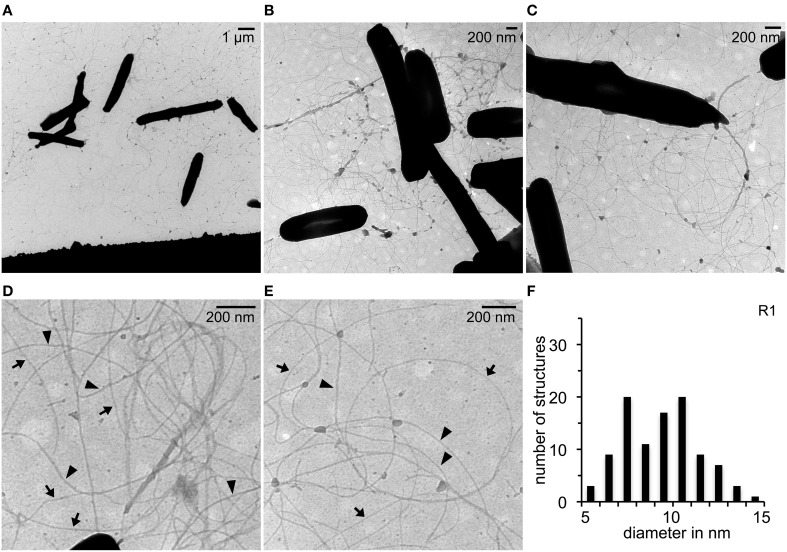
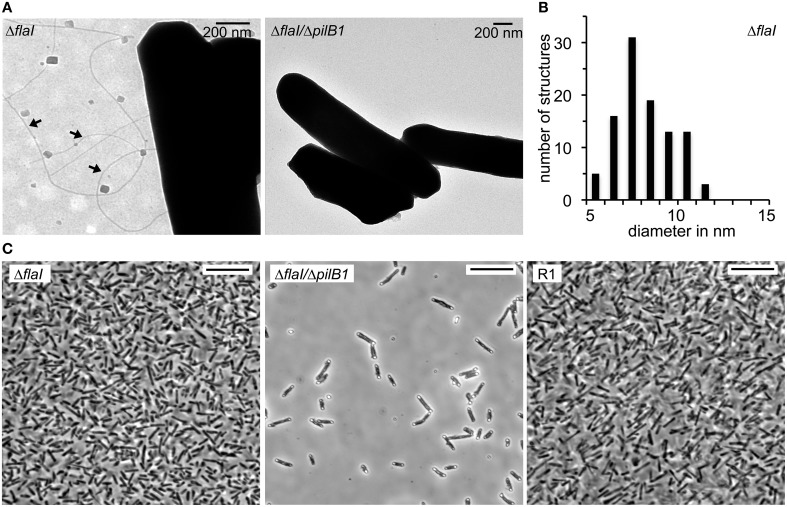
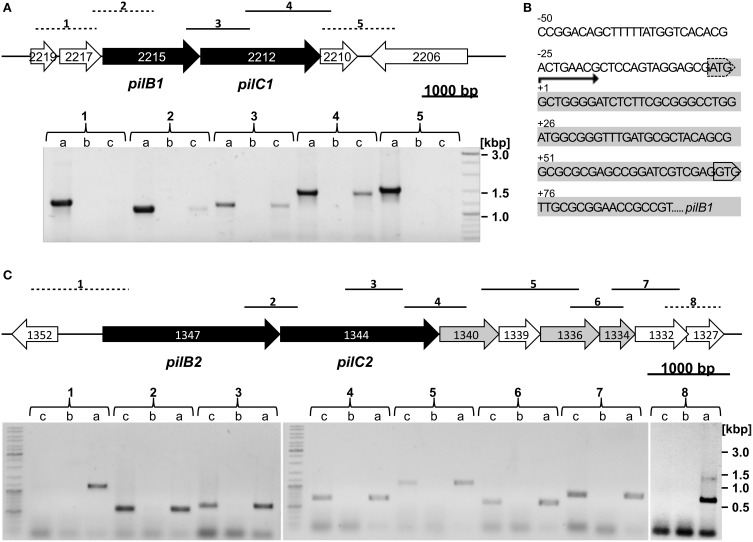
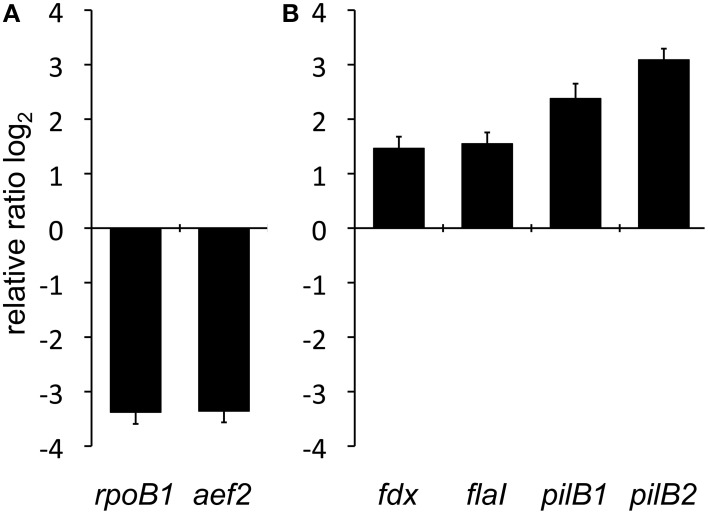
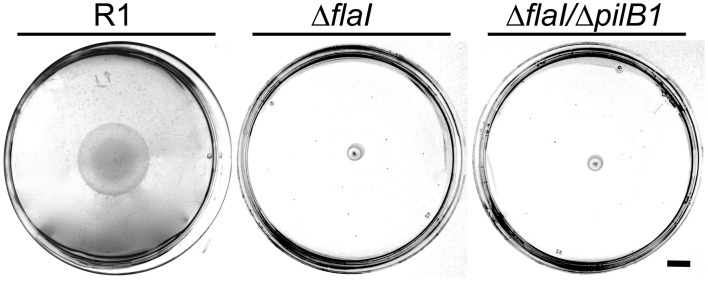
It was recently shown that haloarchaeal strains of different genera are able to adhere to surfaces and form surface-attached biofilms. However, the surface structures mediating the adhesion were still unknown. We have identified a novel surface structure with Halobacterium salinarum strain R1, crucial for surface adhesion. Electron microscopic studies of surface-attached cells frequently showed pili-like surface structures of two different diameters that were irregularly distributed on the surface. The thinner filaments, 7-8 nm in diameter, represented a so far unobserved novel pili-like structure. Examination of the Hbt. salinarum R1 genome identified two putative gene loci (pil-1 and pil-2) encoding type IV pilus biogenesis complexes besides the archaellum encoding fla gene locus. Both pil-1 and pil-2 were expressed as transcriptional units, and the transcriptional start of pil-1 was identified. In silico analyses revealed that the pil-1 locus is present with other euryarchaeal genomes whereas the pil-2 is restricted to haloarchaea. Comparative real time qRT-PCR studies indicated that the general transcriptional activity was reduced in adherent vs. planktonic cells. In contrast, the transcription of pilB1 and pilB2, encoding putative type IV pilus assembly ATPases, was induced in comparison to the archaella assembly/motor ATPase (flaI) and the ferredoxin gene. Mutant strains were constructed that incurred a flaI deletion or flaI/pilB1 gene deletions. The absence of flaI caused the loss of the archaella while the additional absence of pilB1 led to loss of the novel pili-like surface structures. The ΔflaI/ΔpilB1 double mutants showed a 10-fold reduction in surface adhesion compared to the parental strain. Since surface adhesion was not reduced with the non-archaellated ΔflaI mutants, the pil-1 filaments have a distinct function in the adhesion process.
最近研究表明,不同属的嗜盐古菌菌株能够附着于表面并形成附着在表面的生物膜。然而,介导这种附着的表面结构仍然未知。我们在盐沼盐杆菌R1菌株中鉴定出一种新型表面结构,它对表面附着至关重要。对附着在表面的细胞进行电子显微镜研究时,经常会观察到两种不同直径的菌毛样表面结构,它们不规则地分布在表面。较细的丝状物直径为7 - 8纳米,代表了一种迄今为止未观察到的新型菌毛样结构。对盐沼盐杆菌R1基因组的研究发现,除了编码鞭毛蛋白的fla基因座外,还有两个推测的基因座(pil-1和pil-2)编码IV型菌毛生物合成复合物。pil-1和pil-2均作为转录单元表达,并确定了pil-1的转录起始位点。计算机分析表明,pil-1基因座存在于其他广古菌基因组中,而pil-2仅限于嗜盐古菌。实时定量qRT-PCR比较研究表明,与浮游细胞相比,附着细胞的总体转录活性降低。相比之下,与鞭毛组装/运动ATP酶(flaI)和铁氧化还原蛋白基因相比,编码推测的IV型菌毛组装ATP酶的pilB1和pilB2的转录被诱导。构建了缺失flaI或同时缺失flaI/pilB1基因的突变菌株。flaI的缺失导致鞭毛的丧失,而pilB1的额外缺失导致新型菌毛样表面结构的丧失。与亲本菌株相比,ΔflaI/ΔpilB1双突变体的表面附着力降低了10倍。由于非鞭毛化的ΔflaI突变体的表面附着力没有降低,因此pil-1丝状物在附着过程中具有独特的功能。