Grants Jennifer M, Goh Grace Y S, Taubert Stefan
Department of Medical Genetics, University of British Columbia, Vancouver, BC V5Z 4H4, Canada Centre for Molecular Medicine and Therapeutics, Child & Family Research Institute, University of British Columbia, Vancouver, BC V5Z 4H4, Canada.
Centre for Molecular Medicine and Therapeutics, Child & Family Research Institute, University of British Columbia, Vancouver, BC V5Z 4H4, Canada Graduate Program in Cell and Developmental Biology, University of British Columbia, Vancouver, BC V5Z 4H4, Canada.
Nucleic Acids Res. 2015 Feb 27;43(4):2442-53. doi: 10.1093/nar/gkv037. Epub 2015 Jan 29.
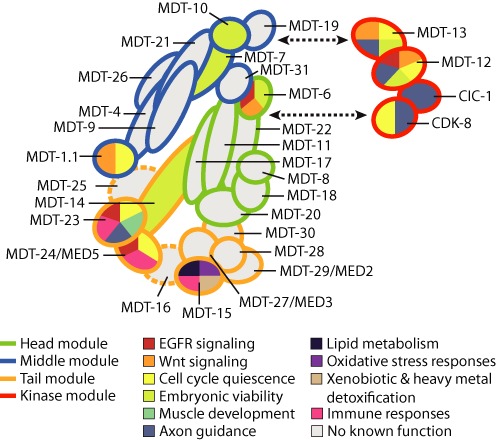
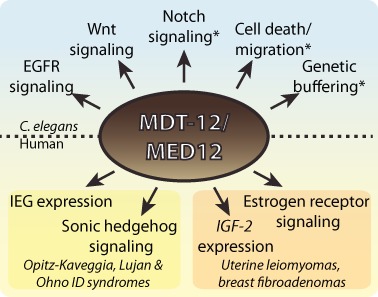
The Mediator multiprotein complex ('Mediator') is an important transcriptional coregulator that is evolutionarily conserved throughout eukaryotes. Although some Mediator subunits are essential for the transcription of all protein-coding genes, others influence the expression of only subsets of genes and participate selectively in cellular signaling pathways. Here, we review the current knowledge of Mediator subunit function in the nematode Caenorhabditis elegans, a metazoan in which established and emerging genetic technologies facilitate the study of developmental and physiological regulation in vivo. In this nematode, unbiased genetic screens have revealed critical roles for Mediator components in core developmental pathways such as epidermal growth factor (EGF) and Wnt/β-catenin signaling. More recently, important roles for C. elegans Mediator subunits have emerged in the regulation of lipid metabolism and of systemic stress responses, engaging conserved transcription factors such as nuclear hormone receptors (NHRs). We emphasize instances where similar functions for individual Mediator subunits exist in mammals, highlighting parallels between Mediator subunit action in nematode development and in human cancer biology. We also discuss a parallel between the association of the Mediator subunit MED12 with several human disorders and the role of its C. elegans ortholog mdt-12 as a regulatory hub that interacts with numerous signaling pathways.
中介体多蛋白复合物(“中介体”)是一种重要的转录共调节因子,在整个真核生物中具有进化保守性。虽然一些中介体亚基对于所有蛋白质编码基因的转录至关重要,但其他亚基仅影响基因子集的表达,并选择性地参与细胞信号通路。在这里,我们综述了线虫秀丽隐杆线虫中介体亚基功能的当前知识,秀丽隐杆线虫是一种后生动物,成熟的和新兴的遗传技术有助于在体内研究发育和生理调节。在这种线虫中,无偏向性的遗传筛选揭示了中介体成分在核心发育途径如表皮生长因子(EGF)和Wnt/β-连环蛋白信号传导中的关键作用。最近,秀丽隐杆线虫中介体亚基在脂质代谢和全身应激反应的调节中也发挥了重要作用,涉及保守的转录因子如核激素受体(NHRs)。我们强调了在哺乳动物中存在个别中介体亚基具有类似功能的情况,突出了线虫发育和人类癌症生物学中介体亚基作用的相似之处。我们还讨论了中介体亚基MED12与几种人类疾病的关联,以及其秀丽隐杆线虫直系同源物mdt-12作为与众多信号通路相互作用的调节枢纽的作用。