Haun Randy S, Fan Chun-Yang, Mackintosh Samuel G, Zhao Hong, Tackett Alan J
Central Arkansas Veterans Healthcare System, University of Arkansas for Medical Sciences; Little Rock, Arkansas, USA ; Departments of Pharmaceutical Sciences, University of Arkansas for Medical Sciences; Little Rock, Arkansas, USA.
Central Arkansas Veterans Healthcare System, University of Arkansas for Medical Sciences; Little Rock, Arkansas, USA.
J Proteomics Bioinform. 2014;Suppl 10:S10003. doi: 10.4172/jpb.S10-003.
The development of novel targeted cancer therapies and/or diagnostic tools is dependent upon an understanding of the differential expression of molecular targets between normal tissues and tumors. Many of these potential targets are cell-surface receptors; however, our knowledge of the cell-surface proteins upregulated in pancreatic tumors is limited, thus impeding the development of targeted therapies for pancreatic cancer. To develop new diagnostic and therapeutic tools to specifically target pancreatic tumors, we sought to identify cell-surface proteins that may serve as potential tumor-specfic targets.
Membrane glycoproteins on the pancreatic cancer cell lines BxPC-3 were labeled with the bifunctional linker biocytin hydrazide. Following proteolytic digestion, biotinylated glycopeptides were captured with streptavidin-coupled beads then released by PNGaseF-mediated endoglycosidase cleavage and identified by liquid chromatography-tandem mass spectrometry (MS). A protein identified by the cell-surface glycoprotein capture procedure, CD109, was evaluated by western analysis of lysates of pancreatic cancer cell lines and by immunohistochemistry in sections of pancreatic ductal adenocarcinoma and non- neoplastic pancreatic tissues.
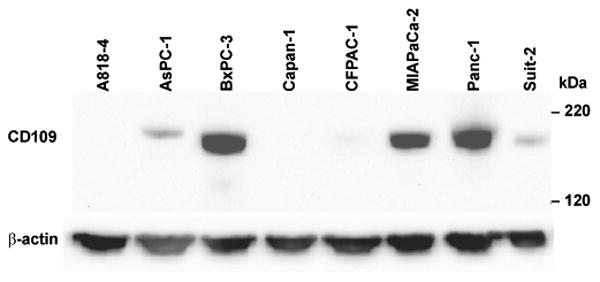
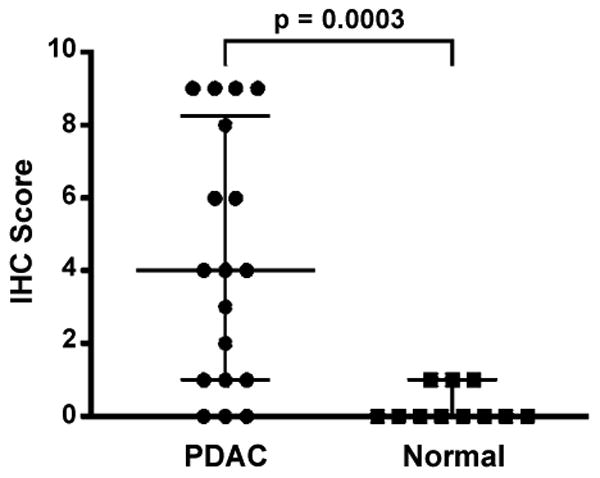
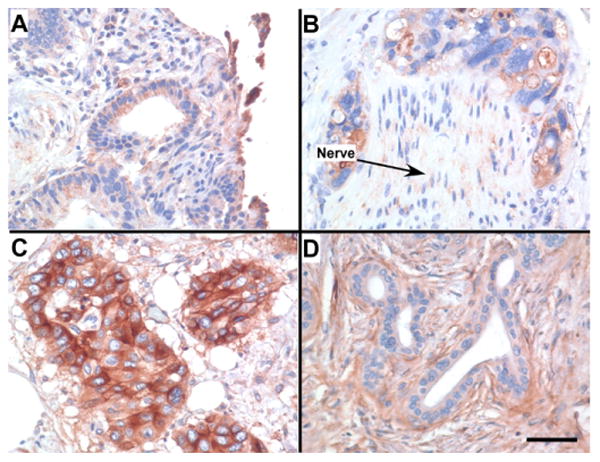
MS/MS analysis of glycopeptides captured from BxPC-3 cells revealed 18 proteins predicted or known to be associated with the plasma membrane, including CD109, which has not been reported in pancreatic cancer. Western analysis of CD109 in lysates prepared from pancreatic cancer cell lines revealed it was expressed in 6 of 8 cell lines, with a high level of expression in BxPC-3, MIAPaCa-2, and Panc-1 cells. Immunohistochemical analyses of human pancreatic tissues indicate CD109 is significantly overexpressed in pancreatic tumors compared to normal pancreas.
The selective capture of glycopeptides from the surface of pancreatic cancer cell lines can reveal novel cell-surface glycoproteins expressed in pancreatic ductal adenocarcinomas.
新型靶向癌症治疗方法和/或诊断工具的开发依赖于对正常组织和肿瘤之间分子靶点差异表达的了解。这些潜在靶点中的许多是细胞表面受体;然而,我们对胰腺肿瘤中上调的细胞表面蛋白的了解有限,从而阻碍了胰腺癌靶向治疗的发展。为了开发专门针对胰腺肿瘤的新诊断和治疗工具,我们试图鉴定可能作为潜在肿瘤特异性靶点的细胞表面蛋白。
用双功能连接物生物素酰肼标记胰腺癌细胞系BxPC-3上的膜糖蛋白。蛋白水解消化后,用链霉亲和素偶联的磁珠捕获生物素化的糖肽,然后通过PNGaseF介导的内切糖苷酶裂解释放,并通过液相色谱-串联质谱(MS)进行鉴定。通过对胰腺癌细胞系裂解物的蛋白质印迹分析以及在胰腺导管腺癌和非肿瘤性胰腺组织切片中的免疫组织化学分析,对通过细胞表面糖蛋白捕获程序鉴定出的一种蛋白质CD109进行评估。
对从BxPC-3细胞捕获的糖肽进行的串联质谱分析揭示了18种预测或已知与质膜相关的蛋白质,包括CD109,该蛋白在胰腺癌中尚未见报道。对胰腺癌细胞系制备的裂解物中CD109的蛋白质印迹分析表明,它在8个细胞系中的6个中表达,在BxPC-3、MIAPaCa-2和Panc-1细胞中表达水平较高。对人胰腺组织的免疫组织化学分析表明,与正常胰腺相比,CD109在胰腺肿瘤中显著过表达。
从胰腺癌细胞系表面选择性捕获糖肽可以揭示胰腺导管腺癌中表达的新型细胞表面糖蛋白。