Vander Zanden M Jake, Clayton Murray K, Moody Eric K, Solomon Christopher T, Weidel Brian C
Center for Limnology, University of Wisconsin-Madison, Madison, Wisconsin, United States of America.
Department of Statistics, University of Wisconsin-Madison, Madison, Wisconsin, United States of America.
PLoS One. 2015 Jan 30;10(1):e0116182. doi: 10.1371/journal.pone.0116182. eCollection 2015.
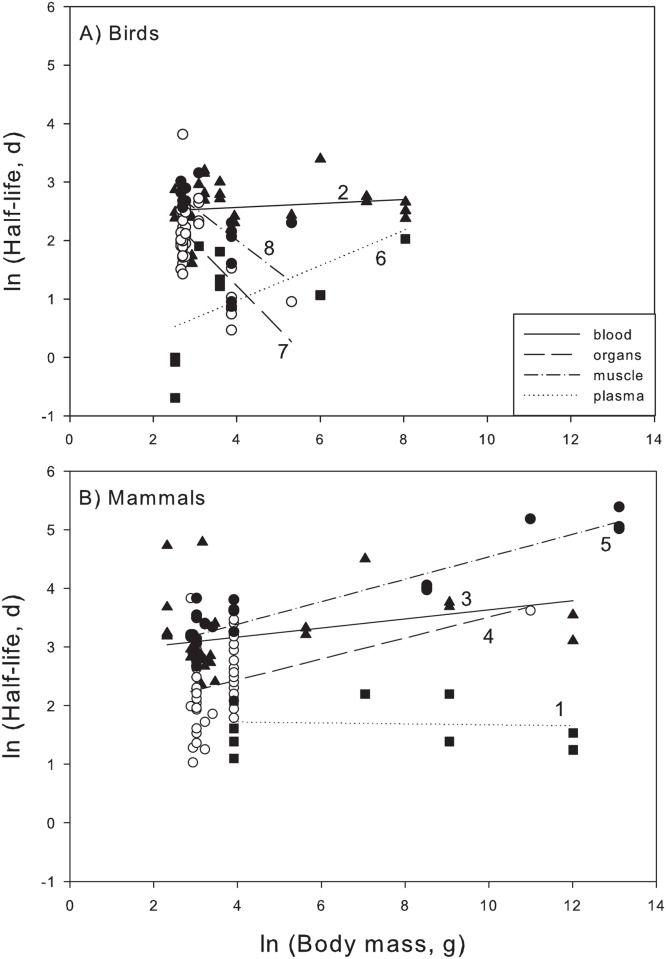
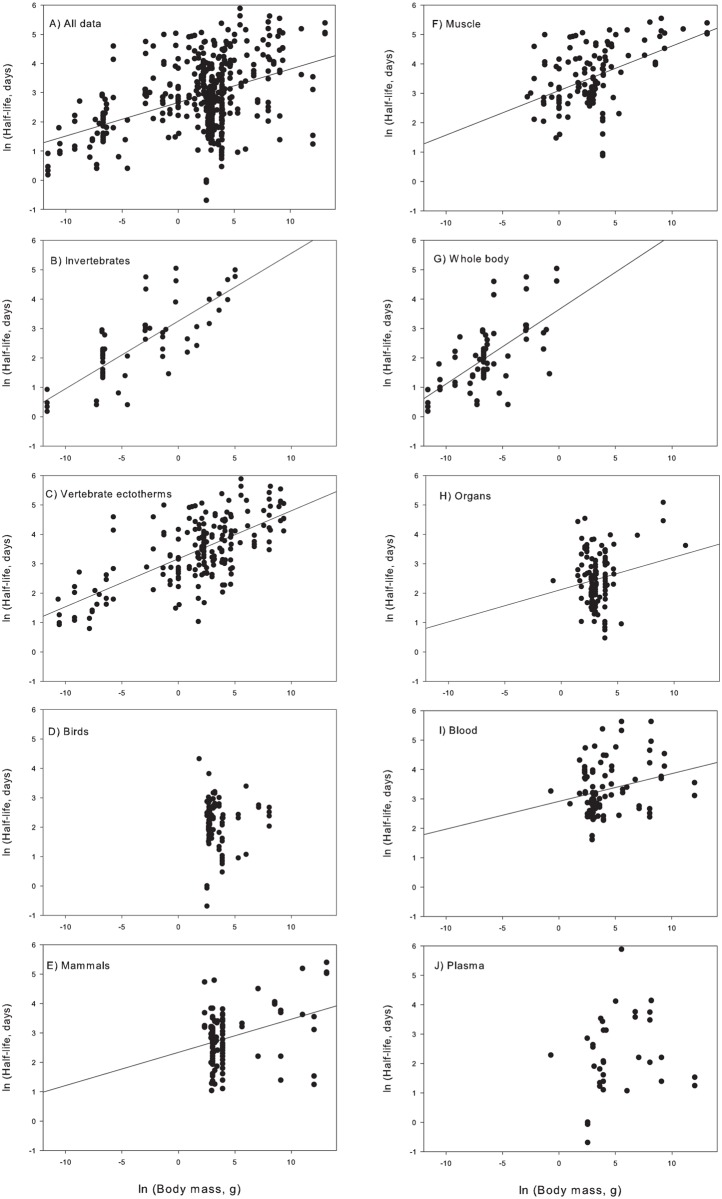
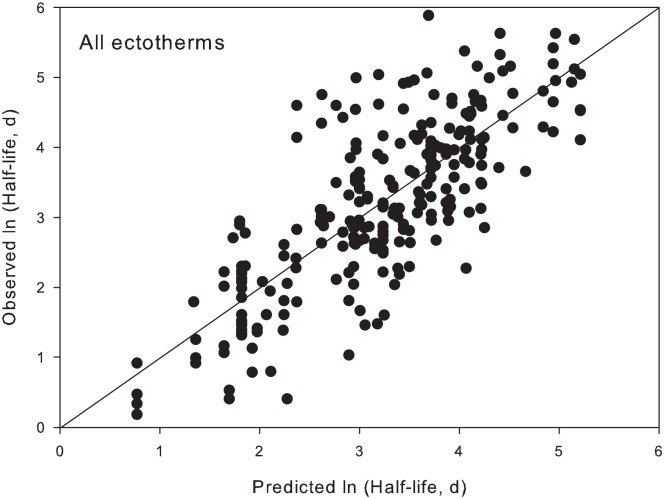
Stable isotopes of carbon, nitrogen, and sulfur are used as ecological tracers for a variety of applications, such as studies of animal migrations, energy sources, and food web pathways. Yet uncertainty relating to the time period integrated by isotopic measurement of animal tissues can confound the interpretation of isotopic data. There have been a large number of experimental isotopic diet shift studies aimed at quantifying animal tissue isotopic turnover rate λ (%·day(-1), often expressed as isotopic half-life, ln(2)/λ, days). Yet no studies have evaluated or summarized the many individual half-life estimates in an effort to both seek broad-scale patterns and characterize the degree of variability. Here, we collect previously published half-life estimates, examine how half-life is related to body size, and test for tissue- and taxa-varying allometric relationships. Half-life generally increases with animal body mass, and is longer in muscle and blood compared to plasma and internal organs. Half-life was longest in ecotherms, followed by mammals, and finally birds. For ectotherms, different taxa-tissue combinations had similar allometric slopes that generally matched predictions of metabolic theory. Half-life for ectotherms can be approximated as: ln (half-life) = 0.22*ln (body mass) + group-specific intercept; n = 261, p<0.0001, r2 = 0.63. For endothermic groups, relationships with body mass were weak and model slopes and intercepts were heterogeneous. While isotopic half-life can be approximated using simple allometric relationships for some taxa and tissue types, there is also a high degree of unexplained variation in our models. Our study highlights several strong and general patterns, though accurate prediction of isotopic half-life from readily available variables such as animal body mass remains elusive.
碳、氮和硫的稳定同位素被用作生态示踪剂,用于多种应用,如动物迁徙、能源和食物网路径的研究。然而,与动物组织同位素测量所整合的时间段相关的不确定性可能会混淆同位素数据的解释。已经有大量的实验性同位素饮食转换研究旨在量化动物组织同位素周转率λ(%·天⁻¹,通常表示为同位素半衰期,ln(2)/λ,天)。然而,尚无研究评估或总结众多单独的半衰期估计值,以寻求广泛的模式并描述变异性程度。在此,我们收集先前发表的半衰期估计值,研究半衰期与体型的关系,并测试组织和分类群变化的异速生长关系。半衰期通常随动物体重增加而增加,与血浆和内脏器官相比,肌肉和血液中的半衰期更长。半衰期在变温动物中最长,其次是哺乳动物,最后是鸟类。对于变温动物,不同的分类群 - 组织组合具有相似的异速生长斜率,通常与代谢理论的预测相符。变温动物的半衰期可以近似表示为:ln(半衰期)= 0.22 * ln(体重)+特定组截距;n = 261,p < 0.0001,r² = 0.63。对于恒温动物组,与体重的关系较弱,模型斜率和截距是异质的。虽然对于某些分类群和组织类型,可以使用简单的异速生长关系近似同位素半衰期,但我们的模型中仍存在高度无法解释的变异。我们的研究突出了几个强烈且普遍的模式,尽管从动物体重等易于获得的变量准确预测同位素半衰期仍然难以实现。