Magnus Maria C, Stigum Hein, Håberg Siri E, Nafstad Per, London Stephanie J, Nystad Wenche
Department of Chronic Diseases, Division of Epidemiology, Norwegian Institute of Public Health, Oslo, Norway.
Department of Chronic Diseases, Division of Epidemiology, Norwegian Institute of Public Health, Oslo, Norway; Department of Community Medicine, Medical Faculty, University of Oslo, Oslo, Norway.
PLoS One. 2015 Jan 30;10(1):e0116362. doi: 10.1371/journal.pone.0116362. eCollection 2015.
The immediate postnatal period is the period of the fastest growth in the entire life span and a critical period for lung development. Therefore, it is interesting to examine the association between growth during this period and childhood respiratory disorders.
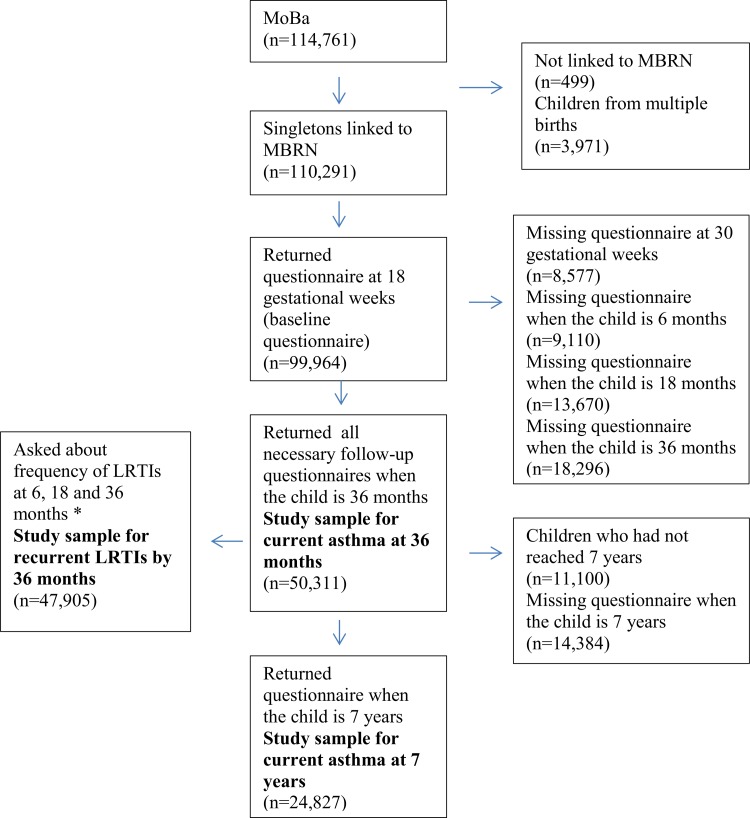
We examined the association of peak weight and height velocity to age 36 months with maternal report of current asthma at 36 months (n = 50,311), recurrent lower respiratory tract infections (LRTIs) by 36 months (n = 47,905) and current asthma at 7 years (n = 24,827) in the Norwegian Mother and Child Cohort Study. Peak weight and height velocity was calculated using the Reed1 model through multilevel mixed-effects linear regression. Multivariable log-binomial regression was used to calculate adjusted relative risks (adj.RR) and 95% confidence intervals (CI). We also conducted a sibling pair analysis using conditional logistic regression.
Peak weight velocity was positively associated with current asthma at 36 months [adj.RR 1.22 (95%CI: 1.18, 1.26) per standard deviation (SD) increase], recurrent LRTIs by 36 months [adj.RR 1.14 (1.10, 1.19) per SD increase] and current asthma at 7 years [adj.RR 1.13 (95%CI: 1.07, 1.19) per SD increase]. Peak height velocity was not associated with any of the respiratory disorders. The positive association of peak weight velocity and asthma at 36 months remained in the sibling pair analysis.
Higher peak weight velocity, achieved during the immediate postnatal period, increased the risk of respiratory disorders. This might be explained by an influence on neonatal lung development, shared genetic/epigenetic mechanisms and/or environmental factors.
出生后即刻阶段是整个生命周期中生长最快的时期,也是肺部发育的关键时期。因此,研究这一时期的生长与儿童期呼吸系统疾病之间的关联很有意义。
在挪威母婴队列研究中,我们研究了36个月时的体重峰值和身高增长速度与36个月时母亲报告的当前哮喘(n = 50,311)、36个月时复发性下呼吸道感染(LRTIs,n = 47,905)以及7岁时当前哮喘(n = 24,827)之间的关联。使用Reed1模型通过多水平混合效应线性回归计算体重峰值和身高增长速度。采用多变量对数二项回归计算调整后的相对风险(adj.RR)和95%置信区间(CI)。我们还使用条件逻辑回归进行了同胞对分析。
体重峰值增长速度与36个月时的当前哮喘呈正相关[每增加一个标准差(SD),adj.RR为1.22(95%CI:1.18,1.26)],与36个月时的复发性LRTIs呈正相关[每增加一个SD,adj.RR为1.14(1.10,1.19)],与7岁时的当前哮喘呈正相关[每增加一个SD,adj.RR为1.13(�5%CI:1.07,1.19)]。身高峰值增长速度与任何呼吸系统疾病均无关联。在同胞对分析中,体重峰值增长速度与36个月时哮喘的正相关关系依然存在。
出生后即刻阶段较高的体重峰值增长速度会增加呼吸系统疾病的风险。这可能是由于对新生儿肺部发育的影响、共同的遗传/表观遗传机制和/或环境因素所致。